Showing posts with label Foreigners in the Philippines. Show all posts

Friday, August 12, 2011

Vigan Visit, The Awesomely Ancient Bantay's St. Augustine Church


This is a continuation post, part 2 actually, about our short stop in the northern Philippine city of Vigan. Time flies, it’s already been more than two months since we were there.

When our kalesa drivers brings us across the river back to “the National Highway” and pulls into the driveway down the hill from the 421 year old St. Augustine church, at the time, I am under the impression that we are still in Vigan. It is only later, while researching for this series of posts, that I learn that this awesomely ancient cathedral is actually in the similarly historical town of Bantay. If there is a sign announcing we have changed towns I don’t remember seeing it.

Truth be known, this country isn’t all that big on directional signs anyway, so I doubt that there is one. After nine years of living and traveling here, generally speaking, I’ve learned that the navigation of streets and roads is a non-friendly-to-traveler process — Having said that, here’s some advice: If you don’t have local knowledge then prepare to ask for lots of directions; and if you’re STILL not sure if you’re going the right way, NEVER go too far before asking AGAIN. For as often as not, you WILL find yourself doubling back—turning around at one mile in the wrong direction is better than ten.

ON that note, I’m absolutely positive that there were NO street signs in the Vigan area back in the 16th century when Salcedo first invaded it in the name of King Philip II. I don’t think it really mattered to those old-time Spanish conquerors anyway what the locals called things and places. Although a story IS widely found on several of the Vigan info sites as to the history of the name of the town:

The agreed upon story tells of a Spaniard checking out the area for the first time (one site even says it was Salcedo himself). He points generally at the overgrown area along the river asking a local for the name of the area. The Ilocano, not understanding Spanish, thinks the Spaniard is asking for the name of a wild plant growing profusely along the riverbank called locally Bigaa (Each a is pronounced separately and not combined into a single sound). Eventually the B is turned into a V as the Spanish tend to do, the n is added and there you go; the place becomes “Vigan,” named mistakenly after a weed growing on a river bank. It’s a good story, but who knows if it’s true or not? After all, 440 years ago is a LONG time.

After Salcedo pacifies the area that is now the coast of Ilocos Sur in the early 1570s (there was not much native resistance by the way), he and his crew of conquistadors settle on the spot that eventually becomes the Spanish colonial town of Vigan. (Actually he names it Ciudad de Fernandina, or city of little Ferdinand). But the intent here is not to comment so much about Vigan, but about the town of Bantay just across the river. It is in THIS smaller town about two decades after the time of Salcedo that Spanish Augustinian monks begin building a church they name after their patron saint, Saint Augustine, who happens to be one of my favorite holy men of all time. (Augustine was a bishop who lived in Roman North Africa, a theological genius from the 5th Century known even today for his mastery of rhetoric and Christian philosophy.)

I’m not sure how it happened this way, but Bantay’s St. Augustine church goes up a good twenty years ahead of Vigan’s primary cathedral called St. Paul. Let me do a quick check online and see if I can find out why:

Aha! Here’s an answer from wikipilipinas.org regarding the history of Vigan’s St. Paul’s: “The first church was built on this site in 1574 (by Juan de Salcedo) and was damaged in the earthquakes of 1619 and 1627. A second was built here in 1641; and the present baroque-style church was built in the 1800s.”

So there you go; I had it mostly wrong. (Don’t hate!) St. Paul’s in its present form is “only” somewhere over 100 years old. Looking at it from close up, I wondered how they managed to make a building from the early 1600s look so modern. The answer is that St. Pauls, compared to St. Augustine, is a relatively “modern” building, completely rebuilt several times since the first Vigan Cathedral was constructed in the late 1500s.

But enough about Vigan things—back to Bantay’s St. Augustine—according to the historical sign on the façade of St. Augustine’s it began to go up in 1590 but had to be rebuilt after being damaged during WWII. Based on that I began to try to find out what kind of battles took place in the Vigan/Bantay area during the 1941-1945 war with Japan.

So here’s what I find: The Japanese easily land their forces in Vigan in December 1941 totally without resistance and occupy it without much incident until the Americans return to that part of Luzon in early 1945. I can find absolutely nothing anywhere about any battles taking place during WWII in the Vigan area. I wondered then how St. Augustine’s could have been so damaged that it had to be rebuilt after the war. I think I found the answer on a site called pasalyan.net specifically about Bantay and what happened to the church in WWII:
“During World War II, on April 15, 1945, three big incendiary bombs hit the church but none of them exploded; however five other bombs exploded fifty meters away from it that resulted in the collapse of its roofs but later-on was rebuilt after the cessation of the arm(ed) conflict.”

Finally! Great detail on exactly HOW The Church of St. Augustine is so grievously damaged during the war; it is bombed by Americans.

I have no doubt as to why American airmen would attack a church. In a nutshell, they bombed it because Japanese soldiers were in it. Thick walled old Spanish churches throughout the country were generally some of the first structures taken over and garrisoned by the Japanese. At the time they spat on Christianity, having no respect for any religion (or culture for that matter) other than their own, which at the time for most Japanese in uniform was a nationalistic, very marshal form of Shinto revolving around the worship of their emperor.

There’s another, perhaps fanciful tale, as to why the Japanese left the Vigan/Bantay area without trying to defend their positions to the last man, as they did in Manila. Luckily for Vigan, the Japanese Imperial Army did not vindictively destroy the town on their way out of it. Check out this romantic little story:

“Before the Japanese withdrawal, they were tasked to destroy the zones they used. The night before they left, they have strategically placed numerous tanks of gasoline and bombs. Apparently, a Japanese military officer had an affair with an Ilocano woman and (she) bore a child. We all know that Japanese have abused women but (this) military officer chooses to take care of his wife and child in secret. He asked the procurator of Vigan seminary that time to take care of his family. The procurator agreed but asked something in return. He asked the officer to leave the town without burning it. Reason is, the townspeople will seek revenge on his family. Thus, the Japanese retrieved (their bombs) and left no marks of destruction.”

There is another site I found (and since lost) that states that this fabled love struck officer was in fact the commander of the Japanese forces in Vigan. If there is any truth to this story at all I would go with that version, since a lower ranking officer wouldn’t have the leverage to disobey an order of that magnitude.

I don’t know though—the whole thing sounds more like a movie script; or, a farfetched fairytale to me.

Long before I knew of any of that though, I found an outside area of the church that looks to be original to its 1590s beginnings. Undoubtedly, few people bother to explore it. Long ago it may well have been a well kept walled garden, but now it seems to be mostly neglected by the caretakers and ignored by visitors. I presume the walls and buttresses here are the original brick; that which is exposed being now much decayed and weatherworn. Here and there on the brick face is a bare hint of the original protective stucco that was probably last applied hundreds of years ago. This unrestored eastern side, well shaded by mango trees, is where you FEEL and SMELL the extreme age of the massive structure. This spot is far more attractive to me than any other part of the olden church. Here, the walls of weathered bricks are moldered and moss covered; plants and vines grow out of deep chinks and on ledges from top to bottom. I must say, when I “discover” this delightfully hidden side of the church I am conveyed to “historical heaven.”

It takes a few minutes before I notice it for what it is, but I begin to get the feeling that this whole side of the building was once part of a warzone. I recognize an area in the brickwork that almost certainly shows battle damage. There are several small pockmarks less than a foot across in several areas across the walls, but there is a decidedly large section of damage that looks as if a small caliber shell or heavy object smashed with high velocity into the bricks there, causing a deep hole surrounded by a missing outer layer of bricks. After I notice that obvious sample of battle damage I begin to look at the other smaller, less obvious dings and pocks, and it sinks in that this whole side of the structure has evidence of ruination caused by weaponry. I suppose at first I don’t realize what I’m looking at because the peacefulness of the place now belies the evidence of its violent past. It makes me wonder what else has happened within the vicinity of that venerable place.

Talking and thinking now about that 66 year old battle damage, and reexamining the photos of it, reminds me of an even older incident that I know also happened right there on the church grounds. I’m speaking of the 1763 rebellion led by Diego Silang. In fact, several times over the centuries it is the church’s highest point location, along with its massively thick walls, plus the unimpeded 360 degree view provided by the hilltop bell tower that has made Bantay’s imposing St. Augustine an automatic choice as a fortification spot.

I don’t want to spend too much more time on Silang since I pretty much covered every aspect of his life and rebellion period in the previous post, but the very fact that The St. Augustine Church existed all those years ago while Diego was active provided a special moment for me, especially while exploring the church, the extensive church grounds and certainly its bell tower. I say that because I KNOW that he frequented these places and was doing so right up until the moment of his death. Stepping in the footprints of history always deeply affects me like that.

And since previously posting on Diego Silang, I believe I’ve figured out WHERE he was killed. If you read my last post you’ll learn that Silang was assassinated by his friend, Miguel Vicos. Based on some clues from the internet, I’m pretty sure this murderous deed happened only a stone’s throw from the church’s main entrance. It would have been just down the hill, near the town’s municipal building in a spot that used to be the town square and now called Diego Silang Park. I’ve created a Google map that shows the site of the church and the possible site of Silang’s death. See it below:
View Bantay Church and Bell tower, also possible Diego Silang death site marked in a larger map
I'm guessing about the Silang death site. I wish I would have actually walked down the hill to the Bantay town hall and police station, as well as the playground now called Silang Park. I think I've got it correct though, based on what I found on this site specifically about Bantay:
"Several battles have spillovers in Bantay, one of which was the Ilocos revolt led by Diego Silang. Here, this heroic figure was killed by a Spanish mestizo nicknamed “Vicos.” The incident took place at Encuentro Street where now stands the Diego Silang Park (Municipal town plaza). Ironically, the Diego Silang Park that was originally constructed in 1763 displays a commemorative monumental figure of Vicos and not of Diego Silang."
(I'm not so sure if the above is absolutely correct though since I've found other historical articles online that claim that the original Spanish inscription honoring Vicos the assassin of Silang was changed a hundred years ago to honor ONLY Silang.)

Once I get my first look at the beauty that is St. Augustine’s I become a photo taking berserker. I didn’t know how much time there would be so I go nuts with the camera. The sky is a brilliant blue; the sun high, and the views around me filled with visual promise. Everywhere I turn there is incredible potential to put together some sublime shots and I am determined to get as many of them digitized as possible before having to depart to see “the next thing.” I have since kicked myself for not having my superior Canon G11 instead of my little handy dandy Cybershot—I did take some gorgeous photos but they would have been even better with the more capable G11.

Approaching the façade of St. Augustine’s I examine it closely with great enthusiasm. After reading that it had been built in 1590 I am immediately skeptical, until I read the part on the sign that it has been rebuilt since WWII.

The front side of St. Augustine’s does look nice, but it also looks new which is what threw me. The architecture is a very busy with lots of pointed arches; to me, it seems in the mode of Spanish Romanesque, although the sign calls it neo-gothic mixed with elements of pseudo-Romanesque. It’s clean colorful and well kept, but to a historical purist like me it’s a disappointment. Back in 1950 when they decided to rebuild it I wish they would have stayed true to its original look and done it exactly the way it was when the Augustinians first put it up. But that’s just me. For instance, I was extremely unhappy when Sacred Heart Parish back in the Michigan town where I went to high school pulled down its little decades old American gothic style church and replaced it with a blandly squat monstrously modernistic thing. Now it looks more like a fancy elementary school than a church.

Wondering what Bantay’s St. Augustine might have looked like originally, I found online photos of a couple of old churches built in the Philippines that might provide some clues. Oddly enough, both of them are also called St. Augustine’s.

The two candidate cathedrals I found have mostly surviving façades that probably show features that might be representative of what was once a part of Bantay’s church. First, there is Manila’s St. Augustine Cathedral, built from 1586 to 1607, with a start date four years earlier than Bantay’s much smaller version named after the same saint. The other church that I like to think may resemble what Bantay’s used to look like is another St. Augustine’s located north of Bantay in the town of Paoay in Ilocos Norte.

The problem with Paoay’s church is that it WAS built well into the age of baroque, which is all about overdone decoration and embellishment. In the photos of the church (see it to the right), other than the fancy Javanese looking stone caps rimming the entire perimeter of the roof edge, not much else looks all that baroque to me, that is until I take a closer look. That’s when I notice that there appears to be a lot more ornamentation on the façade than at first meets the eye. It looks as if a lot of the original adornment and color has been lost to weathering and neglect.

I suspect then that Bantay’s St. Augustine probably resembled more the far simpler post Crusade style of Romanesque cathedral built right around the same time (late 1500s) inside Manila’s Intramuros.

(Boy, those Augustinian friars sure weren’t very imaginative; I mean, they seemed to want to name just about every church they built after their own patron saint.)

Check out the two photos of Manila’s St. Augustine. (The photo to the left is a modern view of it with the missing left belfry) There is nothing elaborate about it. Other than the double stacked decorative columns bracketing its front entrance the only other décor is provided by the few symmetrically placed windows.

Bantay’s front exterior, replaced just 61 years ago, looks to have a lot of extra side-by-side arches pasted on its walls (although after a second look perhaps these arches were part of the original since I notice these same arches in evidence on the old eastern side walls); and instead of using simple round columns to frame the façade, the refurbishers of the Bantay church went with decorative projecting box columns that probably add very little if any functionality.

A final clue that Bantay’s St. Augustine’s probably used to look very similar to Manila’s slightly older St. Augustine’s is that basically the two buildings’ façades are extremely alike structurally. Each has, or had in the case of Manila’s church, two belfries on each front corner that bracket a triangular topped façade with a round single window in the middle of the façade peak. (As seen in the right photo it lost its left belfry to a huge earthquake in the late 1800s.)

All the above of course is pure conjecture, at least the part is on what St. Augustine's facade once looked like; I would love to see a photo of the church before it was reconstructed in 1950 to see how much of my guesswork is true. Surely, such a photo exists somewhere?

Spending a few minutes inside, enjoying the dark cool of the church I snapped several photos there as well. Compared to other churches dating back to colonial times Bantay’s has a very simple interior. I enjoyed the mausoleum feel of the deeply inset tunnel-like front alcove where they keep the image of “Our Lady of Charity.”
The inscription states that it was found long ago by fishermen in a floating box on the Bantaoay River. It is said that at the time only Bantay folks could carry the image, while others from other places could not, thus it is considered miraculous. The sign doesn’t state how long ago this is supposed to have happened.

Last and certainly not least we trek up the long flight of stairs up the hill to the old bell tower. The tower and its bells are amazing. We look out and marvel over the views of city, mountain and country. Over the centuries, undoubtedly thousands of others have done the same thing, including Diego Silang himself, and all the other soldiers and visitors from various countries and times. I’ll let the pictures and captions speak for themselves.

The rest of this post is devoted to the best of the photos I took of this building and of the equally fascinating bell tower situated on a rise above the church, which is itself already located high above its surroundings.

* A side view of the unrepaired eastern side of Bantay’s St. Augustine. This is what you’ll see when you first peek around the corner of the left belfry and lower alcove corner of the church. It doesn’t look like much but that didn’t stop me from going in and checking it out.

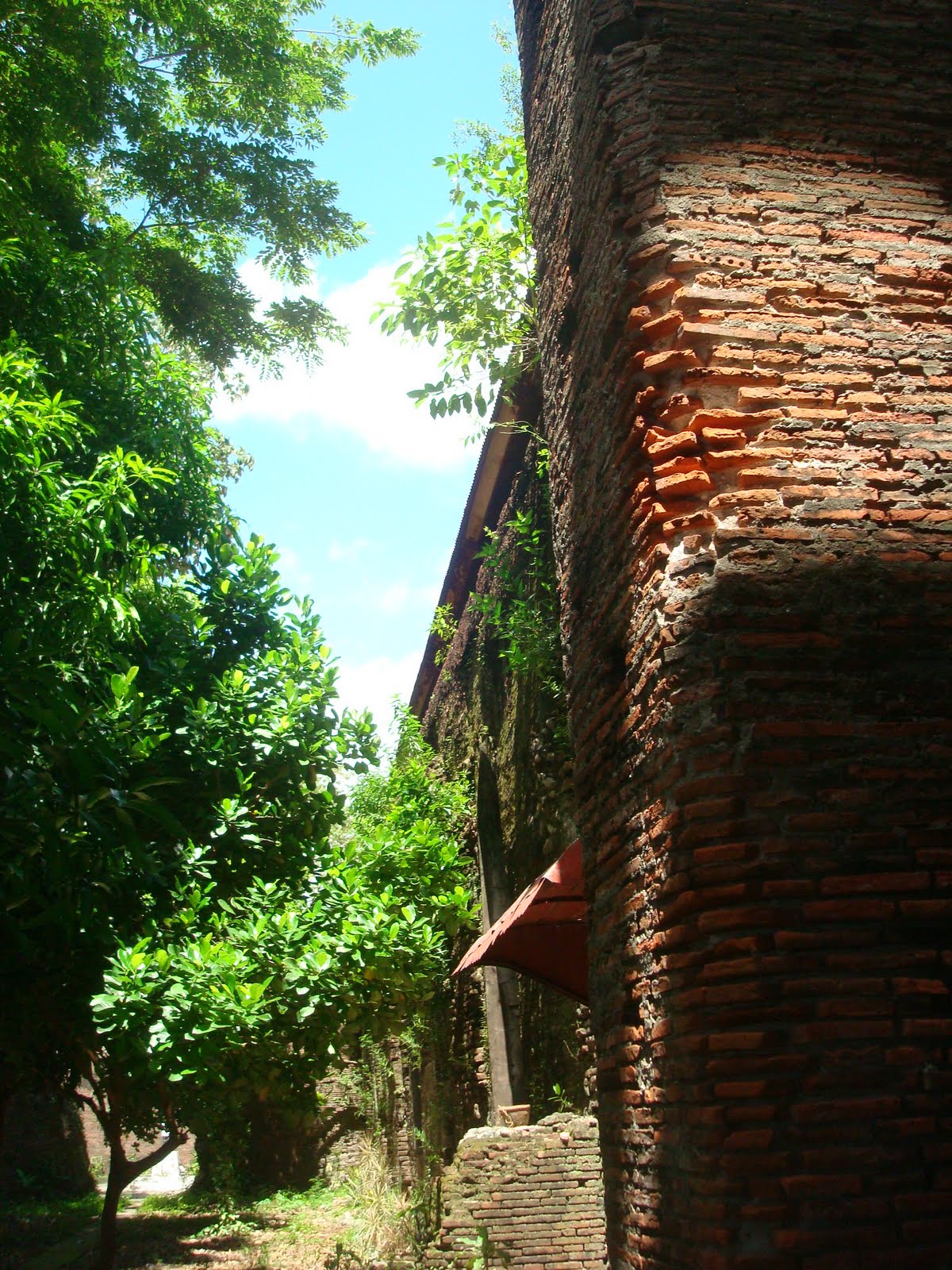
* Also on the eastern side of the church, this is a view looking directly up the wall in the corner formed by the backside of the left belfry / alcove structure. Some of this damage may well be from WWII.

* This is obviously looking up at a dome, but I can’t remember where in the church it is. It’s probably inside the top of one of the alcoves, but don’t hold me to it.
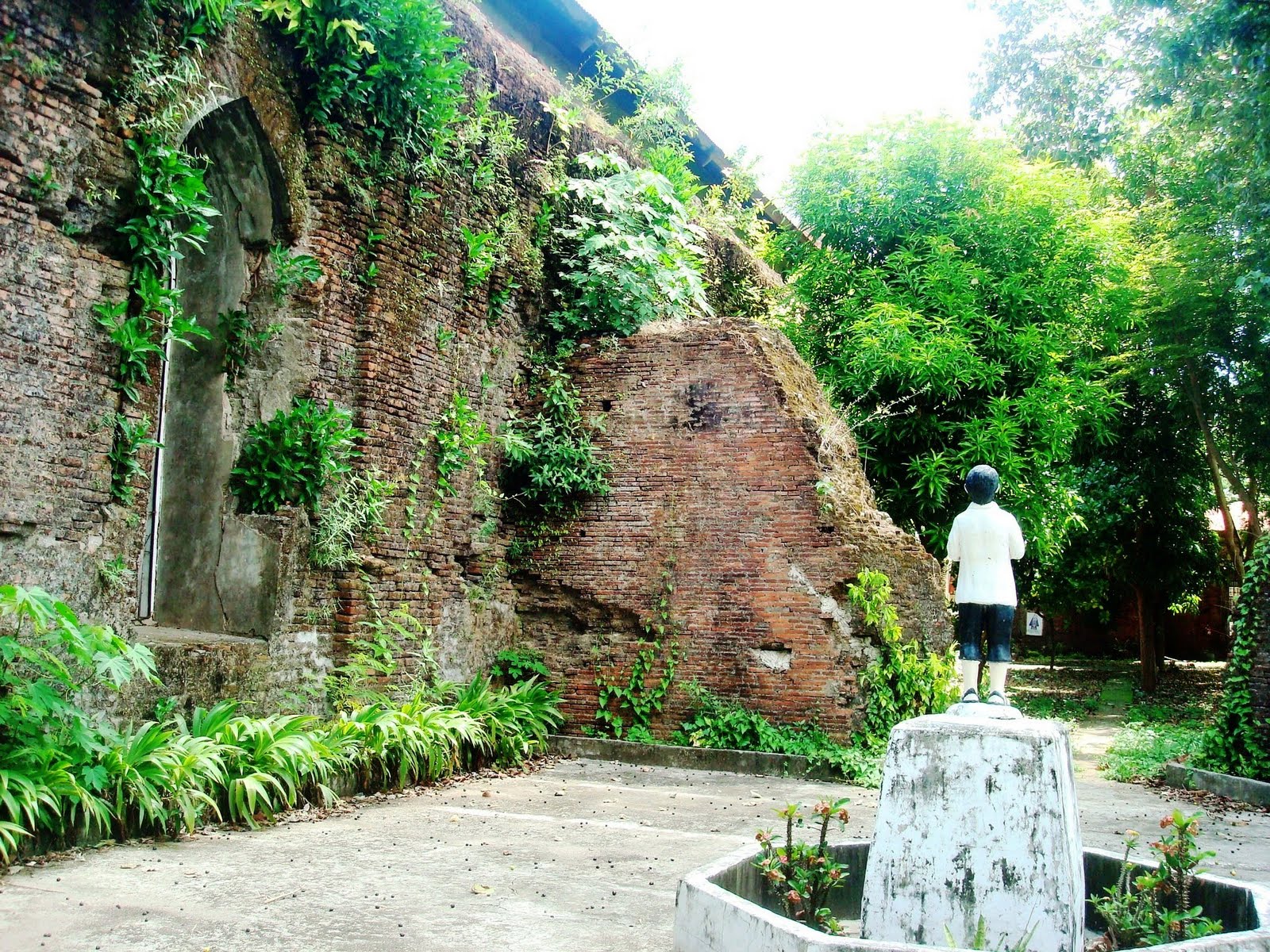
* View from behind the statue of the boy in the semi garden area in the unrenovated eastern side of the church. Looking at some of the ruined areas, I’m sure a lot of it is simply caused by weathering. If the caretakers do not start removing the plants the roots will eventually turn what you see above into a pile of rubble.

* The brick here still has a hint of the encasement stucco that once protected the brick from the elements. Without it, you get what you see, ruination.

* From inside the church looking up at the stained glass window a few feet inside from the main entrance.

* A close up of the stained glass window image of “Our Lady of Charity,” to which the church has been made a shrine in her honor.

* A view of St. Augustine’s bell tower from below its first retaining wall.

* The bell tower from the bottom of its steps.

* Divine standing in the entrance of the bell tower. Notice that there is still a bit of the original stucco or cement covering that once coated all these orange bricks.

* Divine posing in one of the viewing windows, one that looks out over Bantay's cemetery to the southeast.

* Bantay's cemetery. The gap in the hills in the distance I believe is where the Abra River passes through the hills on its way to the sea.

* Well, it IS a bell tower, and it does have plenty of them. Everyone of them appear to be antiques going back more than a hundred years.

* A view to the west of St. Augustine's left belfry and Vigan spreading out in the distance down the hill from there.

* A Close up of the belfry, same view as described in the photo above.

* The bell tower's dome from directly below it through some boards being used for internal support.

* The altar at the front of the church.

* A close up of one of the bell tower bells.

* I LOVE this view of the tower from the bottom of the hillside staircase.

* A statue holding holding holy water at the side rear of the church.
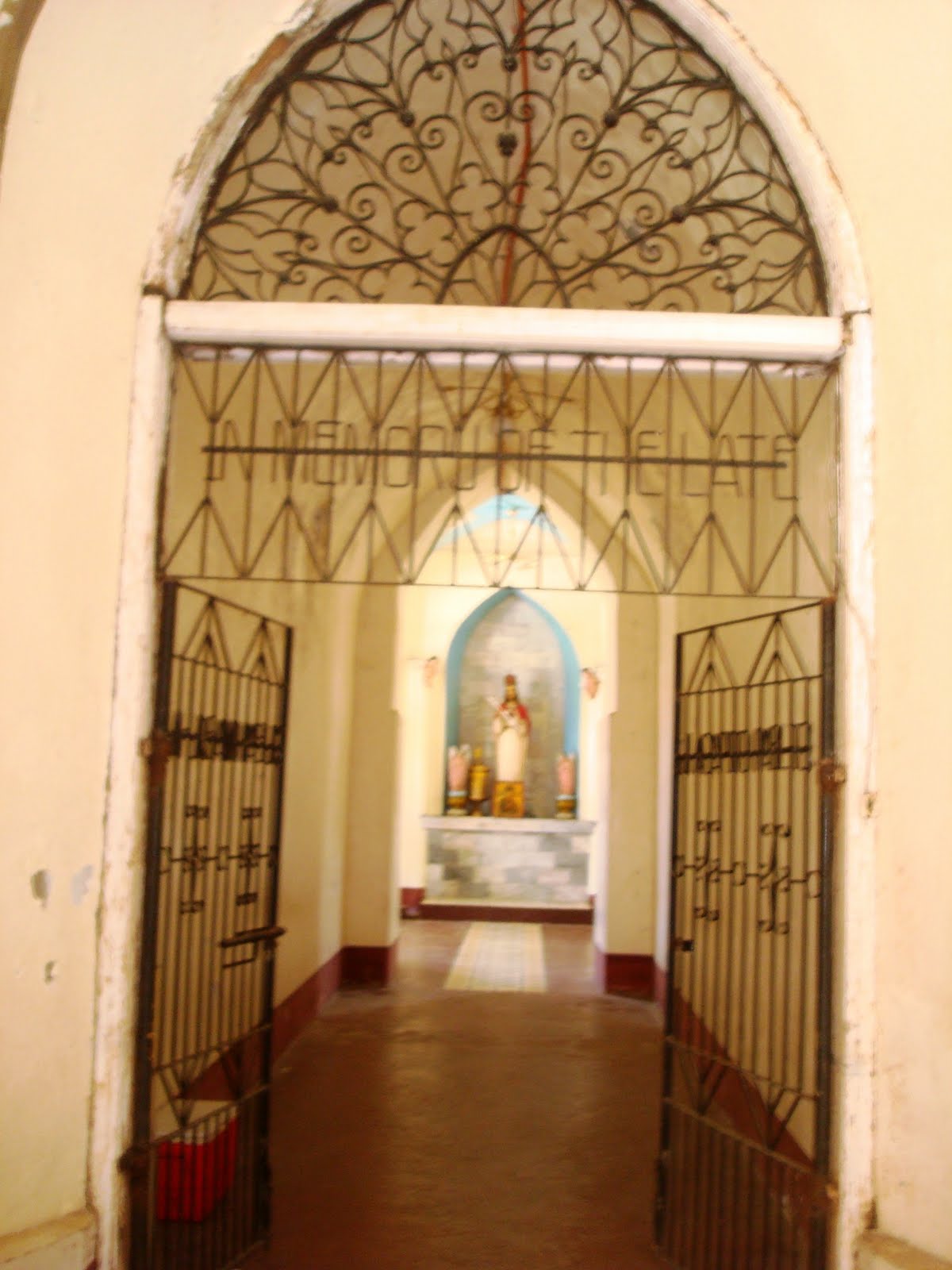
* This one cracks me up. Notice that the ironworks spells out "In Memory of the late." Its funny to me for two reasons, first it's an example of the "interestingly humorous" way Filipinos can use English at times. Obviously, in this case "the late" refers to "the dead." But also, if you are around Filipinos much, especially here in the home land, you'll know about "Filipino Time," which refers to the national tendency to be late, probably even for their OWN funeral. I showed this pic to my wife just to give her a little jazz telling her, "See, this little chapel is devoted to ALL Filipinos!" She's a good sport; I mean, she didn't smack me all THAT hard!

Thursday, May 12, 2011

Complete baso-cervical fracture, left femur... Gulp!


There are at least five or six more posts in store about my last diving adventure, but that all kind of went on hold when my mother-in-law broke her leg a few days ago. I was informed about this with the typical, “Oh no, she fell and broke her hip!”

After making the obligatory response, I think I said something like, “Oh, the poor thing! Where is she now? What did the doctor say?”

But my next response was not nearly so sympathetic, which if you know me is typical of me. I became downright accusatory, perhaps over harshly so, which is even MORE typical of me. For some reason I felt like trying to assign some blame as far as to the cause of this unfortunate event. My finger pointing may have been accurate, but admittedly, it was STILL out of line.

I'm ashamed to say that I said rather caustically, “You know, your mom has smoked for a LONG time, and with her being in her late 70s now, she was practically ASKING for osteoporosis. And by the way, I can guarantee you that she did NOT fall and break her hip. It was the other way around; she broke her hip and fell. People ALWAYS say that because they can’t imagine that someone could snap a leg or fracture a hip merely from standing on it, but you know what? Once the osteoporosis sets in and the bone mass disappears it’s ONLY a matter of time—bones WILL break! Man, I wish all these dummies I see smoking while they’re still young could SEE what’s in store for them, to SEE the damage they are subjecting themselves to after years of sucking in that nasty stuff. And osteoporosis is the least of what they do to themselves usually. ….And to think usually all these horrible conditions befall these smokers when they are too old to pay for the hospital treatment and to take care of themselves, just like your mom.”

Yes, I DO go on. I say these mean things and always feel bad after I say them, but knowing this almost never stops me. I tell myself that I should either find a more sensitive way to expound, but I rarely do. I’m an evil out of control know-it-all. I MUST be stopped.

My wife brought home the x-rays and report. The findings fully explained what actually happened to her mom:

Pelvis—anteroposterior lateral
Complete baso-cervical fracture, left femur, with marked disalignment of fragments
Soft tissue swelling is discernible
Visualized pelvic bones and right proximal femur appear intact
Lumbosacral spine-lateral
No demonstrable compression fracture, visualized lumbar vertebral bodies
Incidental finding of senile osteoporosis

(The xray photo above depicts a similar broken femur)

Another reason I shouldn’t be so hard on my wife’s mom is that she went through life not really understanding how much damage her smoking was doing to her body over the decades. To be even fairer, not even Americans, who should have no excuse for NOT knowing about the dangers of puffing away on cigs, would have known how smoking can lead to weak bones, since science didn’t make the connection until only about 20 years ago.

I tried to guess as to how smoking would lead to low density bone mass. Knowing that smoking causes restricted blood vessels, I conjectured that bad circulation would lead to malnourished bones. After all, bones grow from the inside out by way of the marrow which IS fed through the blood supply. It turns out I was close but no cigar.

From what I read on the internet, there are actually two reasons why an older woman would be more likely to develop osteoporosis from smoking:

The first reason applies to all genders—smoking leads to joint and connective tissue pain from degenerative joint disease so that mobility is lessened. It follows that a person then becomes less active which leads to low bone density. So, when it comes to bones, it’s true what they say, “use ‘em or lose ‘em.”

The second reason applies ONLY to older women—smoking not only causes a woman to go into menopause on average five years earlier than she otherwise would, but being post-menopausal itself tends to lead to osteoporosis due to low estrogen levels. Combined with smoking, the effects of menopause are a double whammy, because smoking reduces estrogen even more—low estrogen means low bone density. So there you go.

Anyway, she finally had the operation this morning—poor thing. It took some doing to talk her into it though, primarily because she felt guilty about the costs of it. There is nothing like Medicare here; few people have any kind of real coverage, and unless someone in the family comes through to cover it there would have been no operation. My wife came home “empty-handed” twice after being told both times by her mom that she didn’t want it done. Her mother said the operation was too expensive, and that she had lived long enough and it was better to just let it be. Finally, I explained that there was NO CHOICE; with her femur broken and splintered she would likely die of a long drawn out painful infection. I sent my wife back and told her to TELL her mom that she WOULD have the operation and it didn’t matter WHAT she said. At this, realizing that she could just relax and be the cared for dependent again, she bowed to our more aggressive insistence and relented.

The cost of putting her leg back together would be out of the question for the average Filipino—150,000 pesos, about $3500. Not so much by US medical cost standards, but it might as well be a million bucks for most folks here. Luckily I am not the only person in the family with at least some form of means, or at least access to getting a loan for it. One of my wife’s older sisters married an American more than 30 years ago and has a life in the states. They make fair money but they just put big bucks on a house in New Jersey and are as strapped as me. But, between the two of us we came up with it. It’s all part of marrying into the average family here—as a foreigner, you basically become the go-to-guy when these sorts of emergencies inevitably pop up. If you aren’t willing to step up and help out you shouldn’t even consider marrying one of these girls. Or maybe you can marry one that comes from a well-to-do family. Good luck with that.

A fellow expat recently required almost the exact same operation as my mother-in-law. Out of curiosity we found out what the same hospital was charging him for the same operation. Unbelievably, they charged him 400,000 pesos! That’s $9300, more than two and half times MORE than what they charged to do the same thing for my wife’s mom. It’s an unfair practice that bugs us expats to no end—to get charged so much more than the local rate. It SHOULD be illegal, but I guess it’s not. Pretty much anything goes when it comes to commerce it seems. There’s the Filipino price and then there is the foreigner price. It applies to almost everything. It’s why I NEVER go with my wife to the market. But there’s not much I can do about it if I’M the one requiring medical care—I can’t very well wear a disguise trying to fool ‘em into a local price, or COULD I?

Monday, March 14, 2011

Don't hate me.....

Since returning from my last scuba foray in January I’ve not done much, other than take the online PADI open water diving course, putter in the yard, sweat a little in the gym, and last but not least, watch a myriad of recently released movies at the Robinson’s theater quadlplex just around the corner. Ahhhh geez, but my life is SO hard, . . . or not. (Do I have two boxes of popcorn at the theater today, or just one? THAT is my life as of late.)

Don’t hate me just because I’ve fallen into this tropical, affordable life of leisure. Believe me; sometimes, even though I’ve come to take it all for granted, it all seems too good to be true; especially when I consider how many folks my age and physical status have it. Most are still hard at work, or they are if they are lucky; and those disabled in some way, like me, are probably not having nearly the good life that I manage to enjoy. It's too good to be true, I think uncomfortably, almost guiltily, and keep expecting something to happen that will bring it all to an abrupt end.

Anyway, I KNOW that it WILL end—our life as it currently exists will surely change as the plan is to take the family back to the states so they’ll have a crack at being Americans. With that, I tell them ALL things are possible, as long as one is willing to work hard, have a plan, save—and again—WORK HARD.

In doing that for them though I’ll be giving up this golden existence I currently have here. Ah well, nothing lasts forever, or so I hear. Unlike here, I know the costs of living stateside will eat up all the money I draw in pension and disability, and probably much much more. . . . Sigh. . . I seriously doubt we'll be going to the movies much when we finally arrive back in the land of the cold and the costly.

Sunday, July 25, 2010

Unexpected Death


Unexpected death has always been a part of this place, but lately it’s become decidedly murderous. In fact, to those of us expats trying to quietly live our lives here in “The City of Angels,” potential violence seems to be swirling around us like never before. The latest spate of killing has left many of us permanent party members shaken, feeling insecure, vulnerable and unprotected.

This month alone there have been three multiple killing murders, all taking place within the dwellings of each of the murdered foreigners: First, a Canadian man and his Filipina girlfriend were killed in their home in the Oasis compound, followed last week by a Brit and his girlfriend in their apartment in Santa Maria 2, and just the other day a retired American air force veteran along with four members of his household were executed in his residence over in Hensonville Court. All these homes are in supposedly gated and guarded subdivisions.

I’m not whining about this. After all, with a six-inch scar on the left side of my chest, where 24 years ago I was slashed open by the business end of a butterfly knife during a mugging attempt by three thugs, I SHOULD know better. I was lucky to survive that attack; the cut was meant for my throat; so believe me, I KNOW personally how dangerous this town can be. We live here at our own risk; we ALL know that. It’s always had the reputation of being a Wild West town, a rep that it continues to live up to. A place where the “have nots” come to take from “the haves,” IF they can. Yet, we all hope that civil progress will eventually permeate and make us less of a target… a pipe dream?

Complacency! Part of the problem is that the trappings of civilization are all around us—nice malls, grocery stores, cafes and restaurants, and plenty of really sweet friendly people. It makes us forget the dangers. On that note, speaking to a tourist at the gym yesterday, an American, he was shocked to find out how quickly violence can be visited upon those not watchful. I related a few of the stories of what’s happened here in the years I’ve lived here and he was aghast, in complete disbelief.

NO ONE LOOKS dangerous you see. Back home, dangerous people LOOK dangerous. Not so here. An armed robber is likely to be an average clean-cut fellow in ordinary attire. Even back in the 80s, the fellows who attacked me looked as innocuous as everyone else. In seconds I was surrounded; without a word spoken, a knife came at me in a sweeping arc from the guy charging into my 11 o’clock. I moved to escape, and instead of my throat, he slashed the skin open just above my heart. I was in and out of the situation in 10 seconds, absolutely delighted to be alive. Indeed, I NEVER felt SO alive when I finally slowed to a walk some 200 yards from the scene of the attack and could finally assess the state of the booboo on my chest.

As we are continually unpleasantly reminded, violence potentially lurks around every corner. This town is a magnet for thugs, thieves and ne’er-do-wells from all over the archipelago. Although, perhaps many don’t start out that way; maybe they come with the best intentions, hoping to find work, only to learn that being jobless is even worse in a strange place with no family off of which to sponge. Most of these desperados resort to simple theft, but desperation, drugs, even drunkenness possibly, all can lead to much worse; something true the world over.

The Grapevine. When foreigners are killed or die in these parts we learn of their passing mostly by way of the expat grapevine, an informal network of communication that “gets the word out.” It’s a system that has become all the more effective with the instantaneous nature of Facebook, email, texting and messaging. And of course we have Harry the Horse, who does a great job of providing “the official word” from the local police, the mayor and from many other of his “personal sources.” Between all of it, both official and ad hoc, we probably have access to MUCH of the truth; although often, many of just put two and two together to arrive at an alternate version of it.

The amazing thing to me is that even with this efficient impromptu communication system, many of us never hear of some of the horrors that have taken place. For instance, the British chap and his girlfriend were killed a stone’s throw from where I now sit, yet until I finally read about it from Harry I appeared to be THE only person within my communication loop that had even second hand knowledge of their demise.

In another murder from last year, when “the crazy American guy” (that’s what we all called him due to his continuously aggressive manic state) bled out at the spot where he finally dropped on Fields Avenue at the entrance of the 7-11, the rumors of exactly how and why he was killed were significantly different from what was reported. What to believe? I spoke to a girl at my gym that personally saw the doomed American staggering away from the man chasing him who she said repeatedly stabbed the pitiful fleeing fellow. My God, I have nightmares resembling what happened to that guy who died in the street literally like a stuck pig.

I probably shouldn’t do it, but I shudder recounting the stories of people killed over the years. The tales of foreigners found trussed and hacked, stabbed or bludgeoned to death in their own homes are legion—seems like a new one pops up every few months or so. A few years ago I attended the quiet burial of a retired marine who was literally buried in a sack; his dismembered body had been found in their home by his wife. (Strangely enough, his wife did not attend the internment). To be fair to Angeles though, he had been killed in a town about an hour away from here. Just the same, we residents become hardened to the parade of gruesome murders and convince ourselves that it could NEVER happen to us.

One way we harden ourselves to it is to talk about these unfortunates in ways that lead us to the conclusion that they died due to their own stupidity. We tell ourselves, ‘THAT could NEVER happen to ME. That German guy was an ass; he was asking for it.’ Or, ‘that Swiss fellow always brought home a veritable parade of bar girls to his house, no WONDER he was killed.’ We ALWAYS do that—always. I try not to, but heaven help me, even I do it. I suppose it’s a way to maintain sanity, to keep from being overwhelmed by fear.

But I also try to make the personal knowledge of the details of each killing useful. To me, finding out the specifics of all the grisly deaths provides valuable lessons of what to do and what to avoid. And actually, all the latest discussion of how three foreign men could allow themselves to be shot to death in their own homes has brought to light a few beneficial reminders of bad stuff that has happened in my OWN home that COULD have led to similar deathly disaster.

Case in point, Divine reminded me today of the time a few weeks back when two men showed up at our gate on a motorcycle claiming that I had sent them to work on our air conditioners. Smart girl my fiancée, this prompted her to call to me at the office. I was with a client and told her distractedly that I had no idea what she was talking about. Thinking it merely a mistake, she sent them away. I only dimly remember the phone call but in talking about it today I asked her why she hadn’t called subdivision security. She says now, in light of the latest epidemic of killings that she should have. If those two men had been able to gain access to our house, who KNOWS what awful things might have happened. Read on…

In trying to figure out how a lone gunman, if indeed there was only one, could kill five grown people with such apparent ease, check out this scenario, one perhaps very similar to what COULD have happened on that day when the two bogus repairmen showed up at our place:

Once the criminal is in the house he brings out the hidden weapon and trains it on one person. I asked Divine hypothetically what she would do if a man got in and held a gun to the head of one or her daughters. Naturally, she said she would do whatever she was asked to save the life of her girl, whether it means handing over money, or even going to the bank to get some.

Here’s the problem with that sort of compliance; once the robber/ransomer gets what he wants he will be compelled to kill everyone in the house to protect his identity. He knows with no witnesses left behind that the police will not likely figure out who did the killing, and even if they do “solve it,” with enough money and negotiation he may well beat the rap and possibly be released in relatively short order (there is no death penalty to worry about). And understand this; the police routinely will not do much more than a cursory investigation unless someone pays for “the costs of it.” And remember, if one side is willing to pay for an investigation, someone else may well pay to counter it.

The justice system can be a strange quirky animal to those of us from other hemispheres and continents. Many times, in the event of a murder, justice is more a question of negotiations between three parties: the defendant’s family, the family of the victim, and the government prosecution team. I’m not saying it’s a bad thing; I’m just describing how it CAN operate. For the most part, locals seem satisfied with this system of give and take, which in actuality is completely outside of written code. The benefits are: The bereaved family gets some compensation, while the offender’s family gets their loved one back. Little of it sits well with victimized outsiders, but they can choose to live somewhere else if they don’t like it.

So, in hindsight, that phone call from my fiancée may well have saved the lives of everyone in the house. Thing is, on occasion we DO have workers in our home, as do LOTS of people for many perfectly valid reasons. In fact, the man who killed the five people is said to be a computer technician; and I’ve seen a purported picture of the guy—he is a handsome young fellow with a winning smile—in the photo he’s tenderly holding a little baby, perhaps his own child. At first glance, I would probably let this guy in my house all day long if he came recommended to fix my computer or to install a new appliance. A beguiling man like that, intent on theft and murder, only needs to get INSIDE the door. Once he pulls a gun and has it trained on a loved one, he’s got you and he’s got everyone in the house and it really wouldn’t matter if you have a gun or not.
Thinking along preemptive lines, I’ve already instructed my people to inform the subdivision’s security guards whenever we have to have unknown delivery or repair people in the house. We will ask the guards to note the men for later identification purposes. Perhaps that will give them second thoughts of carrying out a theft/murder. The problem in the case of the killer computer repairman though is that he was probably already known and trusted by the household. The police have labeled him psychotic, although the better description would probably be psychopathic or sociopathic.

Thing is, unanticipated death reaches out to expats and locals alike. A few months ago my fiancée got off the phone after an animated conversation and told me that her cousin’s body had just been found in a nearby town. She said the left arm of his corpse was horribly mangled and missing below the elbow, as if blown off by an explosion. That was the initial story with more bits of info to come.

Over the days and weeks, more information slowly trickled out as to the state of his mutilated body. Keep in mind though, if I hadn’t continually probed I would not have been told much of anything. THAT is the way of it here. MOST folks do NOT ask questions; they know it’s not safe, that no good can come from knowing anyway. If ONLY I could keep to that advice!

The next time I asked for the latest on her cousin’s death she told me that the investigators counted over 50 bullet holes in him. What! Seems like something like that would have been immediately apparent; then again, there was so much gore and mayhem that perhaps the presence of some little bullet holes weren’t all that apparent until after all the blood and mud had been hosed off. Who knows? I DO know this though; the death, as sensational as it was, NEVER made it into the news! In fact, I asked every local and expat I happened across and NO ONE has ever heard of the shocking killing. How could this be NOT newsworthy? (In this purview THAT is a rhetorical question ONLY!)

But as for me, I HUNGERED for news. I pestered my fiancée with question after question, trying to find out WHY? Why did this quiet young man in his early 30s die so horribly? Who could possibly be THAT mad at him? What did he do to deserve such a thing? No one kills with that sort of brutality unless trying to make an example, or perhaps, out of supercharged passionate anger.

With that in mind, did he have a lover? Yes, he had two of them; in fact, both of these ladies were at the funeral and grieved right next to his widow. What!


(That’s another one for my “ONLY in the Philippines” list!)


Okay, did any of these ladies have a husband or a jealous boyfriend? Nope, apparently not; there was no love triangle that anyone knew about, and if there HAD been a resentful third (or fourth party) then the involved mistress(es) would have let THAT cat out of the bag—no doubt about it.

He was killed at night, apparently bushwhacked driving his motor trike on a back road. Was it a mugging then? No, he still had his wallet and it was undisturbed. It MUST be concluded then that he was purposefully targeted and probably by more than one assailant. Fifty some bullet holes mean probably at least three or more assassins took part. Look carefully at the dead man’s face through the casket viewing window and a bullet hole depression can be seen in the lip, even through the makeup and plaster. The man was riddled.

On that note, was he involved with drugs? No, he was a loving father with small children and had a good job doing fabrication and construction as a master welder. He had no reason to dabble in such things. He didn’t sell drugs and he didn’t take them.

Was he involved in politics? Ahhhh. NOW there was no definite answer. It was a resounding “I don’t know, maybe?” He was known to carry around explosives in the form of “fireworks” for “protection,” and he WAS killed in a time leading up to the elections. Hmmm.

But WHAT! Who carries fireworks for protection? No way. And was his arm blown off from his own explosives? No answer. In fact there never will be an answer. And truthfully, not even the family wants to know. They just want the horrible memory to fade away. In these parts, finding out bad things can be far worse than knowing—how peculiarly un-American—WE MUST KNOW; it’s in our DNA. Folks here on the other hand, seem to be able to shrug off such things and not lose much sleep. Amazing.

Ah, but here’s an interesting cultural oddity that I was fortunate enough to learn about due to this unexplained killing. The family placed three chicks atop the dead man’s coffin where they busily chirped and scratched away throughout the death vigil. The purpose of such a weird practice?—by tradition the chirping chicks provide comfort to the spirit of a person killed too soon in life, perhaps unjustly, where the killer is never expected to be brought to justice. Strange; right?

At this point, I don’t even want to know anymore why the guy was killed. I liked him, he enjoyed coming here on occasion and sitting up in my tower among my fruit trees, but I don’t care enough to put my own life at risk to find out the answers to all these mysteries. His own immediate family has accepted his ghastly passing with nary a mutter so who am I to question it? I shrug it off as they have. For them, it’s all about survival and finances. It would probably be dangerous to pursue answers; and besides, they can’t afford to pay the costs of funding such a thing anyway. Justice does not come free. I couldn’t live like that, but I’m not them.

The ONLY reason I bring up his strange demise anyway is to make the point of how violence can rear its ugly head like a deadly game of whack-a-mo for both foreigner and Filipino alike. Pop! Pop! POP! We all just hope it’s not OUR head that gets whacked, because whether we want to admit it or not, while we live here, we ARE in the game.

Sunday, April 18, 2010

FREE at last

Something catastrophic happened here to one of my “new” family members that completely put me off my blogging even as I was already losing steam with it. It was something so horrendous that it just seemed to collapse me from the inside; took the heart right out of me. Maybe I’ll speak of it soon; I don’t know. If I write about it there’s a possibility that it could affect me in a very negative (dangerous) way, so I’ll have to consider carefully if and how I do it. As usual, there’s more to this place than meets the eye. One has to be very careful. The locals KNOW this instinctively; foreigners have to learn it, usually the hard way.

On a different note, as of the end of last year I am no longer a certified service officer for the VFW. I still assist and advise my successor on a small scale basis, but I can no longer sign forms for claimants, or make decisions for them, nor can I go into the embassy and review their case files or represent them during Board of Veterans Appeals hearings. After 7 years it’s a huge relief to have all of that behind me—again (I had “quit” once before for about a year). The responsibility was more than I wanted to continue to bear. I’m not sure how much longer my very capable replacement will be able to hang in there, but my loyalty to him and my deep respect for his integrity and altruistic devotion to duty keeps me hanging in there as his little helper bee.

Anyway, now that I’m free at last I want to enjoy being retired while I'm still able. Life is short, a phrase that I've used for years, but its taken on REAL meaning as I realize that I ONLY have a couple of decades left (if I'm lucky). For any younger people who happen to read this, believe me, old age sneaks up on your ass.

Aside from looking in the mirror and seeing the deepening lines, the thinning hair, and the bulging waist, it's been my experience with helping other “old veterans” (guys only a little more advanced than myself) that has shown me that health can be an iffy thing. From them I've seen that you never know when the body will just decide to crap out on you. It seems we are all filled with ticking time bombs; whether it be cancer, a heart attack, or some deadly or lingeringly pernicious disease. Or, getting back to the first paragraph of this post, the end could come from just being shot down in the street like a dog.

Anyway, Vietnam War veteran Buck comes to mind for instance. I played golf with him (or pretended to) for the first year or so after leaving the service. I did so weekly with this air force retiree, a happy go lucky fellow in his late 50s; a gregarious man some dozen or so years older than me. He played 3 or more times a week, something I could never do with my set of restrictive afflictions; so seemingly, he was stronger and in better shape than me. Alas, we had a falling out, more of a clash of personalities you could say, and we stopped playing together. A few years later I learned that this robustly active man had a massive stroke and was suddenly confined to his bedroom, unable to walk and hardly able to speak or feed himself. Within a year a subsequent series of “cerebral vascular accidents” took him further down and finally killed him. There wasn't much left of the original golf playing Buck by that time anyway. At the end he no longer resembled the vibrantly stalwart wise-cracking fellow that I had first met not long before.

Sigh. He never saw it coming. It could happen to you and it can certainly happen to me. It’s a crap shoot. And he's just ONE of many I've seen come and go since my arrival in this place. The lucky ones are those that go out like my friend, army veteran George. He died practically on his feet by way of a massive heart attack or aneurism. Bang. Gone. Feeling queasy, he leaned over to splash water on his face in the sink. He closed his eyes to do so and never opened them again. Geez, I have many more examples but I think the point is made. I'm already depressed enough as it is.

So, with that bit of morose observation presented let’s just say that I want to experience some of the good things that this life has to offer before it’s my turn to go down. Pursuant to that ambition we headed south for almost a week for one of my favorite places in the world—Puerto Galera. I'll write that post next. Pictures too! Including bikinis. Don't worry; I'm not the one wearing them. See you then....

Monday, October 19, 2009

Turning OFF the Sound

If you’ve followed my posts going back about a year you’ll know how tortured I’ve been by the various kinds of clamor coming from my multitude of neighbors, and I do have plenty of them. In fact, even with my bad pitching shoulder, I could probably chuck a baseball from the middle of my yard and hit the roof of any of a dozen houses. That is how closely packed the homes are in this part of the subdivision.

Last month marked the beginning of my breaking point when it comes to this never-ending racket. A new neighbor on the other side of the wall from my master bathroom put a caged dog under the eaves of their east side roof. This phobic animal is no more than a dozen feet from where my head hits my pillow. From spying over the wall it appears to be some kind of husky or pug mix. It doesn’t “go off” all the time, maybe a dozen times a day, but that’s plenty.

Folks around here routinely acquire dogs with the sole purpose of raising a ruckus in case anyone approaches. These poor animals then never leave their tiny enclosures for the rest of their miserable lives. Most become neurotic and bark at anything, out of sheer craziness if you ask me. You hear them all the time, these wretched animals barking incessantly for hours on end, probably to simply while away the unending hours of close captivity. It nears the height of animal cruelty, but few people here seem to understand this. ‘The very poor and the plight of animals, eh, so what; we have our own problems, so why worry about some stupid dog?’

The absolute final straw was my “favorite” neighbor, the one that nearly caused me to pull stakes and take off earlier this year when I had the temerity to ask the woman of the house to control her new puppy’s continuous yapping. Three times since then they’ve brought in roosters for a few days at a time, each occasion the piercing sound of the cock’s erratic crowing caused nerve-racking exasperation. Even with two layers of foam over all my windows sandwiched between two panels of plywood, it was not enough. So, enough was enough. I called in Eddy, my fiancé’s brother-in-law, a man who has become my personal builder, for a planning session for one last try at fixing the noise intrusion problem.

I told him I wanted to try four things: first, pack insulation thickly between the ceiling and roof; second, attach shag carpeting over all the walls; three, completely seal all the cracks around the air conditioner; and four, rubber seal all the openings around the doors.

He listened carefully and then countered with: “How about this: We’ll brick up and seal over all four windows of the bedroom and bathroom, and instead of insulating the space between the roof panels and ceiling, we’ll install a second ceiling and insulate the space between the two ceilings.” He agreed that we could easily seal around the aircon and doors, and then, if all that wasn’t sufficient, we could go ahead and put shag carpet on the walls.

“All right! Let’s do it!” I gave him an enthusiastic go ahead. That was last Sunday, a week ago.

Monday was a holiday so they started work on Tuesday morning the second I took off for the office at 0845. After working with my last client at noon, I dallied at the fitness center so as not to get home until well after 4pm. By that time Eddy’s boys had finished cementing in two of the three large windows. Before working with installing cement blocks though they first they had to remove all the glass panels along with the louvers and aluminum framework.

By Wednesday afternoon they had the last of the three windows filled in with cement blocks. When I came home on Thursday half the new ceiling was up and all the finishing cement neatly covered all the blocks where the windows had once been.

Friday was a long day. Eddy and his workers stayed till well after 5pm to finish painting the new ceiling and the walls where the windows used to be.

By yesterday, Saturday, they had the bathroom done as well. The small window in there had also “disappeared,” while the new second ceiling with its own layer of thick insulation was up, with the ceiling and walls given a final whitewashing signaling the completion of the big sound proofing project.

The neighbor’s dog yapped away when I entered my renovated bedroom for the first time after all the new sound resistant features had been added. I closed the door and sat in my easy chair with the TV off. I could still hear the dog, but barely; it sounded miles away.

‘Ahhhh! Success!’ I sighed with great satisfaction. I turned on the aircon and ran a small fan aimed at the open bathroom door where I figured the exhaust fan would help reduce the strong odor of the fresh paint. I notice that the low hum of the aircon along with the small fan completely masks whatever hint of outside sound still manages to infiltrate the room.

To further illustrate the effectiveness of Eddy’s work a storm passed through early in the afternoon today. Normally I cannot hear the TV over the drumming of hard rain on the corrugated metal roof panels overhead, even with the volume full up. But now, with the newly insulated ceiling I could barely hear a faint drumming. I listened to the TV just fine without having to adjust the volume at all.

Most Filipinos cannot understand the consternation I feel every time a dog “goes off” or when one of the neighbors plays karaoke at full volume till way past midnight. I’m not even sure other Americans get as agitated as I do when these horrible sounds invade my space. But for me, it is supreme torture; or I should say, WAS torture, because NOW, all that is behind me.

Last night, my first blessed night under my “new roof,” was one of uninterrupted dreams and tranquilty. In fact, I stayed asleep way later in the morning than I normally do, all because of the wonderful lack of outside sound. The kitchen is just across the breezeway from this room and the usual morning clatter of pots and pans, not to mention the conversation of the girls and the maid as they prepare breakfast was no longer to be heard. In effect, this room is as quiet as the inside of a sealed coffin. Thus, I literally slept like the dead. The hundreds of dollars I paid to achieve it was worth every penny.

Friday, July 03, 2009

It's all about Perspective

Last week my daughter suddenly became so sick that she needed to be admitted. Two days before that she had seemed mostly okay when she was over for her weekly weekend visit along with her little sister. I had noticed a light cough and that was it; but the following Monday night her mom texted the bad news that our daughter could not eat or drink without throwing it back up. Our last communication that night was hope for improvement. By Tuesday morning however, my 8 year old daughter was in a hospital bed with an IV in her slender little arm.

The worst times for any parent are when their children get hurt or sick. For me, at that moment, I would do anything to take their place, to go through the pain and sickness for them. If you’ve never had children it’s hard to explain, the super protective feelings that come along with becoming a mom or a dad.

My darling girl was so weak that she could not even manage words. Asking how she felt and about some of her symptoms, all she did was look at me with no expression. I wanted to cry, but a parent's job is also NEVER to show fear or too much emotion. Love, strength and confidence, always show those things and in that order.

The doctor came in and I helped him by getting her to open her mouth for a throat inspection. It wasn’t red or swollen. “Must be a stomach flu or gastritis,” he opined. From my ex's texts I learned that his single visit was the last time anyone checked on her at all until the next day. I was livid. No nurse to check her IV, no one to check her pulse, or blood pressure, or IV bag, nothing.

On that note, medical care can be a mixed bag over here. If you or a loved one ends up in a medical facility, do not take it for granted that someone wearing whites is doing their job with due diligence. Stay on top of everything yourself. In other words, do not be afraid to be a pain in someone’s ass. If the situation seems to call for it, be a nurse, and doctor too for that matter, especially if no one else seems interested in acting so.

By late the next day though, all that angst and anger was forgotten and my heart filled with joy when my little girl showed definite signs of recovery. Still not willing to eat or drink much, she was able to manage a little juice and water. What a relief! I’m convinced that the contents of that IV may well have saved her tender young life. Antibiotics, fluids and sustenance, that simple combination administered from a plastic bag into a tiny vein eventually did the trick.

Antibiotics seem like such an ordinary thing these days, we certainly take them for granted; but kids used to die of simple viruses like what my girl had right up until the advent of these wonder drugs in the 1940s. It’s true that one of the reasons folks had so many children back in the day was the ugly fact that half of them were likely not to survive long enough to pull their own weight out in the fields. These days, no more fields, no more pulling your own weight, and everyone gets to live. Are we spoiled or what?

My daughter’s plight, and by extension, MY plight, got me to thinking about the availability of modern health care. Even in a country like this, where virtually no one is “covered,” at least not to the level that Mr. Obama would like us all to be, even here, most families are able to come up with the resources to save a young life from simple infections if the need arises. The reality that IS the burgeoning population of the Philippines is a testament to that. Even here, in this desperately poor third world country, almost everyone gets to live to adulthood.

On the other hand, most folks in this country cannot afford a heart by-pass, or brain surgery, or even the regimen needed to save a mangled limb (you see an inordinate number of people missing legs over here); but many families, if lucky enough, DO have “go to” family members that they can “hit up” if necessary. In other words, they have their own "mini Obama health plan" so to speak; and believe me, over the decades, I have found myself on occasion in the position of being one of those “go to” individuals. Sigh. All of us with even a little means who have married into a Fil-family have found ourselves on that proverbial hook.

A huge relief, by Saturday morning my little girl was back to normal. The afternoon before I had stopped by after my volunteer work and was gratified to be able to get her to eat a few Fruit Loops and sip some mango juice. Kids tend to bounce back from sickness quickly; by Saturday morning she was wolfing down her lunch at home as if she had never fallen ill.

Yet, chances are, 75 years ago, she might not have survived. As bad as things might seem to many of us these days, after last week, I am reminded that by and large we live in wonderful, even miraculous, times. Perspective people, it’s all about perspective.

Tuesday, June 23, 2009

The Taking of Pelham 123 (Don’t read this post if you plan to see it)

Way back in 1980 I dimly remember reading the Reader’s Digest abridged version of this novel. I had a lot of time on my hands back then during the 7 months it took to get the Air Force to accept me after my discharge from the Marines. All I recall from the book was that some criminals take over an NYC subway car demanding a ransom for not killing the passengers. That’s it; that’s all I remember; virtually no details at all.

Arriving at the mall a few minutes before noon we checked out the four cinema posters next to the ticket counter. The only movie I was willing to pay money to see was this one. I asked the ticket girl to make sure the projectionist actually turned on the projector this time, since “Last Monday he must not have spotted us in our seats, and by the time he did and turned on the projector, we had missed the first 5 or 10 minutes of the movie.” She barely looked at me with a vacuous half smile, a look I know well, since it usually accompanies a thought cloud that goes like this: ‘Stupid foreigners, always complaining.’

We entered the theater ten minutes to show time and were the only ones there. Cool. But then two chicks came in. Dang it! There is nothing worse in a theater over here than when two or more women come in to see a show in the middle of the day. Daytime man-woman couples are okay; they are usually there to grope each other when they think no one is watching. The ladies however, they are bad news; for they are there not to watch a movie, but to socialize, and by socialize I mean to yack.

Sure enough, even before the flick started I could hear them. Then it got worse when the fat one started to speak into her cell phone, as if giving a play by play to someone, and that was it—I wanted to kill her, literally. I turned in my seat and stared right at her pig face. Nothing. She did what folks do here when confronted in these parts, she avoided my eyes. I sat down and whispered to my gal, “We have to move or I’m going to get kicked out for committing a capital crime.”

Back home I’ve gone to the theatre manager and successfully tattled on such offenders of theater decorum, but here it seems that speaking on cell phones or having conversations during the showing of a movie is only bothersome to grouchy foreigners like me, so complaining of such rude behavior is not likely to accomplish anything other than to reinforce local negative opinions of us.

I stood up and turned around, facing her fully for at least five seconds. She acted like I was invisible. Typical. She kept right on prattling into that accursed cell phone. We grabbed our drinks and popcorn and moved half way across the theater to get away from pig woman. I could still here her but now it was tolerable.

When I had turned around to stare at my tormentor I was a little surprised to see another half dozen theatergoers in her immediate vicinity, I hadn’t known they were there; but I wasn’t surprised that I was the only one who was bothered by her inconsiderate behavior. Back home she would have been shushed right off the phone. Alas, not so here.

So, I was in a murderous mood as the movie progressed up on the screen. John Travolta played Ryder, the heartless killer in charge of taking the train. As soon as I saw him I wanted him dead. Tony Scott, the director, had him looking hard and mean, like a man who had “done time,” or like a man who wanted to intimidate. In this case, it was both. I despise men like that, and their numbers are legion, men who endeavor to look like thugs; I want them gone as soon as I see them, and by gone I mean underground.

Sure enough, the casual taking of innocent lives was soon bloodily depicted. Director Scott had immediately accomplished one of his movie directing missions, to make the audience hate the ransomers.

Even as director Tony Scott has the audience dreaming of Travolta and his vicious henchmen’s bloody demise, Scott has them caring about Garber, the recently fallen-from-grace train dispatcher controller. The noble and likeable Garber is played believably by Denzel Washington.

I won’t go deeply into the story line, but needless to say, a lot of “stuff” happens, most of it violent and loud, and all of it involving profuse heapings of typical New York City profanity, the same kind of vile language used by the crowd of New Yorkers this past weekend at golf’s US Open. I hope you idiots are proud of yourselves. You people make me ashamed mostly because I know you aren't.

Here’s an aside: Do people in New York have the capacity to put more than three words together without using the word fuck? It seems not. In fact, there’s a scene where a teen couple conversing online declare in the heat of the moment, “I fucking love you so fucking much!” Now there’s a movie quote for the ages for you! Tony Scott, what is WRONG with you!

You know, I complain a lot about “things” over here in the Philippines, but the one thing I absolutely love about these people is that when using the English language they do so without using THAT word. God help me, but I hate it. Folks, those of you who use THAT word so gratuitously, do you realize how utterly unsophisticated and low class you sound? If sounding like a moron is what you are trying to accomplish, then hey, congratulations!

Here’s something that struck me as kind of amusing. This movie must have been made during the height of the Obama campaign. I say that because virtually all of the admirable characters in it are black men (and one black woman). There’s Denzel’s character, Garber—black of course—the once high-ranking NYC subway official, now suspected of taking a bribe, yet redeemed by movie’s end as the courageous hero of the city. Then there’s the black SWAT sniper who, while lining the vicious Ryder’s face up in his rifle’s crosshairs, mutters virtuously, “Damn, I hope I’m the one who gets to drop that SOB!” And last but certainly not least is the bravest and most righteous of them all, a black male passenger wearing an airborne ring who selflessly dies in place of his fellow passenger mom who has her little son in tow. Oh, and I shall not leave out the black conductor who valiantly leads the “unneeded” passengers out of the tunnels to safety; but this character is a woman and so doesn’t fit all “the criteria.”

Conversely, other than John Torturo’s character, the NYPD hostage negotiator, most of the rest of the non-black players are white knuckleheads. The flawed mayor, played ably by John Gandolfini, is likable but doesn’t seem all that sharp, except when he asks, “Why didn’t you use a helicopter to get the ransom money to the station?” At this, his retinue of assistants and city officials just stare, while the rest of us “watchers” on the other side of the screen realize that it’s just a Tony Scott excuse to make the NYC police force look like abject idiots as they needlessly crash a multitude of cars and motorcycles, all while getting the $10 Million in small bills to where Ryder wants it.

In a TV promotional spot with Travolta, Washington and Scott, I heard Washington declare that, just like Tony Scott, he also was interested in character development; and I have to say that they did a pretty good job doing that with the Garber character, except for his actions at the very end of the movie. I’ll get into that in a moment.

My problem is with the supposed development of the persona of Ryder, the brutal psychopath played by John Travolta. In most films we look for and usually get some glimpse of decency in the bad guy. In Pelham 123, from scene 1 we see nothing that resembles even a hint of humanity in this killer. In fact we realize within the first ten minutes that there is no one—not man, woman or child—that this brute won’t shoot for his own selfish gain.

Ryder loves the sound of his own voice. He talks and talks, thoroughly enjoying “the game” he plays with “The City.” He has a two-part mission, first, to humiliate the city that had put him in jail the first time he got caught doing bad things; and second, to make a pile of money while going about doing the first.

You see, the $10 Million is a pittance, nothing but a red herring, compared to the hundreds of millions he plans to make by investing in “put” commodity contracts; in other words, making money by investing in downside action and then making the events that causes the downside to happen. The problem is that 4 criminals holding a subway hostage is not what would cause such a thing. What would cause it is if Ryder had declared himself an international terrorist and that the taking of Pelham 123 was only the beginning of a spate of worldwide terrorism. Instead, Ryder denies being a terrorist. Come on Scott, you did want the movie to be logical didn't you? I know, I know, it’s just meaningless details; just watch the movie and enjoy the car crashes, right? Sorry Mr. Scott, not my style.

The final confrontation between Ryder and Garber on the Manhattan Bridge makes virtually no sense to me at all; especially in light of Tony Scott and Denzel Washington’s declaration of the importance of character development. In that final important scene Ryder blathers on and on about “redemption” for crying out loud, as if he put the whole bloody thing together just to give Ryder a chance to redeem himself after taking that $30,000 bribe. BS! It was ALL about the money!

Ryder’s final words as dies on the sidewalk after collapsing with Garber's bullet in his chest, “Now you’re a hero…” What! So what are we supposed to believe, that the irredeemably evil Ryder’s last wish was to make a hero out of Garber? Tell me why such a dyed-in-the-wool murdering psycho savage like Ryder would care even a little about something like that? He wouldn’t. I have to say that Scott and his writers really dropped the ball on this aspect of the film. Just because the man is depicted as a really bad fellow doesn’t mean that they can get lazy when it comes to sculpting the bad man’s words and actions on the screen. It STILL has to make sense to thoughtful movie goers out there, movie goers like me.

On the other hand, Garber's actions make perfect sense to me all the way through; that is until the very end when he refuses to shoot Ryder even as he is goaded by Ryder to do so. How could this guy, even as good as Scott wants us to see him, be displaying the classic Stockholm Syndrome symptoms where the hostage starts to empathize with his captor, after the viciousness perpetrated by this monster called Ryder? Earlier on, Garber had even heard on the radio the shooting death of his conductor buddy and by this very same Ryder. Did he forget about that in just one hour? So how could he be so unwilling to rid the world of this nasty schmuck? I suppose I’m projecting, because I would not have stopped with one bullet. At the word boo I would have emptied the clip.