Showing posts with label sealife. Show all posts

Monday, July 16, 2012

Pattaya June July 2012 Trip, We dive with sharks


Our recent two week trip to Pattaya Thailand, our second in two months, lasted about a week longer than I would have liked. Two reasons: First, after one week I came down with an awful cold that felt more like the flu; and second, we missed our kids—a lot. It’s understandable that contracting an achy body cold could put a damper on a trip, but I was surprised at myself for being so homesick for my kids. The fact that we took one of them along with us in April on the first trip I think greatly stemmed missing all of them that time; but this time it was just us, and “us,” it seems, was not enough. Strange—it really surprised me; so, a little personal epiphany this time around.

Once again we learned that the area around Pattaya in Chonburi Province is chock full of must-see places to visit. It amazes me that so many people, when I tell them that we go to Pattaya, have no idea that there are so many things to do and see there, other than the bars, nightclubs and beaches that Pattaya is evidently mostly known for. Sure, there are bars and girls aplenty in the evening hours, but during the day there are more family oriented activities than anyone could possibly manage to fit in even if they spend a full two weeks there.

Last April, during our last trip to Pattaya, we visited an aquarium called “Underwater World” located just a short 15 minute drive from the hotels off Pattaya Beach. Don says that over the last couple years of its existence he had passed it many times but had never stopped in until taking us there. I still haven’t gotten around to writing about that April trip (goodness, we made SO many!), although I certainly plan to, so I can include all the great pics and vids we took as non wet-getting observers, but this post came about after seeing that diving in the tanks with all the wonderful fish is offered. Immediately, I KNEW that the next time we visited that diving the tanks WOULD become the primary event of that particular two weeks at Pattaya. (And sure enough—it WAS!)

Deciding which pieces of my personal dive gear to take along with us to Thailand was a primary consideration on planning the trip. Don made the correct decision to take along his BCD while I opted to use a loaner at the aquarium. My “buoyancy compensator device” has the dive weights incorporated into it while the aquarium’s does not, which means I had to wear a weight belt and that sucked. As the years have passed and the pounds have packed on I really do not have much of a waist. I was reminded of that unfortunate fact when my weight belt continually tried to make its way down my hips, over my butt and down my thighs. Aaargh! I really MISSED my own BCD. As it turns out I had plenty of room in my check-in bags and would have easily met the weight limits. Live and learn.

The fellow that runs the diving experience at the aquarium is an expatriate Iranian fellow named Ali. He claims to speak limited English, but you couldn’t tell that by me. I simply slowed down a bit my Michigan “speed English” and he more than held his own with me. As an American retired serviceman I have built up a lot of bad historical blood with the country of Iran. For me, this has come about over the years starting in ’79 when our entire embassy was illegally taken hostage by Khomeini’s underlings in Tehran. My personal rancor continued to build in ’83 when 283 of my marine brothers were exploded to death by one of the first of the Islamic suicide bombers.  And then, in ’98, when 19 fellow airmen were killed at the Khobar Tower explosion by another gigantic car bomb funded and fostered by Iran, and not to mention all the IEDs that they continue to supply to insurgents in Afghanistan and Iraq that have killed and maimed hundreds more of us, being aware of all that, you’d think that I would have an intense dislike for Iranians just out of general principle. Thing is, in my travels around the world, particularly in Southwest Asia, I have never met an Iranian that I did not cotton up to. Every single one that I have ever chatted with I’ve found to be extremely personable, deferential, and completely likable. Ali is no exception. He is intelligent, well-spoken, and a gentleman. If you get the chance to dive with him, by all means do it.

As usual, the four of us made our way to the aquarium on our rental scooters, with our gals packing most of our dive gear in backpacks as they clung to our waists in the hectic Pattaya traffic. Don had stopped by to speak to Ali the day before to smooth the way—I call it “Don doing his thing”—and once again, doing so was well worth it since he got them to drop the price of admission; all we had to pay was the $100 each for the dive. Ali had apologized for the cost but he was correct when he explained that the uniqueness of the experience would be well worth it.

We arrived about an hour before the time we needed to start gearing up. I spent the time BSing with Ali while Don and the girls scoped out the tanks we’d be diving through the Plexiglas viewing tunnels. When it was time to get ready to dive Ali said it would be okay if our gals accompanied us to the back area to help us suit up. Truthfully, I cannot do it without assistance. My shoulders and other assorted body parts and joints are just too shot to handle the gyrations of putting on my wetsuit without help. I was surprised that the dressing area is so lacking—only one plastic chair and no tables or enough hooks to store clothing or personal items during the dive, but we made do.

It was a thrill just to find ourselves in the back area of the aquarium. It smells strongly of fish and seawater. I loved it. I went over to the big car-sized entry tank and looked over the edge of the concrete wall down into the water. Surprisingly, one of the largest sharks on site was resting inside, its enormous tan body almost completely filling the giant space from back to front. Seeing that gorgeous creature resting there in all its natural splendor I couldn’t believe I would soon be coursing through the same water with it.

Ali said that most of his diving clients when they approach him to scuba in the tank have absolutely no dive experience at all. With Don’s hundreds of dives since the mid 90s and my two years and 60+ dives, Ali was quite pleased that all he would have to do is float in place and watch us do our thing. I asked him what we were allowed to do as far as the sea creatures we’d be swimming with and his answer was almost shocking to me, “Anything you want. You guys are experts after all.” He did go on to warn us that the groupers at times could be a little aggressive and the same would be true with the large female shark during feeding time. At that I told myself to definitely keep my body parts out of the mouth areas of ANY of the fish in there, a pledge that I forgot about the moment I entered the water of the tank. For a moment I had the stupid thought that if I DID get bitten by something in there that it would provide a really cool souvenir. I’d much rather have an awesome kiss bite scar from a shark than one of those silly tattoos I see on so many people these days.
 
I just completed compiling a video that I’ve already placed on YouTube of all the clips I took during that first dive in the tank containing among other creatures, sharks, groupers, tuna and sea turtles. The rest of this post is about the contents of the 9 minute video, segment by segment.

The first 50 seconds shows Don and Ali making last minute preps and exchanging final words as we then submerge and enter the tank space through the entrance of the entry tub. It’s interesting to see how the air space above the water is completely draped with thick black plastic with banks of bright spotlights at the central apex.
There is an immediate thrill when realizing that there is nothing but water between me and the big fish swimming around the tank. They pass around, above and below us without seeming to care about our presence. I’m not sure if I felt blessedly invisible or satisfyingly accepted; either way, it was cool.

I thought the sight of being so close to the sharks would be off-putting, but it wasn’t like that at all since they convey absolutely no threat whatsoever. There was no fear at all, only excitement.

It was fun also to “spy” on occasion on the “civilian” observers under the curved clear tunnel plastic.  Some of them seemed more taken with us scuba divers than with the sea creatures around us. I do know that a lot of them took a lot of photos of me; every so often they’d flash me good with their camera strobes. I had to laugh into my regulator at one point during the fish feeding period when suddenly I heard an almost urgent knocking on the glass tunnel upon which I was resting. I glanced down and saw this odd looking Asian man giving me the strangest look. He reminds me of one of the Dumb-n-Dumber characters, probably because of that bowl haircut. I suppose he was compelled to demand my acknowledgement. I nodded and went back to my fish watching. Check him out. He’s in the video almost 8 minutes in.

Twice in the video I was fortunate to have one of the large green sea turtles pass very near, looking for a food handout more than likely. At 6:10 you can see what it’s like to swim with one while holding onto its shell. I placed the camera atop of its back and followed along just behind it while lightly grasping the edge of its shell. I did this several times and learned not to hold on too tight. It would let me know to let go by jerking its shell hard side to side. As long as I didn’t impinge its motion though, it was completely happy to let me tag along.

Don was kind enough to take the camera from me a time or two to get me in some shots. At about 4 minutes into the clip I can be seen closely inspecting the big fleshy colored female shark as she lays uncharacteristically (for sharks) on the tank floor. I was thinking it might be sick but I soon figured out what it was doing. It lays there with its snout inches away from a pipe pumping in oxygenated water. Normally, sharks must stay in motion to allow water to pass along its gills so it can “breathe.” In this case the big girl is lazily letting the onrushing water do all the work for her—a very smart shark that.

Oh, and there is another pipe providing the same rush of oxygen rich water to her right, closer to the viewing tunnel where some of the groupers and other smaller sharks do the same thing as the big female. In fact, in the very next segment I approach very closely another smaller spotted shark with its gills being washed by the pipe water. Putting the camera right in its face next to its right eye you can see it idly staring back.

At 7:31 the big female becomes excited by feeding time when two of the Thai tank workers on scuba sets come in with buckets full of small fish. You can see in the video how close she comes to me and in fact she didn’t just pass near but fully pounded into my side with a thud. She did that three times. The first time she powerfully bashed me full into the back of my hamstrings making me think that either Don or Ali had just banged into me for some reason. I swung around to confront my attacker and imagine my surprise when I realized that I had just been powerfully tackled by a very large excited shark. All the fish approached me in similar fashion on occasion during the feeding time, I suppose since they have been conditioned to associate divers with being fed. Ali had warned me about that, telling me to keep my distance. But it was awesome. How many people can say they’ve had something like that happen to them?

Watching the two Thai fellows go about their feeding duties I notice they opt not to wear fins, instead keeping their buoyancy negative so that they can keep their feet mostly on the bottom. I’m thinking that they do it that way so that they can stay vertical, otherwise, trying to manhandle the sharks with one hand while shoving the bucket of fish into their snout with the other would be nearly impossible.

After more than 45 minutes in that first tank Ali gave us the “get out of Dodge sign” indicating the end of the dive. After a short break we headed over to the next marine tank containing the huge rays. The next post and video will cover that dive. Until then….

Monday, July 11, 2011

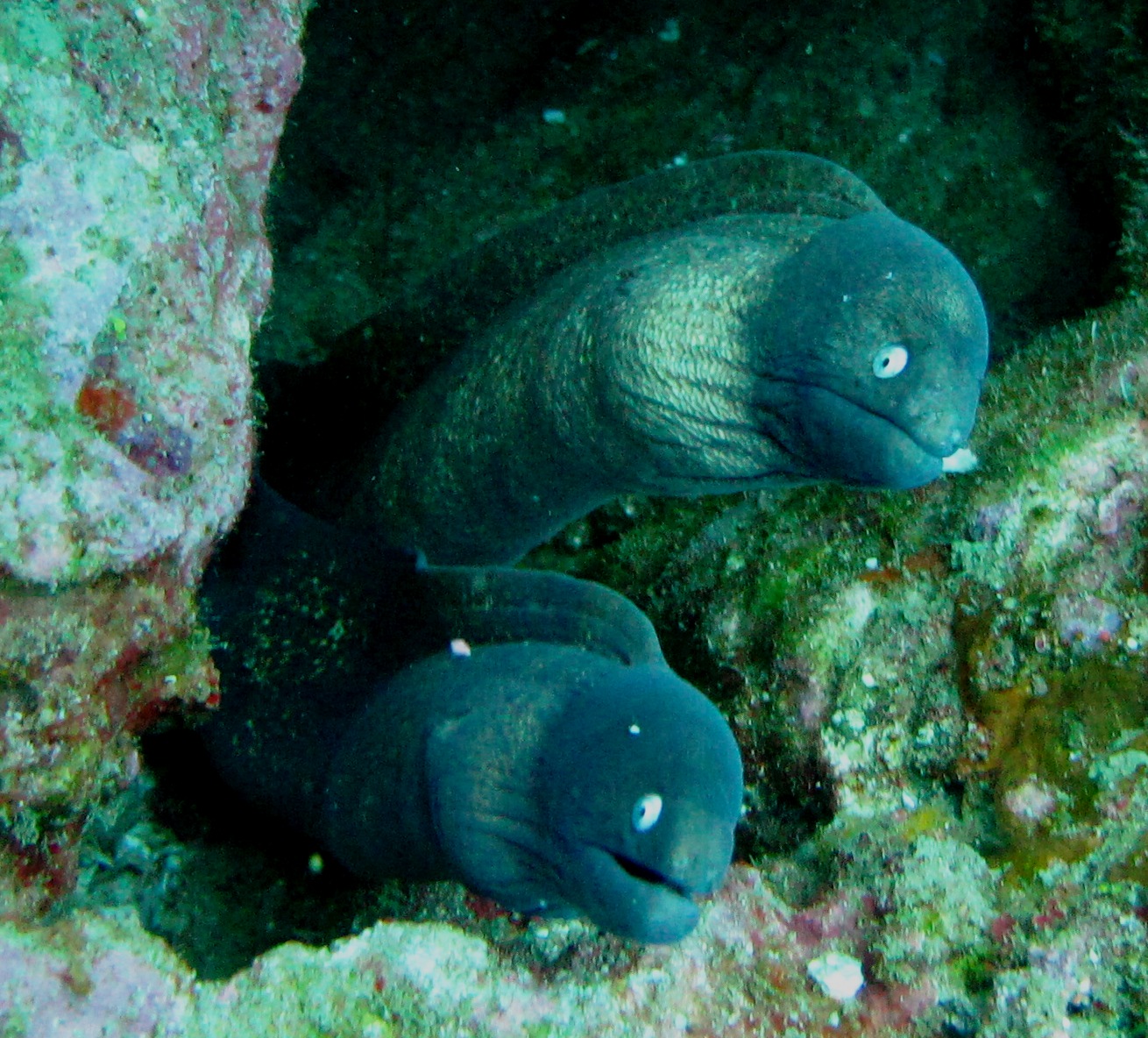
Jellyfish at "the gate" on the way to "Moray Wall"

I HAD to update this post by adding this video clip of "Moray Wall." It truly provides an incredible perspective the others do not. Enjoy!


Our trip to Pagudpud to fill our dive tanks was a complete success. Even with all the side trips we made it back to the hotel in Claveria by early afternoon.
To avoid diving in the dark we decided to quickly get all our equipment together and then immediately head over to the lagoon. In less than an hour we pulled up to the park gate. Don did “his thing,” which is to always try to get best price, but to no avail. We had to pay the full 300 pesos even though it was already fairly late in the afternoon. As the attendant lady said, “Whether it’s for all day or one hour, the fee is still the same.”

We were able to wrangle ourselves into the same pavilion as the day before, right next to the tourism seminar. Not that it mattered much where we ended up, since our intention was to get into our gear and directly into the drink.

The surface swim out to the lagoon’s “gate to the sea” is actually quite long, perhaps as long as 15 minutes or more. Not that it affected how long it took to get out there; but the tide was high that afternoon, as high as we’d seen it. So high in fact that we weren’t able to wade much at all once we entered the water. We put on our fins and began snorkeling only 20 yards from the beach.

We made it all the way out to the western side of “the gate” when Don groaned, “Oh no, I can’t believe it. I forgot my trim weights!”He carries his extra five or six pounds of ballast weights on a belt, where as I keep ALL my weights right in my BCD vest pockets. In the rush, it seems that he had forgotten to strap on the belt.

“What do you think? Should I go back and get it?”

“Yup,” I said, spitting water, “You’ll be fighting buoyancy for the last half of the dive if you don’t. I’ll wait here and just snorkel around while I wait for you.”

“Okay, I’ll be as quick as I can,” he promised.

“Well, don’t tire yourself out. I’ll be fine. Take your time.”

Watching him make the swim back was like watching paint dry. No one swims very fast in scuba gear. It’s just not done. I’d snorkel for a time, checking out what was near the surface in the immediate vicinity, look up to check on his progress, and every time I looked it seemed as if he’d only covered a few more feet.

Finally, I saw him struggle up onto the beach. I sighed thinking, ‘Now I have to wait for him to swim ALL the way back out here again.’

But no, next time I looked up from a bit of snorkeling there he was being pulled though the water by a bangka boat. Don had hold of an outrigger while the boat slowly motored out to my location. Even with the boat pulling him along though, it took more than five minutes for them to get out to me.

During the half-hour of waiting I couldn’t help but notice the huge number of small jellyfish floating all around me; primarily it seemed they occupied the top ten feet of the water column. Occasionally one would break through my defenses (my camera and gloved hands) and one or two of their foot long plus tentacles, which were nearly invisible, would sting me on the face or neck. It wasn’t all that painful, more like a temporary, slightly burning irritation.

I greeted Don as he let go of the outrigger, “Hey, good idea to use the boat man. If you don’t mind, let’s hurry up and get down below all these jellies, seems like their numbers are increasing by the second.”

“Okay, give me a second.” He called a thank you out to the boatman and then told him how much to get from his girlfriend in payment.

Finally! We got our heads together and quickly went over our plan. As always we kept it simple. We would go down, swim to the left down the wall and then explore all the way around the outside of the base of the western “mount” before making our way back into the lagoon directly through the western side, hopefully.

Even with the delay we were doing good; the sky was mostly clear of clouds and the sun was still high enough to give us great light in water that was showing some pretty good visibility.

Before going to regulators we swam a little further, actually going out a ways into the sea through the lagoon’s “gate” between the two miniature seamounts guarding its flanks. You could say it’s like a scaled down version of the Straits of Gibraltar.

Check out the embedded video.
At the very beginning I pan the camera around to capture the way it looks from the water where we are at that moment, just a few seconds before we submerge. In photos from the shore, the gate “seamounts” actually look not all that far away; yet from near the mounts themselves the beach looks a LONG way away.

Once on regulator, instead of heading straight to the bottom, I elect first to tarry near the surface a while to take some video of the multitude of jellyfish pumping away all around us. Looking at the video, they are almost as thick as stars in the Milky Way, and as far as the eye can see in the water.

Watching Don make his way down through them, it was obvious to me why he did so quickly. Last year he opted to cut the sleeves off his wetsuit so that his forearms are free and unencumbered, or so he claims. I’ll take his word for it that THAT is how he is most comfortable, but of course it leaves his exposed arms completely vulnerable. As they certainly were on THAT dive, because his forearms were getting draped on by the jellys, and I KNOW he was feeling it.

Even so, their effects weren’t so bad the day of this video. It was the NEXT day that had an entirely different result, when he paid dearly for having those arms bare. For as copious in numbers as they appear in the clip included with this post, the jellys numbers seemed twice as much the next day.

And that NEXT day, our last day of diving, after two more dives amongst all those active jellys, when he came out of the water the meaty side of both his forearms had scores of angry red welts from where their tentacles had stung him repeatedly. Conversely, with hardly any welts at all, the reverse side of his arms must have been fairly well protected by the thick hair growing on them.

Towards the end of the jellyfish video Don can be seen quite a ways below on the shoulder of the seamount, a fairly extensive, almost flat area some 15 or 20 feet deep. The fun thing about this gently sloping shoulder is that as you go along it to the north, it ends, suddenly and dramatically dropping as a sheer cliff that forms ‘the wall.” This drop continues another 40 plus feet to the seafloor below.

Just as we did the day before, we headed over the edge of that cliff, and then, down “the wall,” as I had started to call it. Don quickly made for the wall’s base far below, while I slowly settled along its vertical face, allowing my slightly occluded ears to equalize as I leisurely followed him down.

By the time I reached the bottom Don was off exploring on the other side of the gorge, which is what the wall forms as it circles around in a rough “u” shape. Because it was bathed in so much light, perfect for photography, I stayed right there along the near side of the wall. Very soon I became glad that I did.

Exploring along the base heading west, something made me spin around and look behind me. There, swimming in the other direction up a narrow ramp was a huge green moray. I knew it was large because it was so long, its body forming a series of “s’s” as it slithered away from me. Without a second’s thought I took off after it. I knew it wasn’t the size of the giant we’d seen the day before, but it was large just the same and I was drooling to capture an image of it. I marveled at the sight of it, the muscularly thick body in continuous motion, its slightly mottled skin glinting an intense shade of green and yellow in the bright stream of sunlight.

‘Wow! Look at that thing go!’

Twenty or so feet up the narrow incline I paused. There was a little yellow and brown striped eel head peeking out from its tiny burrow. It caught my eye just a few inches from my right hand. It was another type of eel, probably a juvenile; I stopped for a split second to take a quick photo, but it was a split second too long. I turned back to look for the big moray but it was gone, likely into a hole in the side of the wall.

I rested there on the ramp of rock, turning my head to find the whereabouts of my dive partner. He was good to go, so I turned back to check out the little eel. Before I even got my head down to focus on it though, another head caught my eye, and then, above it, another head, and then another.

My God, there were eel heads all up and down the side of this wall. It seemed as if everywhere I looked there was another head. It began to creep me out, like being in a dream where everywhere you look, everywhere you are about to step is a snake. I loved it!

I didn’t know where to focus the camera. I put it in video and moved it from head to head before finally finding a really large head some ten feet up the ramp. I pushed up and floated over to it, shooting footage the whole way.

Within five feet, THAT is when I spotted the second head. In the video you can see that it suddenly appears from the other side of the first one. The first thing I notice about them is that they appear absolutely fearless of me. They don’t SEEM aggressive, but I can’t tell for sure. With no little trepidation I push the camera in on them closer and closer, until finally, with my arms extended as far as they’ll go, I have the camera body less than a foot away from the serpentining charmers.

These two fellows also do not come close to the size of the giant we spotted in the cave down below, but they are not small either. For the life of me I could have sworn that they were two very large and very long sock puppets, with the hands and arms of a very large man moving them about.

I can tell they are aware of me, but they do not always seem to care if I’m there or not. Sometimes they appear to get caught up in some kind of eel conversation between the two of them, and while caught up in it, they ignore me. It’s strange; it felt as if they accepted my presence as normal, as if they accepted ME, perhaps as a fellow sea creature.

I would have stayed there longer to just soak in their odd behavior, but there was still much area that we had not seen. You can’t see him in the video, but by the end of the clip Don was right there as well. He saw how engrossed I was and figured there must be something really interesting on the other end of my camera. I’d say he was right.

I did spend another minute taking nothing but still shots of my two enchanting sea serpents. I’ll include a few with this post. You might not agree, but I think the portraits of these dual morays are some of the best undersea shots I’ve ever taken.

After that dive I no longer referred to that area merely as “the wall,” from that time on I’ve been calling it “Moray Wall.”

Later onshore I was a bit bothered when as we excitedly discussed our discoveries with the tourist guy he exclaimed, “Wow, so why didn’t you catch it? It would have made a good meal!” I hope he was joking. I’d hate to see those incredible creatures’ lives ended just to fill some cooking pot. THAT would be a REAL shame.

Our dive was still far from over. Taking one last look over my shoulder at my two new eel pals, I waved so long and continued our exploration. It was time to check out some new territory.

Tuesday, July 05, 2011

The Tall Wall & a Mighty Moray


After Don had made peace with the tourism officials we continued to prepare for our first dive of the day.

It was our third day of diving, including the day we had arrived when we had explored the barren waters just around the point from the eastern end of the Claveria beach.

Our plan that day was to dive one more time in the canyon region, (the labyrinthine area I’ve been raving about in my last few posts) which is made up of a confluence of ravines and fissures, interspersed with gigantic boulders and slabs. We just could NOT get enough of that spectacularly whimsical spot.

By then we knew that the Claveria canyons have way too much to see in just three dives, but three is all we gave ourselves since we still had the entire western side of the lagoon yet to explore; not to mention some intriguing possibilities that we’d learned about from some of the locals. They told us of some promising sites just down the coast to the west. They described very deep waters right along the coastal wall with lots of fish, while others mentioned underwater caves and tunnels. It all sounded too good to be true.

Just hearing about those kinds of adventurous possibilities made us crazy to check them out. But even if all those extraordinary prospects didn’t pan out, the expedition so far was more than meeting our expectations. Yes, the long drive to Claveria had been WELL worth the effort.

The first dive went fairly smoothly except that a head cold I’d been staving off with decongestants was nevertheless getting the upper hand. The meds kept away the drips and stuffiness; just the same, my inner ears resisted equalization. No matter how hard I held my nose and blew, it wasn’t pushing much air where it needed to go behind the eardrums.

Therefore, I had to make depth at a very slow pace; otherwise the pressure behind my eardrums was excruciating. And once I WAS equalized at depth I was forced to ascend slowly as well, to give the pressure some time to leak back out the other way. I needed Sudafed, but that particular brand of superior decongestant is very difficult to find in this country for some reason.

We came up after about an hour, once again chattering happily about the majestic beauty of those incredible canyons. By this time the Claveria tourism official was our buddy. He and several others were very curious about what we were seeing out there. However, it’s difficult to describe something like that. We did our best by using lofty words like wonderful, gorgeous, and stunning; but it just doesn’t do it. Even my pictures and videos don’t do enough to capture the scope of the splendor just outside the lagoon entrance.

On our second dive, for the first time ever we angled toward the left side of the lagoon inlet instead of to the right. An underwater channel extends deeply almost into the middle of the lagoon. We found it from the surface using our masks and snorkels, then we followed it on out to the sea.

Even before leaving the confines of the lagoon, the deepness of the channel provided items of interest at which to gander. Geologically speaking, the sight of the channel way below is itself interesting. It’s easy to see that it’s either an ancient river gorge; or it is a place where flowing lava had deeply cut a channel out to sea. Either way, it was formed a LONG time ago.

Concerning the channel still, the other interesting sight is the continuous flash of fish along it; it’s a veritable fish highway in fact, relatively large ones too. As it gets deeper, towards the lagoon perimeter, the fish in it become more profuse, diverse and larger; although it’s difficult to tell exactly how large since by that time the bottom of it is more than 30 feet from the surface.

Fishermen obviously are aware of this congregation of fish; several times I witnessed boats, three in a line, dragging their nets deeply through the channel right into the lagoon. We took mental notes of this knowing that we could easily be hurt or killed if we got caught up in those dragging nets. It’s one of the dangers we knowingly put up with, diving in places where no one else ever does it.

When we reach the base of the little islet forming the western side of the lagoon inlet we know we are into something special. Inspecting it from the water we are able to see what is both above and below the surface. It reminds me of what they say about ice bergs, that what you see is ONLY the tip of it. It is massive, the amount of rock BELOW the diminutive island protruding above the water. I couldn’t even see all of it because the bulk of it is hidden from view where it drops off a shear edge to the north.

Don makes for the sunlit edge and immediately drops below it out of sight into the eerily dark blue waters far far below. I don’t realize how far until I also reach the precipice. I’ll NEVER get used to that feeling, swimming out over an area where suddenly the bottom is SO far below.

For a second I forget that I am not about to crash to my demise, that I can hover right there, like an ethereal spirit or a wispy hummingbird. My heart always races with the thrill of it, as if I’m cheating death. I follow Don over the edge with camera in video to make the short clip that can be seen in the YouTube embed below.

My inability to quickly equalize causes me to hang high above Don for quite some time. Necessarily in slow motion, I gently drop to ever deeper depths. I let my ears get used to the increased pressure, head cold and all. I drift down the side of the steep wall closer and closer to Don while watching him explore under every rock and in every cranny 50 feet below the waves.

Strangely, by the time I make it down to him we have lost much of the earlier brightness from above, and it happens seemingly in seconds. At first I think the gloominess is from being so deep at the bottom of what amounts to an underwater valley, the sheer sides of it towering high above us perhaps blocking out the sun. But no, craning my neck to look at the surface I can see that it is at least three or four shades darker up there and becoming more so.

I don’t know what the deal is but there is hardly a bit of coral or sponge growing in and along the sides of that gorge. There IS a nice bit fish life, but once again, it is few and far between. We can find it but we must look hard to spot it.

Don and I separate to do our own individual investigations of the area. The next time I glance toward him though, he flashes me with his spotlight. You can see it in the video below. That’s our signal for “come over here!” which I immediately do.

Approaching up through a gap in the rocks I see that he’s checking something out way up inside the recesses of a tiny cavern. Not knowing what he’s got for me I carefully push the camera into the hole’s entrance.

He’s got something lit up way in the back. At first, to me, it looks like a moving lump; but then I see a head with a mouth and beady eyes, then a very thick neck with a very LARGE bit of the rest of it visible that it has not been able to push back out of sight.

It’s a huge moray eel, the biggest I’ve ever seen. Don says when he first came up on the eel its head was protruding from its burrow and that’s how he spotted it, but when he moved in for a closer look, it retreated as deep as it could go. The middle of its long massive body is almost as thick around as my thigh.

With a happy nod and some okay signs flashed at each other, we continue our journey of discovery and separate once again. The darkness was becoming more noticeable. Suddenly, a bright flash pops off like one of the old-time flashbulbs. I look over at Don about 30 feet away thinking he is spotlighting me again. He is looking at me too but with no spotlight. We carry on with our examinations but stop again when the bright light flashes us once more.

‘What the heck was that!’ We look at each other thinking the same thing.

‘Did you do that?’

‘No. I thought YOU did!’

It happens again, for a split second starkly lighting up everything in the gloom around us. Now we know what it is—a thunderstorm is passing overhead with lightning strikes every few seconds. It’s comforting knowing that all that menacing rain and thunder way high above in that OTHER world has nothing to do with us.

Eventually though, when our air pressure approaches and then surpasses the red markings, we have no choice but to return to the land of the air breathers. Leisurely rising up the wall toward whence we came, we get back up to a depth of 20 feet. From there we look up and see raindrops heavily splattering the surface above; we can even make out the distant hiss they make. From down there it sounds like static from a far away radio.

Finding the lagoon inlet channel again, this time we follow it quite a ways back in, almost to the center of the lagoon. Somewhere in the middle of it with only about eight feet of water above us, we listen for the sound of boat engines.

Determining there are no boats about to bear down on us, we surface into a markedly differently world from the one we had departed only a little less than an hour before. The sun is gone, replaced by low dark clouds heavily dumping sheets of rain on everything around, including us. Luckily the bolts of lightning are striking miles away. The storm doesn’t dampen our spirits any; once again, we are ecstatic over what we have seen.

Before making our final swim and wade in to the rain drenched beach, I make a final remark while standing in the shallow water over to my dive partner:

“Dude! That was amazing! We have GOT to go back there again!”

And we would. The only problem is that our next dive was going to have to wait since we had just used up the last of our filled tanks. The next day we would have to find a place to get them refilled, hopefully back up the coast to a dive resort called the Terra Rika in the town of Pagudpud.


More on that little endeavor in the next couple of posts. . .

Friday, July 01, 2011

A tour of a hatchery; lobsters, crabs and cukes


Our third day of diving in Claveria broke sunny, blue and calm. Diving in bright tranquil weather is aces over any other circumstance, especially when it comes to underwater photography; and ultimately, for me, taking pictures down there is what it’s all about.

Based on some earlier remarks I’d made in passing, Don knew I wanted to stop at the hatchery. We passed it every day on the way up the beach road to the lagoon.
The hatchery is a little more than halfway up the coast from the Bayview Inn if driving west on the gravel track to the Claveria lagoon.

He pulled into the hatchery driveway almost as an afterthought, just a few seconds before announcing that he intended to. I was pleased; looking forward to the chance to speak to a marine expert about what exactly was going on in the waters thereabouts. Maybe someone in the hatchery could tell us why the sealife was so meager in the lagoon area and completely missing just a couple miles from it up the beach.

Climbing out of the car, I tell everyone to sit tight until I can find out if we’ll be welcome or not. Three or four folks are standing out in front of their office building, probably curious to see who we are. I stop at the gate and request permission to enter. One of them nods and gestures to come on in. Waving my hand as I approach I call out a hello.


Shaking hands with the first fellow I come upon, I remove my ball cap with my left as an unconscious sign of respect, and continue to shake hands all around while I speak.

“Hi there guys. Hi. How are ya? Hey, we’re visiting the area for a few days from down south and just wondering if you might have the time to show us around your hatchery.” I ask literally with hat in hand.

The oldest looking of the group immediately answers agreeably, “Sure. Why not?” He turns to one of the other younger looking guys, I assume with instructions for his man to give us the nickel tour. I shake hands again with the youthful guide and find out his name is Jay. By this time Don has already joined us and is already meeting and greeting everyone as well.


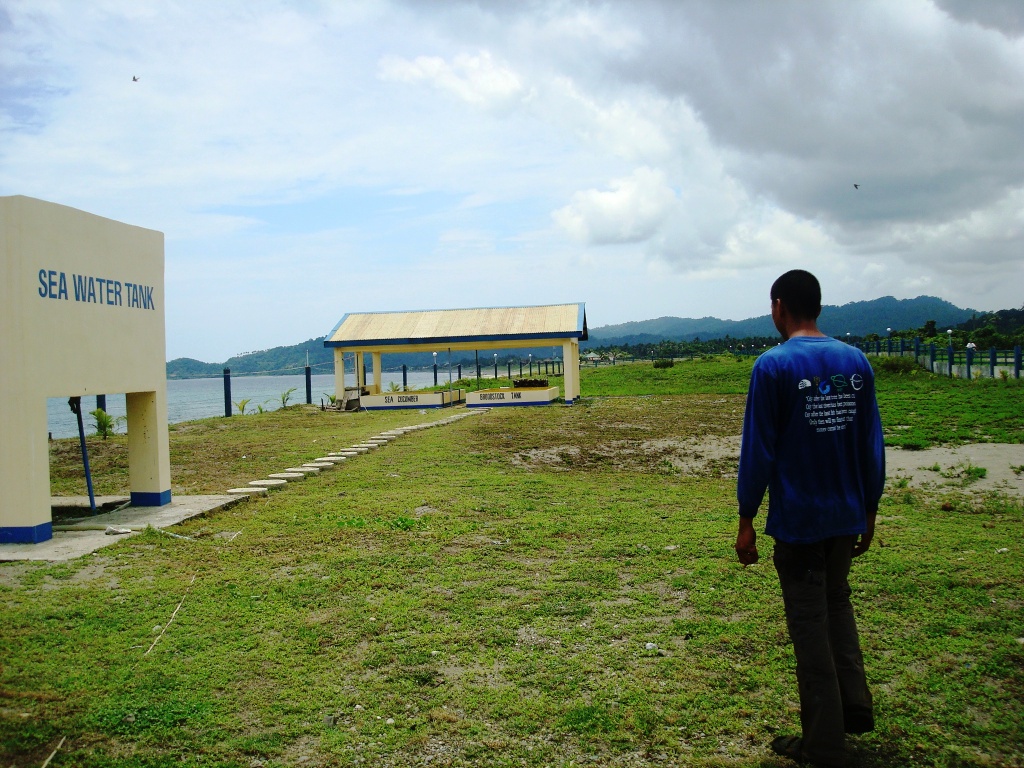
With Jay leading, the three of us walk across a long wide stretch of close clipped grass inside the fenced hatchery enclosure to some open sided pavilions containing water-filled bathtub style concrete tanks.

Not wasting time I pepper Jay with one question after another, starting out asking if the entire shoreline is just as bereft of sealife as the “the dead zone” area appears to be. We explain then that we are recreational divers up from Pampanga to see what we can see along this section of the northern coast.

Surprisingly, he didn’t sugarcoat at all, telling us that overfishing hadn’t left much out there. I forget what he called the style of net fishing that he cited as being particularly destructive, but I’m sure he was referring to the massively long ones we constantly saw manhandled from the beach by up to 20 people.


To me, they look like trawler style filament nets adapted for use from the shore. They use several bangka boats to stretch them way out, mostly horizontal from shore, and then use a gang of strong backs to pull them in to the beach. The nets are hundreds of feet long and weighted on the bottom side.

Surely then, as these things drag and bump along the seafloor they rip and chew up the bottom, stirring sediment and catching anything and everything in its hyper-effective monofilament webbing.

Those nets explain why nothing is left. They even tear up any seaweed and all other life forms that live by clinging to the bottom. All that remains now are endless expanses of sterile sand.

The hatchery’s mission has little to do with restoring the natural undersea habitat. Both Jay and the hatchery’s sign out front announce that they raise high value species for release back into the sea for commercial purposes.

Check out the three videos. From what we saw, the place concentrates on cultivating crabs, lobsters, and sea cucumbers. Then again, we might not have seen everything.

The sea cucumbers I found hilarious. Jay pulled several of the phallic looking creatures from the water and each immediately began to squirt water from one end. I have no idea if it was the head or back end, but seeing them do that struck me hard in the funny bone and I could not stop giggling.

The hatchery’s crabs are equally funny and fascinating. As you can see in the video, this species is perfect for the sandy conditions prevalent to that region. . Jay demonstrates how they find their place in their world. Dropping them back into the water, in less than two seconds they back their way back into the soft sand, completely disappearing without a trace. I had Jay demonstrate the trick twice so Don could check it out too—very compelling stuff for someone who finds the natural world as intriguing as I do. I cringe watching the video now, listening to myself cackle-laughing at how the little crabs do their disappearing act.


We asked Jay if the entire coastline’s underwater environment was as dead as what we saw down at the eastern end of Claveria. He nodded, explaining that what we saw is typical of what we’d find no matter where we dive. But then, pointing east down the coast toward the lagoon, he said that there is a reef area over there still active with fish life.

Hearing Jay’s comment, Don and I nodded excitedly, with Don piping up, “That’s exactly the area where we dove yesterday. So you’re saying there is an actual reef out there? Because all we explored was the area just outside the lagoon along the shoreline.”


Jay explained that further out from shore, straight out from the lagoon is an actual reef that hasn’t yet been destroyed.

Don told our guide about the giant lobster hidden way back under the furthest reaches on the underside of a boulder, asking if there are any laws prohibiting the
use of spear guns to catch something like that. Jay informed us that there are no laws preventing anyone from taking anything. (I heard the implied, ‘and THAT is the problem.’

We left the hatchery thankful for the tour, as well as for the useful information. Unfortunately, just down the road we were about to have an encounter with another
government official that did not go nearly as swimmingly, at least it didn’t start out very pleasantly.