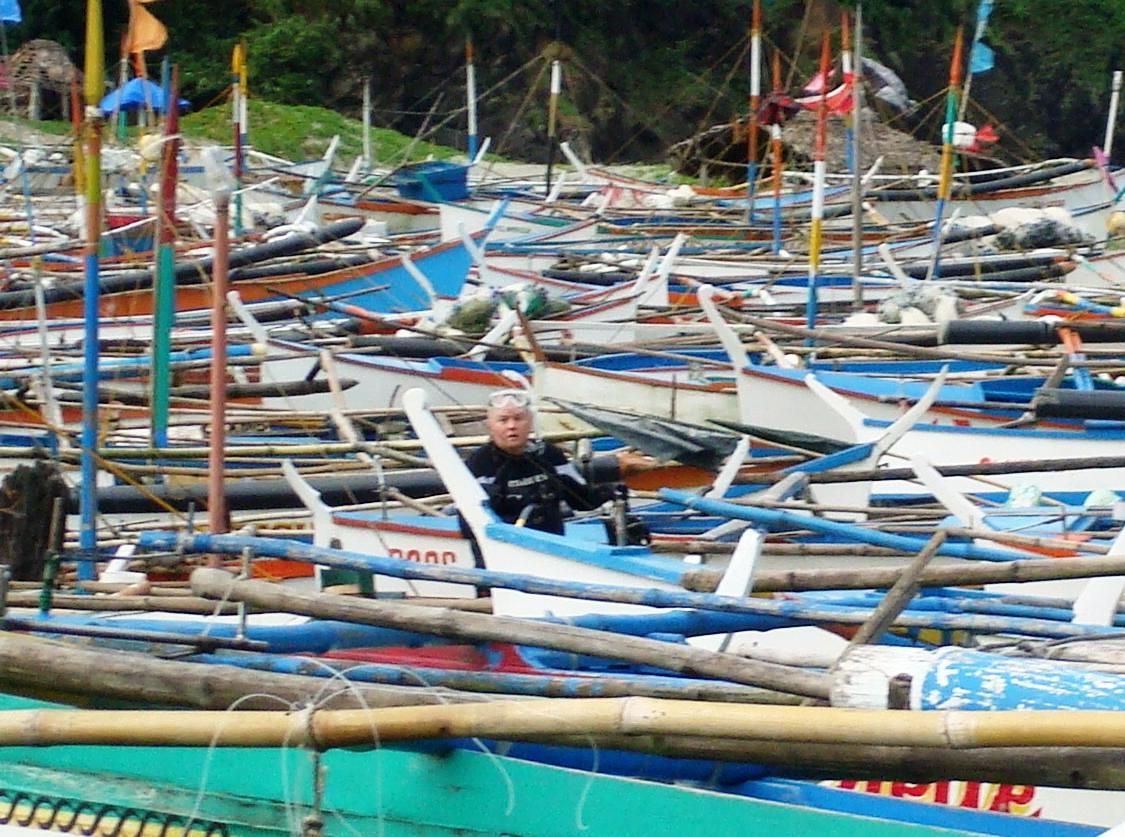
I’ve been waiting for our next dive expedition to start blogging again. Obviously, it took a lot longer than I thought it would. Anyway, we finally made it happen although it was disappointing in two ways. First, my underwater camera package glitched and second, the trip itself was cut in half by some freakishly foul weather. (The locals up north claimed they had never seen that much rain during the Easter season, but who knows, memories are short in these parts.) We got back a few days ago so here goes….
After our previous visit to Claveria last June, which was my first time up there, we’ve been itching to get back and continue our underwater explorations in the waters down the coast from that friendly little town. Just like last time, Don picked us up here at the house late at night to try to miss as much traffic as possible on the way north. Our previous trip we had left around 1 am and that worked pretty well in traffic avoidance. This time he tried leaving even earlier, the plan was for 10:30 pm; even so we didn’t get out of here until near midnight (..the best laid plans of mice and men..).

Long drives in this country are extremely tedious, mostly due to screwed up roads and slow moving trucks, jeepneys and trikes. Over here, if you aren’t passing then you aren’t driving. Back home I wouldn’t think of buying a car without a cruise control but here such a device would be a joke. There’s no way one could leave it on for any longer than half a mile even on one of the few available expressways.
Last June we covered the distance a lot quicker, arriving in Claveria in something like 10 hours and that included a sightseeing stop at the Cape Bojeador lighthouse. This time however we were thwarted by a lot more road construction, probably needed due to damage caused by all the over heavy trucks combined with washouts from heavy rain.

Some 12 hours after leaving Angeles we arrived at The Bayview Inn. Originally our plan was to try to get in a quick dive before dark but obviously we needed some sleep first. Truthfully, I have no idea how Don made it all the way up there without passing out behind the wheel because by 10 am I continually caught myself nodding off trying to stay awake to keep him awake. To that end I was a miserable failure—thank God HE wasn’t.

Checking into our rooms and I passed out on the bed despite the mad-ugly horrible karaoke assaulting us from just below our seaside windows. I took a moment to push some earplugs in as deep as I could get them and that did the trick, mostly. Additionally I turned on the fan to full to add some white noise to the mix and finally turned the TV to the History Channel just loud enough to help drown out the out-of-tune “singing” voices. When I next opened my eyes again it was already getting dark. The sound of heavy rain on the roof and on nearby buildings woke me up along with some particularly awful screeching and moaning that someone was making full blast on one of the two karaokes in the hotel’s two party pavilions.

(By the way, if you plan on staying in The Bayview and you are not a fan of full volume bad singing at all hours of the day and night, then you MUST wear both earplugs AND ear muffs. Then again, if you are from this country then such a thing probably won’t bother you. My wife is a Filipina and although she detests karaoke almost as much as I do at least she is able to tolerate it. Aside from the karaoke though, the rooms are nice, clean, air conditioned, and reasonably priced.)

But there was another noise that rivaled the beating of the rain drops (and the “crappyoke”); it was the furious rhythmic hissing and crashing of the sea on the beach just 100 feet away. I groaned knowing that that particular sea sound did not bode well for our prospective diving. I pushed aside the drapes and through early evening gloom made gloomier still by the rainy weather, saw huge waves crashing white into brown sand.
About then my wife appeared through the door with some rice and pork for our dinner, something she had rustled up down under the stairwell sheltered from the rain using one of the hotel’s little charcoal grills. They don’t offer food but a good Filipina wife can ALWAYS find a way to get her husband some food! I’ve been married to three of them and THAT is a truism common to all three.

“Are you ready to eat? Too much rain out there, and wind, not so good for your diving, is it?” she remarked.
“Well, hopefully the weather will be nicer tomorrow. Anyway… Let’s eat!” I was famished. But first I turned the TV up trying to drown out a particularly bad singer. “Don’t they ever get tired of sounding so horrible,” I grumbled.
The next day dawned sunny but watching the weather on CNN I saw that a strong front was pushing in over the entire north coast of Luzon from the east and it would be doing so for days to come. Unfortunately, that weather front and the rain and wind it brought set the tone for the next few days to come.

Just the same, we hadn’t come all that way not to dive so dive we did. Don wanted to make this trip all about exploring the waters off the coast starting about one mile west of the Claveria Lagoon. During our last trip to Claveria we had only one dive in that area but from what we saw in that single hour under the waves was enough to entice us back with sights of interesting sea walls, canyons, and a myriad of sea life.
The only issue with diving “so far from the car” of course is the need for transportation. There is no way to get down to that section of coast without the use of a watercraft. From what I could see, the shoreline for at least two or three miles to the west of the lagoon consists of steep hills, sheer cliffs, and gigantic jumbles of stones that go right up to the water’s edge and even right into the water. It makes for a beautiful coastline above the water and for some great diving down below; and better yet, it keeps people out of the water and away from the shore. Observation: People near and on the water means over-fishing and garbage IN the water; thus, no people equals GOOD!

First things first, Don paid 1500 pesos to rent a pavilion for each of the next five days that we expected to dive from there out of the lagoon park. It was after 10 am by the time we got there and already jam packed with people enjoying the activities and sights available at the lagoon. Don continued to “do his thing,” wheeling and dealing for a boat and crew to take care of us for the next five days. He arrived at a figure of 500 pesos per day for two trips each day. That’s only a little more than $10 a day but it’s still a lot more than the average person can make up there so they readily agreed to do the work.

We pulled up next to one of the dozen or so quaint pavilions built rough hewn in traditional “bahay kubo” style, only with open sides, and began to unpack our dive gear. I always enjoy the feeling of getting all my dive equipment out and ready to put on and assemble. It feels exactly like I’m preparing for a military mission.
Several of the locals gathered around to watch, especially the kids. After our last trip I’m accustomed to it now, the feeling of being a fish in a bowl, having my every action scrutinized by curious strangers. My wife laughs and calls us “idols” because of all the attention we get. I can understand why they do it. I’m sure I would be doing the same thing if roles were reversed. Even back home the sight of scuba divers would be quite a spectacle to folks not used to seeing them and would draw inquisitive onlookers.

We were suited up with all our gear ready to go when we got word that the boat man had decided to cancel on us. We weren’t all that surprised since that sort of thing is common over here and actually, as it turns out, it was a good thing since the replacement boat and crew, Sonny and his able bodied boys, were awesome.
I won’t go into describing each dive as I have in the past since for the most part all of the dives were similar, well, all except for dive number four (more on that memorable one in a bit). On all five “swims” we dropped into the water in pretty much the same place and got picked up in close to the same place (except for dive four that is).

A huge disappointment for me this trip, and another reason for having less detail to share, was the apparent failure of my camera’s underwater package. I’ve always diligently cleaned and lubricated the housing before and after each dive. The instructions are to rinse it well in fresh water before trying to open it after a dive in seawater. I never store it closed and locked to make sure the all important o-ring does not get flattened. Even so, not long after submerging on the first dive I noticed for the first time ever tiny beads of moisture on the inside of the viewing window. Water and electronics not being good bedfellows I turned it off for the remainder of the dive.
Back in the room that night I closely inspected the o-ring, cleaning it thoroughly with a q-tip. I noticed a piece of grit that came off the yellow rubber ring; it was miniscule but I figured it might have been the culprit for the micro leak. Long story short, on the very next dive I noticed moisture almost as soon as I got into the water and immediately had the boat come back for it.

It was the end of day two and I was desperate to figure out if I could get my camera to work without the housing leaking. That night I dared to completely remove the o-ring, the first time I’d ever done that. Using a toothpick I easily popped it out of its groove. I quickly learned that I should have removed it long before when I discovered how much grit had found its way under the seal which surely compromised it.
There was a reason I was so anxious to get that camera back in the water—dive number four! Of our five dives IT was THE one that I needed to have my camera with me. The other four of our five dives were unremarkable by comparison.
Ah, but that glorious “dive number four,” on the second dive on our second day of diving, was unique in that we made our way along the shore in an easterly direction and we simply kept going until our air was down to less than 400 lbs. We saw some amazing sights on that dive, but dammit, I wasn’t able to get a bit of it recorded with my camera being down. But I digress…

The other four dives were all in sight of the lagoon, about a mile west of where we went into the water as the crow flies. On each we’d drop in, go down to about 25 feet and then explore the bottom, mostly heading in a zigzag fashion to the west. What I remember about those dives are the series of parallel canyons, each running from shallow to deep from the direction of the shore.
Don and I have two distinct ways of getting ourselves transported in one of those tiny outriggers to where we start our dives. Don, who is stronger and still mostly able-bodied, simply dons his BCD and tank and carefully climbs into the boat. I am not able to do that due to my bad back, bad ankles, bad feet, bad shoulders, bad EVERYTHING. So, at the pavilion I would back into the shoulder straps of my heavy tank and BCD and carry it down to the boat where I’d back up to it to allow one of the boatmen to carefully place it inside. That way my equipment and I traveled separately but together!

Then, at the dive site, our routine was to get Don into the water first. He’d usually just roll over the gunnel into the water where I would then pass his fins to him. Once he was situated I’d sit on the edge of the boat and put my fins, mask and snorkel on after which I’d drop in next to him. The boys would pass my BCD and tank down to me where I’d put it on in the drink. Don and I would check each other out, mostly looking for stray air bubbles, and after giving each other the okay sign, down we’d go.
That system normally worked well for us, except for the fifth dive, our last one, due to the arrival of some pretty rough weather. Don was all ready to roll into the water like he always does, but inexplicably to me at the time he suddenly stood up in the boat and leaned over reaching towards the water. (Later he told me he wanted to rinse his mask off). The swells were already getting sizable due to the approaching storm and right at the time he bent down a swell popped our boat up a foot or two. Next thing I knew he was tumbling head first into the water cracking loudly against the outrigger and a horizontal support. It looked and sounded painful. I crossed my fingers waiting to see if he’d broken anything. He popped up in short order, spitting water and coughing, but I was happy not to see any blood on his head and face. It was a close call but all was well.

But that happened on the last dive. On the first dive, as we descended to deeper water, following the side of the first canyon, I began to notice the beginnings of a current, and it was getting chilly. Then, BANG, we dropped full body into THE coldest water I’ve ever dove into. I checked my dive computer later and found we were in a patch of 65 degree water. It was a shock to say the least since the water temp at the surface is probably in the high 80s.
The water seemed to get even colder and the current stiffer as we approached the end of the canyon at its deepest point. We could have gone deeper as the floor continued to slope away from us out to sea but we opted not to. Checking the depth I was surprised to see that we were already near 80 feet down. The last time I looked it had shown just over 50. I drifted up a little as we turned the corner and headed back up to shallower water by following the next parallel canyon towards shore about a 100 meters away.

The neat thing about that part of all the dives we did in that area is that a variety of fairly large fish tended to hang out at the deepest part of each canyon where they empty into the open sea, which is also where the coldest currents seem to be. My observation for that area is that colder water equals larger and more numerous fish.
But dive number four was THE dive of the trip as I’ve already mentioned. On that one we got out of the boat and after going down to about 40 feet we immediately headed to the west to the inside of the little rocky islands so that above us up on the surface we would no longer be able to see the lagoon since we would be on the other side of the point from it.

We followed a series of very narrow deep channels, in some places only a few feet across between 20 and 50 feet deep. After about 20 minutes we passed under the underwater rock arch that we had found during our June trip. It STILL looks just as awesome as it did when I first saw it last June. Back then we had turned around after passing under the arch and coming to a circular depression at the bottom of a 20 foot wall; but this time we ascended the wall and passed over it where we found ourselves almost at the surface. Instead of turning around we continued west as per our dive plan. We had told Sonny to look for us on the other side of the point so we weren’t worried about going short on air with no boat in sight.

That area “around the bend” is filled with underwater ridges that sometimes break the surface along with numerous miniature rock islands that dot the surface. With all that towering rock all around we could look up to our right and left and see that we were surrounded by islets and ridges where rough water visibly busted foam, even from way down where we were, which sometimes was not all that deep.
Here’s an aside: I’m thinking that the locals don’t eat lionfish, probably because they are so dangerous to handle with all those poisonous feathered spines. There are a lot of them in the Claveria area and for the most part they are fearless, caring not a hoot about our presence, only bothering to slowly turn away at our approach. On that wild fourth dive we twice came upon huge ones, the largest lionfish I have ever seen and I’ve seen some big ones in the waters of Puerto Galera. Each of these Claveria versions looked to approach three feet long, which means they were probably closer to two feet in length due to the magnification that happens looking at objects underwater. Still, even Don marveled at their size and he has seen hundreds more than I have.

But the real treat of that dive, dive number four, took place when we were at around 1400lbs of air left in our tanks. Don led the way up and over a ridge that took us up into shallower waters closer to shore into a huge semicircular natural pit with a flat bottom about 50 feet across. For starters the sides of this large half barrel-shaped feature was interesting to look upon all by itself. It was like an immense inside-out layer cake with each stratum just under a foot thick, maybe ten or twelve distinct levels stacked from top to bottom. It was quite striking. Again, just like the giant sized lionfish, I’d never seen anything like that geological feature anywhere before-- strange and remarkable indeed.

Noticing that Don had strayed quite a ways ahead of me, I kicked my way over in his direction to see what had caused him to move away so quickly. Coming up on his left I saw that he was using his spotlight to peer into the base of the far wall of the circular shaped depressed area.
Blowing air steadily from my lungs for a few seconds while moving forward to Don, I continued to hold empty until I descended slowly some five feet to the seafloor, settling on a rock step at the base of the wall a few feet from my inquisitive dive buddy. Until that moment I thought he was merely peering into a deep horizontal crack that seemed to be part of the same geology that had formed all that horizontal strata in the rock formations all around us. But no, this was no mere sideways crack in the rock; this was huge, obviously the opening to a major overhang or cave.

I say major because there was probably room for another couple of divers to line up right next to us, to our right and left, with plenty of room to spare. At first I tried to gaze inside using only the light available from above and behind me but that was useless. The blackness to my front was absolute and complete, with no diffusion of light invading the interior whatsoever. From my understanding, it’s exactly like that on the moon where there is no air to deflect and diffuse light—again, very interesting to actually observe it.
Don pointed at himself and then pointed at me to wait while he went in.
‘Nope, that’s not going to happen!’ I thought loudly as I turned on my own light and entered right along with him. If it had been a narrow affair like some of the other caves we’ve found I would have waited for him to clear it but not this time. There was obviously so much room in there that I just didn’t see the need to wait around while he had all the fun.

Looking around the interior, pointing our lights here and there, we discovered that it was even larger than we first imagined. I do realize that dimension can grow in the telling; so now, doing my best to avoid exaggeration, I’ll say that the distance from the entrance to the far wall is between 30 and 40 feet. The ceiling averages between 6 to 9 feet, maybe less. That describes the depth and height; the width was also quite extensive, perhaps also 30 or more feet. In other words, it was BIG in there.
I remember trying to read my computer in the cave and being unable to do so; in fact, my arm was barely visible. To see the readout I had to point my flashlight at it, although I suppose I could have used the backlight. Surprisingly, I remember the depth readout being 6 feet. I’m fairly sure we were under the shoreline back inside the cave but later it occurred to me that no matter how deep the cave the depth gage is only going to read the pressure of the water column and at that spot inside the cavern the column of water above me was just 6 feet.

Don flashed his light at me and I came over. There on the rock floor next to a step was a chubbily huge black blotched puffer about two feet long, the largest I’ve ever seen, AGAIN. I doubt it had ever seen a human before. It hardly budged as I came near—another photo opportunity lost.
And speaking of fish, the entire massive cavern was filled with fingerlings of a species of cave fish. I know them specifically to be cave fish because I recognized them to be the same type of fish that we discovered last June in the much smaller coral caves just outside of the lagoon about a mile away. So these particular fish seem to prefer large enclosed spaces.

I say “filled with fingerlings” but that is an understatement because those fish virtually crammed every available bit of space in the cave. As we moved about they literally “made a hole” and did so immediately to accommodate our bodies. It was fascinating to watch although I would never have known about the fish doing that except that I took a few minutes to just lie still at the far back corner to watch the sublime spectacle happen as Don slowly made his way throughout the cave. Without being back there I wouldn’t have been able to see much of anything, but with the light of the cave entrance backlighting Don and all those thousands of fishies, suddenly everything became crystal clear.

Ah, before I forget, there was another really cool phenomenon that I observed and it was something that we caused. Every bit of air we breathed out ended up being trapped on the ceiling above us. When I first noticed it after about 5 minutes of being inside I didn’t gather what it was I was looking at. They don’t look like bubbles at all, to me they resembled squirming streams of liquid mercury. It even had the same color of the stuff. Don supposed that the trapped air might still be there when we go back again in a couple months if it can’t find any fissures in the rock above to escape through. I’ll be curious to see if that is so. I’m thinking that it will all have disappeared by then, if it’s not gone already, having dissipated its way back into the water itself.

Later, discussing the cave with Don, I asked him if he noticed how the water in there was strangely free of any obvious silt or floating particles of any kind, other than the tiny free-swimming fish. In fact, there was no detectable current or movement of water in there at all, even though just a few feet outside the entrance the currents were strong enough to move us about. An academic question would be, “Is it always like that in the cave, totally free of water movement and silt? And if so, why?”

Being retrieved on these exploratory dives could be somewhat of an adventure in itself, depending on the state of the seas at the time. When we popped up “around the bend” at the end of the fourth “cave dive” we found ourselves in a tight channel basically bounded by jagged jumbles of rock on the shore and out to sea as well. So yes, we were surrounded on all sides by jagged rock ridges and islands. Luckily for us the swells, although bad, were not bad enough to keep our boat at bay. Or maybe it was, but they didn’t have any choice but to come in and fetch us. I suspect it was the latter since the next day as soon as Don dropped into the water, Sonny at the last second informed us that there was no way they could get us from among the rocks like they had the day before. That was disappointing news for us since now that I had my camera housing properly sealed I was eager to get back to the cave and capture some videos and stills. Dang it!

By the time we popped to the surface more than an hour later the weather had gotten a lot worse. The storm that would end up sending us packing early the next day was almost upon us, and boy-oh-boy, the waves were no longer simply choppy, but had turned into rolling swells that lifted us WAY up and then dropped us WAY down. During one of the “way ups” we spotted the boat about 500 meters away. I whooped at them but it was obvious they had already seen us as they were busily trying to start their ancient little inboard motor with a pull rope that they had to attach, wind, pull, attach, wind, and pull, etc. Perhaps the rough tossing they were taking was making it difficult for them because by the time we finally heard the tell-tale popping of the old two-stroke I was getting a bit green around the gills.

The little bangka never seemed so small as it did to me coming toward us, bobbing and crashing awkwardly into and through the huge waves. They got within 50 feet of us and turned away. Sonny yelled something but we couldn’t hear him. We weren’t concerned though as we knew from his gestures that they needed to come around for another pass.
On the second approach they headed directly at us again, only this time they dropped an anchor to achieve more control. It was then that I noticed something on the faces of the three boatmen, something I’d never seen before—concern! I yelled out to Don, “Let’s not lollygag when it’s time to get aboard. Those guys are having trouble and they look worried to me man.”

“You don’t have to tell me that. I fully intend to get the hell on that boat as fast as I can so we can get the hell out of here!” he yelled back.
The dropped anchor ploy worked pretty well. It seemed to keep the outriggers from crashing up and down as much, or at least long enough for the boys to pull our tanks up and in with us pushing up on the bottom of the tanks to help them get our super heavy rigs over the gunnel. After that it was up to us to get ourselves back in as well. Don never seems to have a problem with that while for me it’s the most painful and difficult part of the process. I’d take a deep breath, grab the gunnel with one hand, an outrigger support with the other and heave myself up as high as I could.

My goal was to get my hips high enough so that I could get one foot over the edge into the boat. Once I managed that I simply rolled my body over the side, usually crashing hard into whatever or whomever was in the way. It was painful but I never minded the pain as long as I attained the nearly impossible goal of heaving my decrepit body up and into the boat. It sucks to get old and used up!
All that night the storm hit us hard. Sheets of rain assaulting the tin roof above us rivaled the roar of the surf on the nearby beach. Don texted me the next morning, “Looks like Mother Nature beat us this time. We are out of here.”
The locals said they’d never seen anything like it this time of year. So, it was just our luck. While packing the car in the pouring rain the hotel owner’s daughter, a

woman a bit younger than me, talked with me as I also waited for my wife to square things up with our bill. Don had already decided to drive home by way of the Cagayan Valley and it turned out that that was an excellent decision since we learned from the owner’s daughter that we really had no choice since the National Highway was completely flooded and impassible going back the way we had come.
Almost 13 hours later Don pulled up in front of my house. I hate long drives, especially in this country where you NEVER KNOW what kind of craziness you’ll see. Long drive and all though, I must say that the diving up there is more than worth the mind-

numbingly long and boring (well 90% boring, 10% terrifying!) drive to get there and back. In fact, we are already planning our next trip up there, probably in late May or early June. We’ll see how it goes after we get back from Thailand in about two weeks.