Saturday, July 16, 2011

Claveria Scuba Expedition, The beginning of the end


Saturday afternoon and we have but one dive left in our Claveria scuba expedition; we are sad but excited.
(Above: view from the boat on the way out of the lagoon.)

We want to get in at least one dive down the coast to a spot where the locals, mostly fishermen, are telling us about whenever we ask if they know of places where there are lots of fish. If there isn’t so much great underwater sightseeing right there around the lagoon I’m sure we arrange a dive down that way much sooner, especially after the great things we end up seeing there in our final dive.

(Photo left: A colorful nudibranch and above it some kind of seasquirt.)
Don does “his thing” and makes a deal with a local boatman to take us. I think all together, including the tip from me, we pay 500 pesos, almost $12. I am MORE than willing to pay them the extra 200 pesos after the help they give me in getting in, out, and then back in the boat again. I ALWAYS need extra assistance with the wreck that my body has become.

The two boat guys have their little outrigger pulled up into the shallows just off the beach near our pavilion. With my tank already strapped on I simply back up to the side of the boat, unbuckle it and let them put my BCD and tank aboard. (Below: Colorful sealife clinging to the side of island's base wall.)


Don, on the other hand, hates to take off his gear during transport to and from a dive. At least he, with his freakish strength, is able to actually pull himself up into the little bangka. Watching him, he's awkward to say the least, but VERY entertaining. He pulls his whole body up, gear and all, onto an outrigger support and then slowly crawls on his hands and knees to the edge of the boat. I have to counterbalance by leaning away from him to keep the boat from tipping. At last he makes it in. All that just to keep from having to shed his gear for the ride out. I HAD to chuckle.

“How in the hell did you just DO that Man!” I marvel.

I couldn’t do that in a million years, nor could I have done it even back in my heyday. His strength never ceases to amaze. (Below: beautiful seastar on side of seawall.)


Check out the embedded YouTube video below. I start filming just as we pass through the lagoon’s channel. The eastern side of the lagoon’s “gate” is seen first and I continue to pan across the front of the boat until the western side of the “gate” is in view.

In the clip Don apparently signals me to pan around one more time, I think asking me to film the view of the lagoon from that aspect. I should ask him what he wanted there I suppose. At the time, it was impossible to hear each other over the boat’s banging two-stroke motor. It sounds more like a ½ stroke! What a racket! It’s all you can hear in the video.

(photo right: feathery life forms on seawall. What are they?)

The coastline is gorgeous. Hills, covered thickly with verdant foliage rise like miniature mountains straight out of the sea. Where we are heading the hill's vertical prominence at the very edge of the shore is what makes the diving so interesting since their verticality continues far beneath the waves as well.

In the last fourteen seconds of the video the very bow of the boat points directly at the spot we are heading for. It’s the two tiny islands just out from the far point of land. THAT is the place where we egress the boat for just over an hour of some of the best diving yet, as can be seen in the two videos below.

But first, just getting out of the little bangka is an adventure in itself. Don surprises us all when he simply throws himself sideways into the drink from his perch to my front. He doesn’t even go on regulator; he pulls his mask on, grips his snorkel in his teeth and before we know what his plan is, SPLASH! (Below: Beautiful delicate pinkish gorgonian.)


As for me, I do it a little more deliberately. First I jump in with my mask and snorkel only. Then I have my fins passed into the water one at a time as I put each one on. So far so good. The next thing I need is my tank already attached to my BCD vest. The boat guy struggles to lift it then drops it over the side next to me in the water.

I expect it to bob straight back up to the surface, but it doesn’t!

‘What the…?’ xxx xxx(Below: Delightfully hued soft coral in a sea of other clinging colorful creatures.)


Then I remember that I FORGOT to put some air into my BCD to make it buoyant! Cursing my absentmindedness, I take a breath and dive down to find it. The boat has drifted a bit away from it but happily its still buoyant enough to keep it from sinking too far or quickly. I only have to go down a few feet to retrieve it. I pull it back up with me and there’s Don, wondering what the heck I'm up to. (Below: small blue gorgonian.)


With one hand on the floaty part of an outrigger and the other clutching the top of my BCD, I ask him, “Hey man, can you shoot a little air into my BCD? I forgot to do it in up in the boat and I can’t reach the inflator."

He does so and now the BCD and tank easily float allowing me to quickly pull into the shoulder straps, velcro on the bellyband and snap together the buckles of the two holding straps. Faster than its taken to write this I’m in my gear and ready to dive. With a thumbs down and an okay to Don, down I go.

The water is way too deep for the boat guys to drip anchor there and too far away from the little rocky island to moor; just the same, they are able to keep it floating in the exact same spot for the hour and a half we stay there. But now, thinking back on it, once I was in the water I think they ended up pulling the boat close enough to the island to drop an anchor on it.


But none of that concerns me as I submerge and almost imperceptibly begin descending. I still have to take my time because of my stuffy head. For once, Don and I don’t have much of a dive plan. Basically the idea is to keep each other in sight, no more than a few seconds of swimming from each other. Of course how far that is will depend on currents and visibility. Ten feet down and we have our answer: clear water with hardly a hint of a current, so everything looks great.

Looking about, the good visibility provides an immediate thrill. We are fairly close to the precipitous coastline, perhaps less than 60 feet away, just the same, staring down I can see that the bottom is a LONG way beneath me. Even closer than the shore though is the island. Seeing it rise from the seafloor like a fat roughhewn pillar, I am drawn to it like a moth to a flame; but hopefully not to the same effect of course.

Suddenly I see another diver in the water heading over to the island. At first I assume it's my dive partner, but then after a double take I realize it’s one of the boatmen. He sees that I’m looking at him and he motions for me to come over. At that I put my camera on video, press the on button and start filming.


Once I realize it’s not Don I’m looking at, I take a closer look at the guy. Much to my surprise he’s trailing an airline. The rubber tube he's breathing from looks to be clipped to the small of his back to a lanyard where it then runs up his back to his mouth. Controlling the length of it by coiling and uncoiling it with his hands, he still manages to use his hands to swim as well. In the first video below he’s not that deep yet, less than 25 feet; but then I remember that he’s NOT on scuba. At that, I’m VERY impressed.

I can’t imagine trying to suck in enough air through a small rubber tube that would allow me to swim and operate at depth. Then I remember while still up in the boat
that they had started up a little gas driven engine in on the deck at the very point of the bow. At the time I didn't even realize that it was an air pump.

In the two videos of the diver kid, notice that he seems unable to stay continuously at depth; every so often he has to go back to the surface, probably to get a full breath. I suspect that the pump is not quite able to push enough air to allow him to remain at depth comfortably.


This is evident right off the bat. In the first clip he beckons urgently for me to come over. When he sees I’m on the way he points into the deep crevice running up the side of the submerged part of the island, but then can’t seem to wait for me and kicks hard for the surface.


I see why he’s called me over. That humongous vertical crack in the base of the island is a fantastic feature. It goes so deep into the rock that at first I can’t make out the back wall. I begin to think it might actually be the entrance to a very tall cave. That would have been really cool, but I soon see that essentially it’s a chimney going from the seafloor all the way up to the top of the rock.


Aside from that awesome geologic aspect it’s the life forms in and around it that electrify me. The soaring cleft is chock full of a variety of busily swimming fish, and for the first time in all my Claveria dives I see various samples of gorgonians growing from the side of cliff faces. No matter how many times I get to see those things I have to stop and admire their sublime perfection. They truly are exquisite. Whenever I see one I’m sure that God MUST love best the creatures of the deep.

In the video below, the kid goes in after Don to point out something inside the
colossal crevice. Quickly, I pan over to my depth gauge to show that he is easily managing a depth of 45 feet. I didn’t know until later but the kid wants Don to spear some fish for him. The problem is that the fish he points out are two of the most fabulous in there, a very large pair of batfish. I had seen them in there a few minutes earlier, seemingly at play. I greatly enjoyed the sight of them swooping after one another, their muscularly thick triangular bodies effortlessly darting about. Their shape reminds me of US Air Force B2 Bombers, but they rip and soar through the water more like Navy F18 Hornets.

Shortly after shooting the footage of the kid swimming high above me, Don comes out
of the crevice and swims down to me where I wait on the sandy bottom. I’m puzzled because he acts so upset. He points at the kid high above us, shaking his head all the while. I find out after the dive that the guy persistently wants Don to spear the batfish, something Don equally persistently refuses to do. He tells me an hour
later up at the pavilion that there was no way he was ever going to kill the ONLY TWO fish of that type we had seen in all our hours in Claveria waters. I was proud of him! Now, if only the people frequenting the lagoon area would start thinking along those lines. THAT would be awesome.

The dive continues and we see several more amazing and interesting things. That will be in the next post, the last one about our wonderful dives there in Claveria.

Wednesday, July 13, 2011

"Skylight Cave" and the Western Side of Claveria Lagoon


We did a total of three dives out the channel to the western side of Claveria’s lagoon. From that, we have a pretty good feel for what’s out that way. First, there’s the visual drama of Moray Wall, the first terrain feature that one runs into once passing through the lagoon’s “gate” to the left. I’ve described this notable area in very glowing terms in two previous posts, Jellyfish at the Gate and The Tall Wall. (Photo above: 4 baby lobsters)


Thinking now on how to describe the rest of the lagoon’s western diving, the first thing that comes to mind is the spot I call “Skylight cave.” One of the locals, a woman in fact, pointing vaguely out to the western side, told us of a cave “out there,” and if Skylight cave IS the cave she was referring to, then we found it on our very first time out.
(Photo above: presumably a species of nudibranch)

We almost DIDN’T find it. On our initial dive out to the western side of the lagoon, we nearly swam right over the top of the little cavern. It was late afternoon but feeling more like evening due to dark stormy conditions up on the surface. Gliding just above and through ancient volcanic rocks overgrown with old layers of coral material, I spotted a squared off rectangular opening in the coral a few feet below and below that saw a white sandy floor. Realizing that there was a cave down there, I caught Don’s attention and pointed down at it, jabbing hard several times with my right forefinger.


There wasn’t much air left in our tanks, but that didn’t concern us much since we knew that the rest of the dive would be through fairly shallow waters. Knowing that, we opted to take a few seconds and explore this unexpected discovery. (Photo above: I believe some type of small triggerfish)

And actually, during that first time at the Skylight I don’t even drop in to it. I stay high and video Don from above as he swims through and out the open ended cave.
During that first time quickie exam of the cave he simply drops in through the “skylight,” takes a quick look around and then swims out of the bottom opening located on the seaward side.

Near the beginning of the clip I surface for a brief moment providing a glimpse of the gloomy stormy weather above. I MUST rave about my G11 once again: Even with the lack of anything more than indirect sunlight, my Canon does a great job of clearly capturing the action beneath the waves. I've embedded the YouTube of that clip below:

The cave floor is covered with a layer of gravel and white sand. There appears to be no creatures living on it at all, probably from being so exposed to strong surges of water coming in from the open sea when they get high and violent. I’m sure that the rush of strong wave action, especially during high seas and typhoons completely scours the cave floor, keeping it sterile and barren.


On the other hand, there is plenty of colorful invertebrate sealife clinging to the ceiling and upper walls of the cave, including different kinds of ascidians and sponges. Some parts of the coral walls are porous, with holes and crevices shallow and deep. Even a few various species of smaller fish use the cracks and fissures at the top of these walls as their homes, as well as back in dark sheltered corners and alcoves.

Examining the videos closely, the cave can probably be better described as a wide spot in a spaciously deep fissure partly enclosed by jumbled boulders. I say this since the cavern has so many open areas across the top of the ceiling and even out through its sides. (Photo above: Taken from the floor of Skylight Cave directly upward at the "skylight." The rectangular opening frames a blue sky. From where this is taken the surface is about 12 feet above.)


A signature aspect of the cave are broken chunks of rounded semi-flat rectangular stones wedged askew at several places in its ceiling and walls. These fallen and jammed “roof” pieces are what provide openings for sunlight to stream in. These sunbeams make the cave welcoming and friendly instead of darkly ominous like so many other lightless caves I’ve explored. (Photo above: The cave's skylight from a few feet above looking down at the cave floor almost 10 feet below.)


The welcomingly brightly lit interior, lit up by several sizes of sunbeams is why I call it Skylight cave. It is located on the edge of an extensive zone of similar terrain, thick with deeply fissured ancient volcanic rock, most of it heavily encrusted with old and new coral, as well as with plenty of other types of clinging reef creatures. The YouTube embedded below is from our final visit to the cave, when there was plenty of sunlight available as can be seen with all the sunbeams throughout its interior. (Photo above: Looks like seaplants, right? But nope, that's a clownfish and those green plant like tendrils are actually its anemone home and hideout.)


Many of the numerous fissures are quite wide and run for relatively long distances throughout the western side of the lagoon. During our final dive of the lagoon we took turns exploring some of the wider ones, although occasionally we found
ourselves having to push ourselves back out of those that narrowed too much to allow us to pass, while others just closed up completely. (This photo is of another Nudibranch, a form of one that I've never seen before, perhaps unique to this part of the Philippines.)

Almost all of these long narrow fissures, most at a depth of less than 10 feet, have long open cracks running along their top sides. These cracks make it easy for one diver to follow the progress from above of the “spelunker diver” swimming through the circuitous tunnel like trenches below. (The photo left is of the infamous Crown of Thorns Starfish, hated far and wide for its reputation as being a reef destroying coral eater. I saw just one of them in the lagoon area, so I'm assuming they are not much of a problem in that part of Claveria. After all, you have to HAVE coral before these pointy predators can eat them.)

This region, on the western side of the lagoon (left side looking at it from the beach), is not as stunningly impressive as “the canyons” or “moray wall,” but I appreciate the much greater diversity of sealife hidden and protected within its multitude of nooks, fissures and crannies. In fact, I predict that because of all those hidden crevices, clefts and cracks, that no matter how many times one dives in that area, at least one new and different life form will be observed on every dive; whether its five dives or fifty. Check out a sample of this area by way of this YouTube selection I took during our last dive of the area:

On our very first journey into the lagoon’s west side, immediately after the discovery of Skylight cave, we attempted to swim directly back to the beach. It LOOKED like it should be a piece of cake; BUT, trying to do so turned out to be a costly mistake. Soon, we lost all our water depth, to the point that it barely
reached our knees, if we had been standing, which we weren’t. In hindsight, we should have reversed course, but committed to moving ahead, we continued, hoping that the water level would get deeper as we moved forward. (Below: Another shot of one corner of the cave's skylight looking directly up at the sky.)


Don finally just stood up, deciding to risk a broken ankle or knee by hoofing it directly over the partially submerged rocks to the relatively nearby shore. As for me, with my historically rickety ankles, there is no way I could ever attempt such a thing. I decided that I would continue pulling my body through the shallow water toward the center of the lagoon and hope for the best.

Soon, the water was not even deep enough to cover my whole body, even while lying flat on my stomach. I continued forward though, by lifting my body up by doing a pushup and then flopping forward, always searching for the next little pool or series of pools that I could use to keep going through the sharp rocks. I did my best to keep from dragging my stomach and legs over their jagged edges, not wanting to rip apart my expensive wetsuit. At the same time, I was greatly aware of keeping
my camera from swinging and whacking along on its tether. I can buy ten wetsuits for the cost of that one item, so I did my best to keep it balanced behind and above my right shoulder. (Above: Two reef fish of a species that once again I've never seen before. They have exquisite coloring that camouflages them perfectly for where they live.)

I did this for about twenty minutes, all the while a thunder storm whipped torrents of rain across the lagoon’s surface. I concentrated so hard and was breathing so deeply and loudly in my regulator that I barely noticed any of the bad weather, except that every few seconds I’d hear the loud crack of a lightning bolt. Thankfully I gave them little mind since they all appeared to be striking miles away.


To make matters worse, I could not head straight for my aim point since spiky coral and even shallower water continually caused me to detour in a zigzag fashion. My extreme efforts made me lose track of time. To finally get to deep water may have taken me even longer than 20 minutes, or more likely, it was much less than that;
but so exhausted was I from flopping my body forward through water hardly a foot deep, while strapped with almost 70 pounds of gear, that it FELT like forever. I think hell must be like that.

(Photo right: Looking down at one of the many narrow fissures located on the western side of the lagoon.)

We definitely learned an important lesson that I offer here for anyone ever considering trying to swim, snorkel or scuba across that western side of the lagoon, to or from the beach—DON’T!—especially in low tide, which is what we had going on during that time.


WE certainly learned OUR lesson, for the next time we returned from a western lagoon dive, Don brought us back in by following the southern edge of the seamount guarding the western side of the lagoon entrance. Quite by luck, we found that the little island’s inside perimeter has a convenient little channel around it that easily accommodates a swimmer or diver all the way back to the channel entrance. Doing it that way was a heck of a lot easier than doing painful combination pushup-belly flops through
shallow water on sharp coral for 15 or 20 minutes, THAT is for SURE.

All the still photos included in this post were taken of sealife I spotted in rock fissures and fractures in and around the western side of the lagoon, which of course is also where Skylight cave is located.

Monday, July 11, 2011

Jellyfish at "the gate" on the way to "Moray Wall"

I HAD to update this post by adding this video clip of "Moray Wall." It truly provides an incredible perspective the others do not. Enjoy!


Our trip to Pagudpud to fill our dive tanks was a complete success. Even with all the side trips we made it back to the hotel in Claveria by early afternoon.
To avoid diving in the dark we decided to quickly get all our equipment together and then immediately head over to the lagoon. In less than an hour we pulled up to the park gate. Don did “his thing,” which is to always try to get best price, but to no avail. We had to pay the full 300 pesos even though it was already fairly late in the afternoon. As the attendant lady said, “Whether it’s for all day or one hour, the fee is still the same.”

We were able to wrangle ourselves into the same pavilion as the day before, right next to the tourism seminar. Not that it mattered much where we ended up, since our intention was to get into our gear and directly into the drink.

The surface swim out to the lagoon’s “gate to the sea” is actually quite long, perhaps as long as 15 minutes or more. Not that it affected how long it took to get out there; but the tide was high that afternoon, as high as we’d seen it. So high in fact that we weren’t able to wade much at all once we entered the water. We put on our fins and began snorkeling only 20 yards from the beach.

We made it all the way out to the western side of “the gate” when Don groaned, “Oh no, I can’t believe it. I forgot my trim weights!”He carries his extra five or six pounds of ballast weights on a belt, where as I keep ALL my weights right in my BCD vest pockets. In the rush, it seems that he had forgotten to strap on the belt.

“What do you think? Should I go back and get it?”

“Yup,” I said, spitting water, “You’ll be fighting buoyancy for the last half of the dive if you don’t. I’ll wait here and just snorkel around while I wait for you.”

“Okay, I’ll be as quick as I can,” he promised.

“Well, don’t tire yourself out. I’ll be fine. Take your time.”

Watching him make the swim back was like watching paint dry. No one swims very fast in scuba gear. It’s just not done. I’d snorkel for a time, checking out what was near the surface in the immediate vicinity, look up to check on his progress, and every time I looked it seemed as if he’d only covered a few more feet.

Finally, I saw him struggle up onto the beach. I sighed thinking, ‘Now I have to wait for him to swim ALL the way back out here again.’

But no, next time I looked up from a bit of snorkeling there he was being pulled though the water by a bangka boat. Don had hold of an outrigger while the boat slowly motored out to my location. Even with the boat pulling him along though, it took more than five minutes for them to get out to me.

During the half-hour of waiting I couldn’t help but notice the huge number of small jellyfish floating all around me; primarily it seemed they occupied the top ten feet of the water column. Occasionally one would break through my defenses (my camera and gloved hands) and one or two of their foot long plus tentacles, which were nearly invisible, would sting me on the face or neck. It wasn’t all that painful, more like a temporary, slightly burning irritation.

I greeted Don as he let go of the outrigger, “Hey, good idea to use the boat man. If you don’t mind, let’s hurry up and get down below all these jellies, seems like their numbers are increasing by the second.”

“Okay, give me a second.” He called a thank you out to the boatman and then told him how much to get from his girlfriend in payment.

Finally! We got our heads together and quickly went over our plan. As always we kept it simple. We would go down, swim to the left down the wall and then explore all the way around the outside of the base of the western “mount” before making our way back into the lagoon directly through the western side, hopefully.

Even with the delay we were doing good; the sky was mostly clear of clouds and the sun was still high enough to give us great light in water that was showing some pretty good visibility.

Before going to regulators we swam a little further, actually going out a ways into the sea through the lagoon’s “gate” between the two miniature seamounts guarding its flanks. You could say it’s like a scaled down version of the Straits of Gibraltar.

Check out the embedded video.
At the very beginning I pan the camera around to capture the way it looks from the water where we are at that moment, just a few seconds before we submerge. In photos from the shore, the gate “seamounts” actually look not all that far away; yet from near the mounts themselves the beach looks a LONG way away.

Once on regulator, instead of heading straight to the bottom, I elect first to tarry near the surface a while to take some video of the multitude of jellyfish pumping away all around us. Looking at the video, they are almost as thick as stars in the Milky Way, and as far as the eye can see in the water.

Watching Don make his way down through them, it was obvious to me why he did so quickly. Last year he opted to cut the sleeves off his wetsuit so that his forearms are free and unencumbered, or so he claims. I’ll take his word for it that THAT is how he is most comfortable, but of course it leaves his exposed arms completely vulnerable. As they certainly were on THAT dive, because his forearms were getting draped on by the jellys, and I KNOW he was feeling it.

Even so, their effects weren’t so bad the day of this video. It was the NEXT day that had an entirely different result, when he paid dearly for having those arms bare. For as copious in numbers as they appear in the clip included with this post, the jellys numbers seemed twice as much the next day.

And that NEXT day, our last day of diving, after two more dives amongst all those active jellys, when he came out of the water the meaty side of both his forearms had scores of angry red welts from where their tentacles had stung him repeatedly. Conversely, with hardly any welts at all, the reverse side of his arms must have been fairly well protected by the thick hair growing on them.

Towards the end of the jellyfish video Don can be seen quite a ways below on the shoulder of the seamount, a fairly extensive, almost flat area some 15 or 20 feet deep. The fun thing about this gently sloping shoulder is that as you go along it to the north, it ends, suddenly and dramatically dropping as a sheer cliff that forms ‘the wall.” This drop continues another 40 plus feet to the seafloor below.

Just as we did the day before, we headed over the edge of that cliff, and then, down “the wall,” as I had started to call it. Don quickly made for the wall’s base far below, while I slowly settled along its vertical face, allowing my slightly occluded ears to equalize as I leisurely followed him down.

By the time I reached the bottom Don was off exploring on the other side of the gorge, which is what the wall forms as it circles around in a rough “u” shape. Because it was bathed in so much light, perfect for photography, I stayed right there along the near side of the wall. Very soon I became glad that I did.

Exploring along the base heading west, something made me spin around and look behind me. There, swimming in the other direction up a narrow ramp was a huge green moray. I knew it was large because it was so long, its body forming a series of “s’s” as it slithered away from me. Without a second’s thought I took off after it. I knew it wasn’t the size of the giant we’d seen the day before, but it was large just the same and I was drooling to capture an image of it. I marveled at the sight of it, the muscularly thick body in continuous motion, its slightly mottled skin glinting an intense shade of green and yellow in the bright stream of sunlight.

‘Wow! Look at that thing go!’

Twenty or so feet up the narrow incline I paused. There was a little yellow and brown striped eel head peeking out from its tiny burrow. It caught my eye just a few inches from my right hand. It was another type of eel, probably a juvenile; I stopped for a split second to take a quick photo, but it was a split second too long. I turned back to look for the big moray but it was gone, likely into a hole in the side of the wall.

I rested there on the ramp of rock, turning my head to find the whereabouts of my dive partner. He was good to go, so I turned back to check out the little eel. Before I even got my head down to focus on it though, another head caught my eye, and then, above it, another head, and then another.

My God, there were eel heads all up and down the side of this wall. It seemed as if everywhere I looked there was another head. It began to creep me out, like being in a dream where everywhere you look, everywhere you are about to step is a snake. I loved it!

I didn’t know where to focus the camera. I put it in video and moved it from head to head before finally finding a really large head some ten feet up the ramp. I pushed up and floated over to it, shooting footage the whole way.

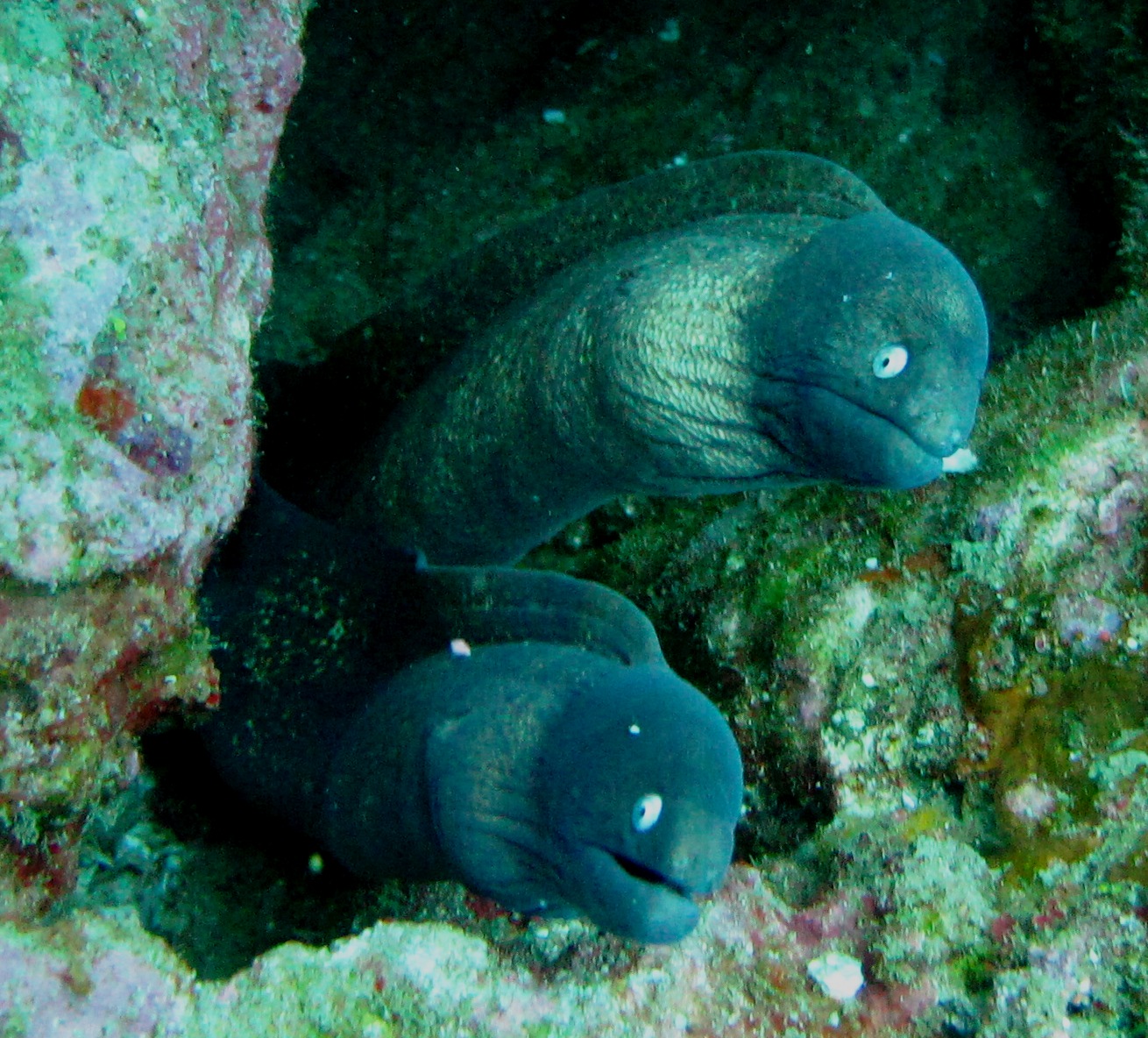
Within five feet, THAT is when I spotted the second head. In the video you can see that it suddenly appears from the other side of the first one. The first thing I notice about them is that they appear absolutely fearless of me. They don’t SEEM aggressive, but I can’t tell for sure. With no little trepidation I push the camera in on them closer and closer, until finally, with my arms extended as far as they’ll go, I have the camera body less than a foot away from the serpentining charmers.

These two fellows also do not come close to the size of the giant we spotted in the cave down below, but they are not small either. For the life of me I could have sworn that they were two very large and very long sock puppets, with the hands and arms of a very large man moving them about.

I can tell they are aware of me, but they do not always seem to care if I’m there or not. Sometimes they appear to get caught up in some kind of eel conversation between the two of them, and while caught up in it, they ignore me. It’s strange; it felt as if they accepted my presence as normal, as if they accepted ME, perhaps as a fellow sea creature.

I would have stayed there longer to just soak in their odd behavior, but there was still much area that we had not seen. You can’t see him in the video, but by the end of the clip Don was right there as well. He saw how engrossed I was and figured there must be something really interesting on the other end of my camera. I’d say he was right.

I did spend another minute taking nothing but still shots of my two enchanting sea serpents. I’ll include a few with this post. You might not agree, but I think the portraits of these dual morays are some of the best undersea shots I’ve ever taken.

After that dive I no longer referred to that area merely as “the wall,” from that time on I’ve been calling it “Moray Wall.”

Later onshore I was a bit bothered when as we excitedly discussed our discoveries with the tourist guy he exclaimed, “Wow, so why didn’t you catch it? It would have made a good meal!” I hope he was joking. I’d hate to see those incredible creatures’ lives ended just to fill some cooking pot. THAT would be a REAL shame.

Our dive was still far from over. Taking one last look over my shoulder at my two new eel pals, I waved so long and continued our exploration. It was time to check out some new territory.