When I eat mangoes I like them ripe, soft and juicy, where the flesh is yellow and more sugary than sugar. That is usually how they sell them in grocery stores. Unfortunately for me, that is not how the denizens of this house like them. No, they want them green, hard and tart.
Of all the people here, the primary mango picker of the house is my 12 year old, Jen-Jen. During the production period of my two particular trees—one an apple mango, the other an Indian mango—she’ll come and ask every couple of days or so for permission to pick a dozen or so. I always tell her, “Okay, go ahead. Just be careful.”
I used to ask her and the others to please let a few ripen up for me, but I don’t bother any more. They really seem to relish them green. I don’t get it. I guess they’re okay with salt; but to me, certainly not something to relish. I mean, I would only eat them like that if I had to, and so far, I’ve never had to. Why would I? I tried it a couple times like that but it just doesn’t suit my taste buds. I always ask them why would you want to eat sour mangoes when you can eat them sweet. Oh well, it’s what they like.
Watching the two of them work together to manipulate the long bamboo mango picker you have to admire Jen and Jon’s enthusiasm. Jen, being the stronger of the two, handles the picker; while her eleven year old cousin, Jon, acts as spotter, telling her which way to maneuver the basket end, with its leading edge shaped to strip the mangoes from the tree.
Of course, like many of the useful items in and around the house, my brother-in-law, Eddie, fabricated our two bamboo mango pickers as well. One is long and the other is REAL long. As the low hanging fruit become scarce, and then nonexistent, we find that only the REAL long picker will work to get the fruit that are left high and away.
The other day, enjoying the reduced heat of late afternoon, I puttered around a bit in the yard while taking in the sight and sounds of my mango picking “team” high in the trees above. It occurred to me to go in and grab the cam and take a video of the dynamic duo doing their thing more than 30 feet up in the air.
Without the tower we’d never be able to reach most of the mangoes; although I’d probably finally be able to have a ripe one or two for once. The tower’s stairs and platforms, along with the catwalks between the trees, allows us to reach all but a few of the much sought after fruit.
Aside from the facilitation of mango picking though, I enjoy the tower as a stationary getaway vehicle. In a matter of just a few seconds I’m in an entirely different world of rustling leaves and cooling breezes. Just being way up there in the trees, hidden from the world by the thick sheltering foliage while spying out on that same world through a screen of green, usually while sipping thoughtfully from a morning or evening coffee, or afternoon iced tea, makes life here not just bearable, but positively enjoyable and relaxing.
Showing posts with label yard. Show all posts
Showing posts with label yard. Show all posts
Tuesday, March 22, 2011


Friday, August 27, 2010
The fishpond & all the rest, the movie...
Now that the fishpond is complete I decided to make a quickie video to show it off as well as to show off the entire back area of our little City of Angels bungalow.
Divine and I are quite proud of what we’ve done with the place. When viewing the video keep in mind that what you see did not exist when we moved in back in December ’07. What is now our master bedroom back then was an outdoor utility shed completely separate from the house. It had a long sink, a small storage room and open windows all around. We filled in all the windows, converted the storage room into a small bathroom and the sink area into ceiling to floor closets.
The video starts off at the breezeway entrance to our bedroom. The reason for the curtain outside the door is to veil it off from the kitchen’s back entrance, which unfortunately directly faces the bedroom entryway. Due to this juxtaposition of doors we hung the curtain diagonally for privacy. I didn’t want to step out of the bedroom in my “all together” only to be seen by someone happening to be standing on the other side of the kitchen screen door. Not that I run around all that much in an indecent state, but I like being able to if I want to.
Notice also at the end of the breezeway the iron works gate and fence. That gate is the entrance to the equally secure covered side yard where the maid does wash and prepares food. We put in drainage, lots of clothesline, a long sink and extra power plugs. The side yard project was one of our first to get done in order to secure the back side of the house. Security is job one in this country, especially in this town.
 I provide a quick look at our bedroom. Its small, but I love it that way. We have everything we need in there; plenty of closet space, a bathroom, bookshelves, a comfortable recliner, and a computer and desk workspace where I now sit.
Next is the porch, the space that provides the reason that we don’t really need a sprawling master bedroom, gigantic master bedrooms being the norm in so many houses over here. I take it for granted now, but the porch is where I live. In that wonderful space I watch TV, read, eat our meals, entertain my foreigner friends, and just generally hang out. From there I can see the entire yard, the walk-in finch cage, the entrance to the tree tower staircase; and now that it’s complete, we can also see and “hear” the fishpond waterfall.
 Eddie is the reason that we have a mango tree growing up through the roof of the porch. Originally, when I first dreamed up the porch, I assumed that its dimensions would be limited by the tree; but not to someone like Eddie who immediately came up with the idea of incorporating the tree. As soon as he broached the idea I couldn’t imagine it any other way.
Keep in mind that in December of 2007 the back area seen in the video encompassing what is now the tower, fishpond and porch was dark, dank and dirty. A rusty broken down double swing sat where the porch now is; and a small four foot by four foot concrete pad surrounded by mud, where the fish tank in the porch is now, is where the previous occupants used to hand rinse their laundry. Other than the two mangos and one jack fruit tree there were no plants of any kind; the three fruit trees lower branches had evidently never been pruned and huge piles of leaves filled and spilled out of the back corner where the fishpond is now. An ugly concrete block fence encompassed the entire perimeter. It was VERY unattractive to say the least.
 Looking out into the grassy main yard from within the porch the grass looks green and lush. It was not like that before we worked on making it that way by building the poor soil up by spreading hundreds of buckets of rich compost that we produced ourselves. Every banana peel, tree leaf, apple core, chicken bone and grass clipping has gone into building some of the most amazing soil I’ve ever seen. Today, when I was digging into the oldest of our compost soil I saw earthworms as big as garter snakes. Those worms are “my boys.” They chew it all up, and from the back end, they spew it all out as dark rich castings. I love my worms.
 Moving past the bar and mango trunk looking into the side of the finch cage I could only spot a couple of the fifteen birds that live in there. I figured out why they were all hiding once I got up into the tower and saw a storm approaching. They always head for the dry safety of their nesting baskets when they smell precipitation coming. Smart birds those finches.
Stepping out the porch and into my flip-flops I head up the stairs of the tower, now in its second year of existence. Remember the view from the ground as we climb the tower from landing to landing. Not much is visible outside the walls of our little compound. To live in most houses in the Philippines is like this, a very claustroph obic walled in experience. That’s why I love my 46 foot tower where I always feel like I’m rising into an entirely different world as I climb its fifty plus steps.
Ascending higher and higher the breeze becomes apparent in the brisk movement of the long mango leaves. Looking down provides a unique and interesting view of the yard, garden and pond. After two years the three trees have tended to envelope the tower; constant pruning is necessary to keep them at bay. A bright umbrella is seen in the front side of the yard where my nephew squats in its shade as he clips the grass.
Directly to our rear is the house of a Brit whom I have yet to meet even though he and his girlfriend have been there for months now. She told Divine that he is interested in climbing the tower; I told her to tell him to come over any time. Evidently he lives less than half the time in country; mostly he lives back where he’s from I guess.
 The third landing is where the entrance to the primary catwalk begins. The sturdy walkway securely allows anyone to climb into the mango tree coming from within the porch and then zigzags down into the jackfruit tree. It feels so safe that it’s easy to forget that the height where it ends at the jackfruit is more than 15 feet up.
Arriving back at the landing I stop and make a comment about the loud music coming from a neighbor’s house, the culprit being a maid doing some outdoor chore. Typically people will open the windows and crank the stereo full blast so they can hear it outside. Maids are notorious for doing it here, but they aren’t the only ones.
Climbing the final two flights the viewer sees on the right the hugely blocky Robinson’s Department Store where we usually go to see movie s; to the left of that in the far distance is Mt. Arayat, what’s left of an ancient long dead volcano. A beautiful blue sky and rainless white clouds frame the picturesque old mountain. The camera spins all the way around to the west and entirely different sky can be seen. A line of
  dark storm clouds is well on the way. Until getting up there I had no idea. If not for the ominous line of approaching weather the Zambales Mountains would be visible in that direction.
On the way back down we take a short stop at the second floor landing and step onto the smaller catwalk for a look at the fishpond from directly above it. Back on the ground the camera pans back to the west and notice that only a hint of the approaching weather is visible.
The grass is spare at the spot where my workers all walked, trampling my beloved grass into near oblivion. After a light sprinkling of fertilizer and compost material, that stressed out piece of yard is beginning to regain its former greenness.
The area containing the tower, garden and pond is super tiny. To disguise its miniature dimensions I broke it up with three mounds of thick lush greenery in the form of rock gardens. Walkways winding between these features further give the feeling of more space than what actually exists.
The waterfall rock wall looks amazing in the video. Using the reinforced concrete support posts as a means to display foliage and vines, in effect framing it with plants, was a stroke of visual genius, even if I do say so myself.
 To the rear of the falls is the original high side walkway that once provided access to the top of the now nonexistent rock garden feature that was replaced by the pond. That walkway is still there but now it’s the rear rampart providing access behind the waterfall wall. Eddie put up some sturdy bamboo rails, and if you look closely you can see that he wrapped traditional handmade Abacá rope around all the bamboo joints. This unique rope woven from the strands of fibers of the Abacá plant, from the banana family, provides extra strength and beauty. Directly under the bamboo handrail central to the rock wall can be seen the waterworks and control valves.
 I made a point of aiming the camera from directly above looking down the face of the waterfall rock wall. I must say it looks amazing. (There I go again!) Again, the view outside the immediate area within the garden and trees is occluded just enough to fool the eyes and mind into thinking the surrounding space is much larger than it is. Success! That is exactly the impression that we strove to achieve.
Divine bought seven of the floating water plants that she was told at the store are called Lotus. Now I’ve looked at images of L otus and not one resembles this plant. It’s a very beautiful floating plant that to me looks like a cross between a rose flower and a cabbage. If anyone knows what it is PLEASE clue me in. It’s driving me nuts not being able to identify it.
So that’s our own little bit of self made heaven. If it’s not paradise then it’s the next best thing. I hope you enjoyed taking a look at it.
Divine and I are quite proud of what we’ve done with the place. When viewing the video keep in mind that what you see did not exist when we moved in back in December ’07. What is now our master bedroom back then was an outdoor utility shed completely separate from the house. It had a long sink, a small storage room and open windows all around. We filled in all the windows, converted the storage room into a small bathroom and the sink area into ceiling to floor closets.
The video starts off at the breezeway entrance to our bedroom. The reason for the curtain outside the door is to veil it off from the kitchen’s back entrance, which unfortunately directly faces the bedroom entryway.
 Due to this juxtaposition of doors we hung the curtain diagonally for privacy. I didn’t want to step out of the bedroom in my “all together” only to be seen by someone happening to be standing on the other side of the kitchen screen door. Not that I run around all that much in an indecent state, but I like being able to if I want to.
Notice also at the end of the breezeway the iron works gate and fence. That gate is the entrance to the equally secure covered side yard where the maid does wash and prepares food. We put in drainage, lots of clothesline, a long sink and extra power plugs. The side yard project was one of our first to get done in order to secure the back side of the house. Security is job one in this country, especially in this town.
 I provide a quick look at our bedroom. Its small, but I love it that way. We have everything we need in there; plenty of closet space, a bathroom, bookshelves, a comfortable recliner, and a computer and desk workspace where I now sit.
Next is the porch, the space that provides the reason that we don’t really need a sprawling master bedroom, gigantic master bedrooms being the norm in so many houses over here. I take it for granted now, but the porch is where I live. In that wonderful space I watch TV, read, eat our meals, entertain my foreigner friends, and just generally hang out. From there I can see the entire yard, the walk-in finch cage, the entrance to the tree tower staircase; and now that it’s complete, we can also see and “hear” the fishpond waterfall.
 Eddie is the reason that we have a mango tree growing up through the roof of the porch. Originally, when I first dreamed up the porch, I assumed that its dimensions would be limited by the tree; but not to someone like Eddie who immediately came up with the idea of incorporating the tree. As soon as he broached the idea I couldn’t imagine it any other way.
Keep in mind that in December of 2007 the back area seen in the video encompassing what is now the tower, fishpond and porch was dark, dank and dirty. A rusty broken down double swing sat where the porch now is; and a small four foot by four foot concrete pad surrounded by mud, where the fish tank in the porch is now, is where the previous occupants used to hand rinse their laundry. Other than the two mangos and one jack fruit tree there were no plants of any kind; the three fruit trees lower branches had evidently never been pruned and huge piles of leaves filled and spilled out of the back corner where the fishpond is now. An ugly concrete block fence encompassed the entire perimeter. It was VERY unattractive to say the least.
 Looking out into the grassy main yard from within the porch the grass looks green and lush. It was not like that before we worked on making it that way by building the poor soil up by spreading hundreds of buckets of rich compost that we produced ourselves. Every banana peel, tree leaf, apple core, chicken bone and grass clipping has gone into building some of the most amazing soil I’ve ever seen. Today, when I was digging into the oldest of our compost soil I saw earthworms as big as garter snakes. Those worms are “my boys.” They chew it all up, and from the back end, they spew it all out as dark rich castings. I love my worms.
 Moving past the bar and mango trunk looking into the side of the finch cage I could only spot a couple of the fifteen birds that live in there. I figured out why they were all hiding once I got up into the tower and saw a storm approaching. They always head for the dry safety of their nesting baskets when they smell precipitation coming. Smart birds those finches.
Stepping out the porch and into my flip-flops I head up the stairs of the tower, now in its second year of existence. Remember the view from the ground as we climb the tower from landing to landing. Not much is visible outside the walls of our little compound. To live in most houses in the Philippines is like this, a very claustroph
 obic walled in experience. That’s why I love my 46 foot tower where I always feel like I’m rising into an entirely different world as I climb its fifty plus steps.
Ascending higher and higher the breeze becomes apparent in the brisk movement of the long mango leaves. Looking down provides a unique and interesting view of the yard, garden and pond. After two years the three trees have tended to envelope the tower; constant pruning is necessary to keep them at bay. A bright umbrella is seen in the front side of the yard where my nephew squats in its shade as he clips the grass.
Directly to our rear is the house of a Brit whom I have yet to meet even though he and his girlfriend have been there for months now. She told Divine that he is interested in climbing the tower; I told her to tell him to come over any time. Evidently he lives less than half the time in country; mostly he lives back where he’s from I guess.
 The third landing is where the entrance to the primary catwalk begins. The sturdy walkway securely allows anyone to climb into the mango tree coming from within the porch and then zigzags down into the jackfruit tree. It feels so safe that it’s easy to forget that the height where it ends at the jackfruit is more than 15 feet up.
Arriving back at the landing I stop and make a comment about the loud music coming from a neighbor’s house, the culprit being a maid doing some outdoor chore. Typically people
 will open the windows and crank the stereo full blast so they can hear it outside. Maids are notorious for doing it here, but they aren’t the only ones.
Climbing the final two flights the viewer sees on the right the hugely blocky Robinson’s Department Store where we usually go to see movie
 s; to the left of that in the far distance is Mt. Arayat, what’s left of an ancient long dead volcano. A beautiful blue sky and rainless white clouds frame the picturesque old mountain. The camera spins all the way around to the west and entirely different sky can be seen. A line of
  dark storm clouds is well on the way. Until getting up there I had no idea. If not for the ominous line of approaching weather the Zambales Mountains would be visible in that direction.
On the way back down we take a short stop at the second floor landing and step onto the smaller catwalk for a look at the fishpond from directly above it.
 Back on the ground the camera pans back to the west and notice that only a hint of the approaching weather is visible.
The grass is spare at the spot where my workers all walked, trampling my beloved grass into near oblivion. After a light sprinkling of fertilizer and compost material, that stressed out piece of yard is beginning to regain its former greenness.
The area containing the tower, garden and pond is super tiny. To disguise its miniature dimensions I broke it up with three mounds of thick lush greenery in the form of rock gardens. Walkways winding between these features further give the feeling of more space than what actually exists.
The waterfall rock wall looks amazing in the video. Using the reinforced concrete support posts as a means to display foliage and vines, in effect framing it with plants, was a stroke of visual genius, even if I do say so myself.
 To the rear of the falls is the original high side walkway that once provided access to the top of the now nonexistent rock garden feature that was replaced by the pond. That walkway is still there but now it’s the rear rampart providing access behind the waterfall wall. Eddie put up some sturdy bamboo rails, and if you look closely you can see that he wrapped traditional handmade Abacá rope around all the bamboo joints. This unique rope woven from the strands of fibers of the Abacá plant, from the banana family, provides extra strength and beauty. Directly under the bamboo handrail central to the rock wall can be seen the waterworks and control valves.
 I made a point of aiming the camera from directly above looking down the face of the waterfall rock wall. I must say it looks amazing. (There I go again!) Again, the view outside the immediate area within the garden and trees is occluded just enough to fool the eyes and mind into thinking the surrounding space is much larger than it is. Success! That is exactly the impression that we strove to achieve.
Divine bought seven of the floating water plants that she was told at the store are called Lotus. Now I’ve looked at images of L
 otus and not one resembles this plant. It’s a very beautiful floating plant that to me looks like a cross between a rose flower and a cabbage. If anyone knows what it is PLEASE clue me in. It’s driving me nuts not being able to identify it.
So that’s our own little bit of self made heaven. If it’s not paradise then it’s the next best thing. I hope you enjoyed taking a look at it.
Saturday, October 10, 2009
Pothos, I Hardly Knew You

Last year when I had landscaped the area under my newly built tower and equally towering fruit trees to the point that it was ready for planting, I sent Divine out to do some shopping at the local nurseries. Of the 20 or so types of plants she came back with, four were types of vines. I liked her choices thinking that the different colored runners would look great crawling through the recently placed stones of my rock garden. I was right; among the stones, the natural mix of plants is living art.
It turns out that three of these ivy-like plants that Divine bought are different kinds of Pothos. I’ve seen these viney plants all over the world, used as house and office plants, but never worried about what they are called. I am ashamed to admit it, and me a self-styled lover of all things in nature. Why had I never heard its name before?
Even though I wasn’t familiar with what they are called, it was fairly easy to find and identify it on the net. I typed “tropical houseplants” into the search engine and there it was on the first page of possibles.
‘Ah, Pothos, so that’s what it’s called!’
What a strange name; it definitely doesn’t roll naturally off the tongue, at least not off mine. I keep tending to call it Porthos; which would be pretty cool, naming a plant after one of The Three Musketeers. I guess I could break it down into Pot-hos, which said out loud phonetically sounds like the plural of a trampy pot. Weird how my mind works.
I planted all the vines Divine brought home in the shadiest part of the new garden, figuring they wouldn’t do well in direct sunlight. I’m sure the fact that they don’t prefer full sun is why you see these plants all over the world in
 every mall you’ve ever visited and on display in so many doctors’ offices.
The vines flourished in their new home among the shady rocks beneath my thickly leafed mango trees. In no time my many Pothos plants began to sprawl out of the confines of the small rock garden. One particular vine pushed its way beneath the bench against the wall upon which the bench rested, although I didn’t really pay much attention to the wayward tendril until it popped up above the bench back. It was neat how its roots attached to the painted concrete blocks and then, as the Pothos pressed ever upwards, its roots continued to attach themselves tightly to the decorative painted bamboo above the blocks.
The roots don’t seem to care what it is they find themselves up against. As the vine sprouts outward into the world, the brown worm-like roots attach themselves to whatever it is they happen to touch up on, and so tightly that it seems as if they have glued themselves onto that host surface. Once Pothos has tacked itself to something it ain’t coming off; it actually seems to become chemically part of the surface to which it is attached.
I can’t believe I’m devoting an entire post to this plant, but the more I watch it in my garden the more fascinating I find it to be. It’s next amazing feature after its efficient roots are its prolific leaves. They aren’t all that amazing as they grow in a potted plot in your grandma’s living room, but the leaves of the Pothos plants become truly extraordinary once it begins to grow upwards on a tree or up a wall, for once the plant starts to climb, each successive leaf grows larger than the one beneath it.

The Pothos growing up the wall behind the garden bench is now about 8 feet up, and incredibly, its top leaves are almost a foot wide. When I first noticed the size of the uppermost leaves on that plant I thought I was witnessing some kind of natural miracle. I had never seen any similar plant with such elephantine leaves. Why were they doing that? I had to find out why they were growing so large and how much larger could they possibly get? And so, I looked up this otherwise ordinary plant on the internet to learn that it is called Pothos and to find out its secrets.
Researching the plant I was amazed to learn that in the tropics it can grow upwards into trees to the height of 65 feet. Even more amazing is that the leaves on a mature climbing Pothos can actually grow three feet across! None of that would have seemed even remotely possible until I had the opportunity to see my own Pothos plants now in action. None have climbed that high nor have any of the leaves reached those yard wide proportions, but at least now I know of their exciting potential.
I also have several Pothos plants growing outside in hanging planters and their vines seem quite content to grow downwards with some vines as long as 20 feet so far. The interesting thing is that none of these potted Pothos vines seem to have the least inclination to grow upwards when they come i
 n contact with a wall. It seems that only those plants that grow rooted in the ground will send their vines upwards into trees and up walls. I really do not understand why this would be. Nature can be so quirky at times, but those miraculous eccentricities are much of the attraction for me.
Another curiosity is that the Pothos leaves stay small and ordinary as the plant travels outward along the ground. It’s only after it grows upwards that its roots begin to activate by attaching themselves deeply into the vertical surface, growing deeply and quite snuggly into that material. The same is true of the leaves; it is not until the vines begin grow upward attaching to some kind of surface, that its leaves become robust and start to reach their full potential in size and thickness. To compare, I have another different type of tree climbing vine that sends out super long reddish tendril like roots all the way down to the ground; unlike the Pothos vines though its leaves do not increase in size as they grow upwards into the tree.
I’ve already trained several Pothos plants to start growing up the massive trunk of my outdoor mango tree using u shaped staple nails to hold them in place on the tree to get them started on their journey upward. So far they are doing wonderfully and seem to love their new home growing up the side of the tree.
Seeing how beautiful those tree growing Pothos have become, Divine and I were inspired to transplant a half dozen Pothos “babies” to the base of our “indoor” mango tree by using the end cutting technique. It’s been about a month so far and the six little vines are just now beginning to send out their first new leaves. I can’t wait to see if they will thrive as well as their outdoor
 tree climbing counterparts.
As far as I’m concerned, Pothos has become my new favorite plant. Pothos is king.
Saturday, June 27, 2009
My Jackfruit Tree
Boys and Girls, today’s subject is my jackfruit tree. Maybe I’ll just do a quick pictorial on it, or that’s my intention as I sta rt this. Let’s see how it goes.
There is a strange fruit over here, at least I thought so the first time I saw it back in the 1980s. The locals call it langka—I just call it jackfruit. We have a nice sized tree in our yard that does a pretty good job of producing these gigantic “berries.” I call them berries because the jackfruit sort of resembles humongous mulberries with their similar segmented outer texturing, and according to Wikipedia the jackfruit really is related to the tasty much smaller mulberry. I think they must be related the same way lawn grass is related to 12 foot corn plants.
The first time I saw fully developed jackfruit hanging from a branch high overhead I thought initially that they weren’t real, like some weird natural hoax. I could not believe that anything that big could possibly grow from a tree. Imagine finding a 50 pound Macintosh dangling from an apple tree; of course, it’s not possible.
L ast year we had 15 or 20 of these berry behemoths suspended overhead on our jackfruit tree, but were unable to taste even a single one of them. I was disappointed; I love eating jackfruit in my halo halo, a Filipino treat made with concentrated milk, shaved ice and a “mix mix” of various confections like colorful gelatins, syrupy fruit and sweet beans. Yummy.
A big problem with growing these tasty jackfruit giants is their propensity to rot before they attain full ripeness. We touched on this very subject one day when my electrician buddy stopped by. Sitting at the porch table with drinks in hand looking up at my tree loaded with a score of huge rotting fruit, he told me the secret is to keep them covered with plastic bags from the time the jackfruit are still unblemished.
According to him, what starts the fruit rotting are bats from where they nibble at them during the night. He says once the skin is opened by the bats it allows bugs and bacteria to do their nasty business. I don’t know; maybe he’s right. I know there certainly are a lot of bats swooping and looping around but I don’t think any of them are fruit eaters. The way they fly, making impossible turns in the air; it appears they are going after insects. I don’t think insect eating bats also eat fruit. Maybe I’m wrong.
My doubts concerning the bats notwithstanding I had Divine’s high climbing nephew, the fearless “Ungoy,” go up in the tree and cover with plastic bags as many of the jackfruit he could safely reach. Ever concerned with aesthetics, I had him first paint all the bags a dark green; otherwise it w ould look like I had trash hanging off my tree. I’m a stickler about stuff like that.
Surprisingly, one jackfruit actually sprouted out near the base of the tree about two feet from the ground—strange place for a fruit to grow. That one was easy to cover, although I had Ungoy go ahead and do it along with the rest.
After awhile I mostly forgot about my plastic covered fruit, but every so often I’d inspect them for progress. After a few weeks I noticed that the bags had started to bulge as the jackfruit began to expand in them. They looked like when you blow into a plastic bag just before popping it in your sister’s unsuspecting ear.
I kept asking when they would be ripe enough to try, but I kept getting a “Hindi pa” from them—Not yet. I continued to ask, and more frequently as I became concerned while observing that the unprotected jackfruit, ballooning to the size of oversized loaves of bread, turned brown, starting in certain spots initially, and then with time, those rotten spots joined into a single overall disgusting black putridity.
The fact that these gigantic fruit are hovering precariously over your head can be disconcerting if you think to look up and see them up there. As I said, they can get up to 30 or 40 pounds, so if you are unlucky enough to be under one when it happens to fall, you are likely to come away with at least a minor concussion.

This year we were indeed fortunate enough to be able to eat at least a half dozen of my jacks. I don’t know why, but not all shielded inside the plastic came through unspoiled. It seems these giant fruit with their seemingly tough skin are quite vulnerable to a number of insects and bacteria.
One of the last of the rotten ones fell today. I’m always pleased not to have been in the landing zone when it happens. Cradled in your arms, with their astounding girth and weight, they feel like a rigid limbless body. In si ze, the only other comparable fruit or vegetable I can think of are super pumpkins and jumbo watermelons. Both those big babies can also get so large that they must be cradled in both arms to carry them; then again, both also grow resting on the ground, where large fruits and veggies are SUPPOSED to grow when they intend to reach massive proportions.
One of the largest of the jacks that we were able to successfully grow to consumable maturity was the one that sprouted near the ground. We cut it free just yesterday in fact. It’s the one in Divine’s arms in the pic below. I asked her to pose with it for about 4 shots; by the last one her back and knees began to give out. It probably weighed 35 pounds or so. Wikipedia says they can get up to 80 pounds. No way! I just can’t imagine that.
.JPG)
Still on the subject of size, the stems attaching the jackfruit to the tree are correspondingly thick and branchlike. These branches carrying the ful weight of the fruit are also necessarily very flexible. Check out the photos—you can see that they are under enormous pressure appearing like ropey rubber bands bending to their limit under the strain of the fruit’s weight. Like I said, I’ve never seen anything like it.
One night during a storm, several of the super-large extremely rotten ones splattered with a thud onto the lawn below. Once again, the comparison to a body comes to mind; in this case, to a decomposing cadaver. Huge blow flies, the kind that go after decaying meat began to swarm aboard the nasty wet mess. The smell at that early point is a combination of rot and sweet. Ugh. The decomp juice, as they call it sometimes on the CSI shows, is so harsh that any spot on the yard soaked with it for more than a few minutes dies out for several weeks. I wasted no time composting the rancid fruit flesh underground with all the other yard waste from that day. A week later I happened to dig back into the same area—big mistake—there was no longer even a hint of a sweet aroma, now it smelled exactly like a rotting animal, complete with wriggling maggots and worms.
Contrast that bit of graphic revoltingness to the perfectly ripened jackfruit we harvested yeste.JPG) rday. I was going to say pick, but that word simply doesn’t apply. I had to use the extra sharp pruning clippers to cut the thick tough stem. Even then it didn’t come off easy.
rday. I was going to say pick, but that word simply doesn’t apply. I had to use the extra sharp pruning clippers to cut the thick tough stem. Even then it didn’t come off easy.
For the photo-opp Divine brought out the largest knife in the kitchen. Watching her through the camera lens I can say in no way is cutting through a jackfruit like cutting through an equally large watermelon or pumpkin. I’ll use the same.JPG) comparison as before; jackfruit “flesh” is dense and as resistant to a knife blade as is raw muscle tissue. She really had to work at cutting through the center of that fruit “body.”
comparison as before; jackfruit “flesh” is dense and as resistant to a knife blade as is raw muscle tissue. She really had to work at cutting through the center of that fruit “body.”
Before it can be eaten, the yellowish inner fruit has be simmered into a softened condition, again, much like meat has to be cooked before the tissue can be successfully masticated and consumed. Folks here love the stuff. I like it as well, but pretty much only served in halo-halo, the sweet treat I described earlier.
This hou sehold eats the stuff up almost as fast as it can be prepared. Still, that last big one provided enough of the sweet gooey stuff to fill several jars. Of course, they are emptying fast, as expected. In fact, I just had a big glass of halo-halo myself which, of course, included a big old dollop of jackfruit. Delicious!
This was supposed to be a quickie pictorial, but as usual, I had more to write about than I thought I would. My apologies.
And speaking of pictorial, click here to view the full flickr slideshow of My Jackfruit Tree.
 rt this. Let’s see how it goes.
There is a strange fruit over here, at least I thought so the first time I saw it back in the 1980s. The locals call it langka—I just call it jackfruit. We have a nice sized tree in our yard that does a pretty good job of producing these gigantic “berries.” I call them berries because the jackfruit sort of resembles humongous mulberries with their similar segmented outer texturing, and according to Wikipedia the jackfruit really is related to the tasty much smaller mulberry. I think they must be related the same way lawn grass is related to 12 foot corn plants.
The first time I saw fully developed jackfruit hanging from a branch high overhead I thought initially that they weren’t real, like some weird natural hoax. I could not believe that anything that big could possibly grow from a tree. Imagine finding a 50 pound Macintosh dangling from an apple tree; of course, it’s not possible.
L
 ast year we had 15 or 20 of these berry behemoths suspended overhead on our jackfruit tree, but were unable to taste even a single one of them. I was disappointed; I love eating jackfruit in my halo halo, a Filipino treat made with concentrated milk, shaved ice and a “mix mix” of various confections like colorful gelatins, syrupy fruit and sweet beans. Yummy.
A big problem with growing these tasty jackfruit giants is their propensity to rot before they attain full ripeness. We touched on this very subject one day when my electrician buddy stopped by. Sitting at the porch table with drinks in hand looking up at my tree loaded with a score of huge rotting fruit, he told me the secret is to keep them covered with plastic bags from the time the jackfruit are still unblemished.
According to him, what starts the fruit rotting are bats from where they nibble at them during the night. He
 says once the skin is opened by the bats it allows bugs and bacteria to do their nasty business. I don’t know; maybe he’s right. I know there certainly are a lot of bats swooping and looping around but I don’t think any of them are fruit eaters. The way they fly, making impossible turns in the air; it appears they are going after insects. I don’t think insect eating bats also eat fruit. Maybe I’m wrong.
My doubts concerning the bats notwithstanding I had Divine’s high climbing nephew, the fearless “Ungoy,” go up in the tree and cover with plastic bags as many of the jackfruit he could safely reach. Ever concerned with aesthetics, I had him first paint all the bags a dark green; otherwise it w
 ould look like I had trash hanging off my tree. I’m a stickler about stuff like that.
Surprisingly, one jackfruit actually sprouted out near the base of the tree about two feet from the ground—strange place for a fruit to grow. That one was easy to cover, although I had Ungoy go ahead and do it along with the rest.
After awhile I mostly forgot about my plastic covered fruit, but every so often I’d inspect them for progress. After a few weeks I noticed that the bags had started to bulge as the jackfruit began to expand in them. They looked like when you blow into a plastic bag just before popping it in your sister’s unsuspecting ear.
I kept asking when they would be ripe enough to
 try, but I kept getting a “Hindi pa” from them—Not yet. I continued to ask, and more frequently as I became concerned while observing that the unprotected jackfruit, ballooning to the size of oversized loaves of bread, turned brown, starting in certain spots initially, and then with time, those rotten spots joined into a single overall disgusting black putridity.
The fact that these gigantic fruit are hovering precariously over your head can be disconcerting if you think to look up and see them up there. As I said, they can get up to 30 or 40 pounds, so if you are unlucky enough to be under one when it happens to fall, you are likely to come away with at least a minor concussion.

This year we were indeed fortunate enough to be able to eat at least a half dozen of my jacks. I don’t know why, but not all shielded inside the plastic came through unspoiled. It seems these giant fruit with their seemingly tough skin are quite vulnerable to a number of insects and bacteria.
One of the last of the rotten ones fell today. I’m always pleased not to have been in the landing zone when it happens. Cradled in your arms, with their astounding girth and weight, they feel like a rigid limbless body. In si
 ze, the only other comparable fruit or vegetable I can think of are super pumpkins and jumbo watermelons. Both those big babies can also get so large that they must be cradled in both arms to carry them; then again, both also grow resting on the ground, where large fruits and veggies are SUPPOSED to grow when they intend to reach massive proportions.
One of the largest of the jacks that we were able to successfully grow to consumable maturity was the one that sprouted near the ground. We cut it free just yesterday in fact. It’s the one in Divine’s arms in the pic below. I asked her to pose with it for about 4 shots; by the last one her back and knees began to give out. It probably weighed 35 pounds or so. Wikipedia says they can get up to 80 pounds. No way! I just can’t imagine that.
.JPG)
Still on the subject of size, the stems attaching the jackfruit to the tree are correspondingly thick and branchlike. These branches carrying the ful weight of the fruit are also necessarily very flexible. Check out the photos—you can see that they are under enormous pressure appearing like ropey rubber bands bending to their limit under the strain of the fruit’s weight. Like I said, I’ve never seen anything like it.
One night during a storm, several of the super-large extremely rotten ones splattered with a thud onto the lawn below. Once again, the comparison to a body comes to mind; in this case, to a decomposing cadaver. Huge blow flies, the kind that go after decaying meat began to swarm
 aboard the nasty wet mess. The smell at that early point is a combination of rot and sweet. Ugh. The decomp juice, as they call it sometimes on the CSI shows, is so harsh that any spot on the yard soaked with it for more than a few minutes dies out for several weeks. I wasted no time composting the rancid fruit flesh underground with all the other yard waste from that day. A week later I happened to dig back into the same area—big mistake—there was no longer even a hint of a sweet aroma, now it smelled exactly like a rotting animal, complete with wriggling maggots and worms.
Contrast that bit of graphic revoltingness to the perfectly ripened jackfruit we harvested yeste
.JPG) rday. I was going to say pick, but that word simply doesn’t apply. I had to use the extra sharp pruning clippers to cut the thick tough stem. Even then it didn’t come off easy.
rday. I was going to say pick, but that word simply doesn’t apply. I had to use the extra sharp pruning clippers to cut the thick tough stem. Even then it didn’t come off easy.For the photo-opp Divine brought out the largest knife in the kitchen. Watching her through the camera lens I can say in no way is cutting through a jackfruit like cutting through an equally large watermelon or pumpkin. I’ll use the same
.JPG) comparison as before; jackfruit “flesh” is dense and as resistant to a knife blade as is raw muscle tissue. She really had to work at cutting through the center of that fruit “body.”
comparison as before; jackfruit “flesh” is dense and as resistant to a knife blade as is raw muscle tissue. She really had to work at cutting through the center of that fruit “body.”Before it can be eaten, the yellowish inner fruit has be simmered into a softened condition, again, much like meat has to be cooked before the tissue can be successfully masticated and consumed. Folks here love the stuff. I like it as well, but pretty much only served in halo-halo, the sweet treat I described earlier.
This hou
 sehold eats the stuff up almost as fast as it can be prepared. Still, that last big one provided enough of the sweet gooey stuff to fill several jars. Of course, they are emptying fast, as expected. In fact, I just had a big glass of halo-halo myself which, of course, included a big old dollop of jackfruit. Delicious!
This was supposed to be a quickie pictorial, but as usual, I had more to write about than I thought I would. My apologies.
And speaking of pictorial, click here to view the full flickr slideshow of My Jackfruit Tree.
Friday, June 12, 2009
Yellow Cosmos, My Happy Accident, a Little Gift from God

I am the kind of amateur naturalist that always looks for sights never seen by me before. Mother Nature feely hands me these little gifts every day or two, and she does so all on my little postage stamp of a yard.
Because of these natural gifts from “Mom Nature” I’m in the habit of carrying my digital camera around with me specifically for those just-in-case moments. I want to be ready to "snap away" with my trusty digi-cam as I search in my daily yard strolls for what I now refer to as “God’s happy little accidents.”

Because of these natural gifts from “Mom Nature” I’m in the habit of carrying my digital camera around with me specifically for those just-in-case moments. I want to be ready to "snap away" with my trusty digi-cam as I search in my daily yard strolls for what I now refer to as “God’s happy little accidents.”
For instance, I spotted a tiny plant sprouting at the base of one of my rock garden features. From the look of the infant pinnate leaf foliage my first impression was that it was a baby version of a plant that I used to call ragweed, although what I thought of as ragweed is not what is displayed as such in Wikipedia. As a kid in Michigan I’d pulled many of these marigold-like plants over the course of my thousands of hours weeding gardens and lawn areas on the grounds of our acre or so of ex-farmland.
Like I do with most wild plants that find a way to sprout on the property I live on here, I opted not to pull this little sprout with fern-like leaves. For one thing I wasn’t sure if it actually was that plant that I knew as ragweed since back home they don’t exist singly like this one; in Michigan and throughout the US they come up by the scores and even by the thousands resembling a drably weedy version of marigold. The fact that this one was solitary intrigued me. I left it alone and even placed two stones around it to keep the maid from stepping on it.
‘Let’s see what it grows up to be.’
.jpg)
Over the next week or two it developed a more complicated system of foliage and I realized that rather than ragweed it now reminded me more of a daisy. By comparison, ragweed greenery is thicker than and not as shiny as what I was seeing on this more delicate plant. I began to assume that it actually was some kind of daisy, probably from a seed dropped off serendipitously in that spot by a bird or a by the wind—like I said, another “happy accident.”
My expectation grew at the appearance of a flower bud. What color would it be? How large the blossom? (. . .What a nerd I am, eh?)
Finally, I came home one afternoon and there it was, and it was fantastic. It was yellow, but not a pure yellow, more of a burnt yellow, like an oil paint yellow with a hint of brown mixed smoothly in. Chance placed it in a fairly shadowy area where the yellow flower heads seem to pop like tiny visual detonations. The eye is drawn to them from all the way across the yard.
I went online to try to identify it. After searching through a half dozen web images of “yellow flowers” I discovered one in flickr titled “yellow cosmos.” From the aspect of the photo it seemed similar to my flower. I followed up in Wikipedia and confirmed it. Indeed, my flower is of the genus of plants called Cosmos.
.jpg)
Cosmos—what a perfect name for this yellow blossoming plant! Supposedly, it originates in the Americas, although I also see references that it grows throughout the Asian tropics, including Malaysia and Thailand. Certain types of cosmos are even used as an herb.
I still don’t know if cosmos grows in the wild here, or if mine happens to have been blown in or dropped off by a bird from a neighbor’s yard. R egardless, I’m now collecting it's seeds and drying them to try to further propagate it. My one spindly plant is tending to droop and lay down; so I’m thinking that they grow better in a bed. I’ll have to see how that goes.
Isn’t the internet awesome? It definitely makes me realize how much I do not know. Truthfully, I had never heard of cosmos before. . . . So much to learn—so little time. Sigh. . .
 plants over the course of my thousands of hours weeding gardens and lawn areas on the grounds of our acre or so of ex-farmland.
Like I do with most wild plants that find a way to sprout on the property I live on here, I opted not to pull this little sprout with fern-like leaves. For one thing I wasn’t sure if it actually was that plant that I knew as ragweed since back home they don’t exist singly like this one; in Michigan and throughout the US they come up by the scores and even by the thousands resembling a drably weedy version of marigold. The fact that this one was solitary intrigued me. I left it alone and even placed two stones around it to keep the maid from stepping on it.
‘Let’s see what it grows up to be.’
.jpg)
Over the next week or two it developed a more complicated system of foliage and I realized that rather than ragweed it now reminded me more of a daisy. By comparison, ragweed greenery is thicker than and not as shiny as what I was seeing on this more delicate plant. I began to assume that it actually was some kind of daisy, probably from a seed dropped off serendipitously in that spot by a bird or a by the wind—like I said, another “happy accident.”
My expectation grew at the appearance of a flower bud. What color would it be? How large the blossom? (. . .What a nerd I am, eh?)
Finally, I came home one afternoon and there it was, and it was fantastic. It was yellow, but not a pure yellow, more of a burnt yellow, like an oil paint yellow with a hint of
 brown mixed smoothly in. Chance placed it in a fairly shadowy area where the yellow flower heads seem to pop like tiny visual detonations. The eye is drawn to them from all the way across the yard.
I went online to try to identify it. After searching through a half dozen web images of “yellow flowers” I discovered one in flickr titled “yellow cosmos.” From the aspect of the photo it seemed similar to my flower. I followed up in Wikipedia and confirmed it. Indeed, my flower is of the genus of plants called Cosmos.
.jpg)
Cosmos—what a perfect name for this yellow blossoming plant! Supposedly, it originates in the Americas, although I also see references that it grows throughout the Asian tropics, including Malaysia and Thailand. Certain types of cosmos are even used as an herb.
I still don’t know if cosmos grows in the wild here, or if mine happens to have been blown in or dropped off by a bird from a neighbor’s yard. R
 egardless, I’m now collecting it's seeds and drying them to try to further propagate it. My one spindly plant is tending to droop and lay down; so I’m thinking that they grow better in a bed. I’ll have to see how that goes.
Isn’t the internet awesome? It definitely makes me realize how much I do not know. Truthfully, I had never heard of cosmos before. . . . So much to learn—so little time. Sigh. . .
Tuesday, January 20, 2009
First Papaya
Since I was four and cultivated a bean sprout from a seed, I have loved the miracle that is plants. And not just flowers and vegetables, but all plants; whether trees, weeds, or wild flowers, I’m fascinated by them all.
When I travel to new places, usually, the first thing I notice are the trees and flowers, after that, maybe the architecture, and way after that, perhaps the people. (I'm not a people person). If I see something green and growing that I’ve never seen before, I definitely take note, and probably a picture if I have a camera; I can’t help myself.
My first time in the tropics to Equatorial West Africa over three decades ago, one of the first things I remember noticing there were the crazy looking papayas with their long straight stalks and crowns of foliage at the top. Now THAT is one unique plant to someone who has mostly lived in temperate zones, as I always had up to that time.
When I travel to new places, usually, the first thing I notice are the trees and flowers, after that, maybe the architecture, and way after that, perhaps the people. (I'm not a people person). If I see something green and growing that I’ve never seen before, I definitely take note, and probably a picture if I have a camera; I can’t help myself.
My first time in the tropics to Equatorial West Africa over three decades ago, one of the first things I remember noticing there were the crazy looking papayas with their long straight stalks and crowns of foliage at the top. Now THAT is one unique plant to someone who has mostly lived in temperate zones, as I always had up to that time.
 Look carefully at the base of the wall in the above photo. Those are my papayas from last March.
The papaya is common, it’s everywhere you look in this country, but MAN, to me, it is SO cool. From my experience I can’t even think of another single plant to compare it to; I can only compare it to several others, as if the papaya is some kind of strange amalgamation of many kinds of plants. They grow like crazy almost anywhere, or not so crazy, depending on the soil and moisture conditions I suppose.
Check out the little papayas in the photo above. We planted them in late February or so and by March they were as you see. They got a little stunted from the boys as they put up that bamboo fence behind them, but once my little green guys got their roots under them, BAM!, up they shot. xxxxxxxxxx By June they looked like this, about five feet high.
 The girls were going to try and do a jump-and-snatch, but I insisted they use the dang ladder!
As I post this it is now mid-January, only ten months since we planted them. It’s taken quite some time for my largest and most robust papaya to finally bare an edible fruit, but it was definitely worth the wait.
xxx
But, before I talk about the fruit I have to confess that I’m not sure how to classify the plant. I mean, is it a bush, is it a tree, what IS it exactly? I guess it’s just a big fast growing plant. To me, it resembles a gigantic flower because of its over-sized flower-like center "stalk." My largest one of the four, at ten months has an honest-to-God trunk, exactly like a tree; but the huge long stemmed leaves all grow directly from this center “trunk,” which reminds me how leaves sprout from the main stalk of a flower plant.
xxxx
So, no, I don’t think it’s a tree, at least not like any tree I can think of. Then again, maybe its related to the much slower growing palms or the similarly fast growing banana-types, all of which grow from the center, but the papaya just doesn't resemble these other types of plants as far as the fruit and leaves go. So, go figure...
That's the ripe papaya, the one below with the yellowish color, the others above are still green.
xxx
Then there’s the fruit itself… I’m trying to think of any other fruit that, depending on what stage it’s picked, or how it’s cooked, resembles either a fruit or a vegetable; and believe me, it CAN seem to be both.
xx
For example, my favorite Filipino dish is chicken tinola cooked in a broth of stewed green papaya, which is definitely a vegetable; but then again, one of my favorite fruits are orangish-yellow, fully-ripened, delicately-juicy papaya slices. Eating it one way will not bring to mind the taste of it the other way. It’s as if they have two completely different taste and texture identities. Like I said, the papaya is really something! I cannot get enough of the leaves, especially the view of them from directly below. Check it out; is there a God or what?
 This particular papaya is only ten months old and it stands well over 15 feet. We just came from a visit to Cebu where I saw individual papaya "trees" that must have been at least twice that. These are not annuals or even biennials; one plant can evidently live for many years, and they seem able to continue to grow in height for the entirety of their life span.
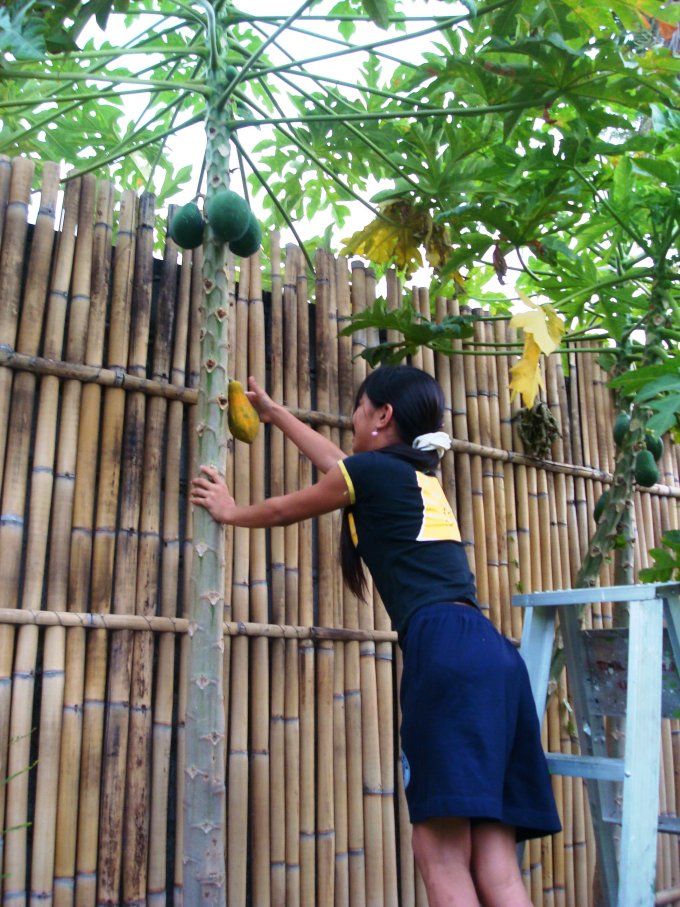 Janine received "the honor" of picking the first papaya; plus she's young and spry enough not to get hurt too much if she falls off the ladder while picking it. Just kidding. No, she volunteered, when asked.
 I think by next year, if we are still living here, we will have to get a taller ladder, that is if we are going to be able to keep plucking papayas from its ever higher heights.
 xxxxxxxx The "fruit version," freshly sliced papaya chunks. My favorite!
Go here to check out the complete flickr set of "Papaya Picking."
Monday, January 12, 2009
Snail Mulching
.JPG) Every leaf that falls from my trees, all the grass clippings, and every bit of vegetable kitchen waste goes into the ground of my yard. I make sure of that. I learned to do that when I was a kid in Michigan, to mulch and compost all plant-type biodegradable material that happens to get generated in my immediate surroundings.
Every leaf that falls from my trees, all the grass clippings, and every bit of vegetable kitchen waste goes into the ground of my yard. I make sure of that. I learned to do that when I was a kid in Michigan, to mulch and compost all plant-type biodegradable material that happens to get generated in my immediate surroundings.I learned to do that in school, in my Earth Science and Biology classes, as well as from the magazines my dad bought, especially one called Organic Gardening. Burning leaves or tossing out grass clippings with the regular garbage was unthinkable. Wh
 y would anyone do such a thing when they can easily let it break down naturally into its basic elements and thus re-nourish the soil?
I’m reminded every evening that there are unfortunates here who never heard of such environmental endeavors when I watch the ugly effects of scores of little raked up piles of twigs and leaves as each pile is lit up. From up in the tower I can see each burn spot from the telltale white smoke clouds. Up they go where they join together into one massive pall of hazy air pollution. Its dry season now so there's no cleansing by daily rainstorms and the drier it gets the more people want to burn stuff. As much as I would like it to be otherwise, it's what they do in places like this.
In fact, from my travels I’ve learned to equate the smell of smoke with the Third World. Whether Africa, South America or here in Asia, one thin
 g all underdeveloped countries have in common is the acrid odor of burning, whether it is brush, garbage, or just from cooking fires; take a whiff, and for sure something will be alit nearby.
The poor here really seem to have this ingrained firebug penchant. Not long after I first moved into this house, I watched as one of my newly hired maids raked up a small pile of fallen leaves and a candy wrapper or two and then nonchalantly lit it up. She did this even though I pay to have my garbage picked up, notwithstanding that my desire to compost was not yet known to her. Rather than take the effort to pick it up and place it in the can, sh
.JPG) e opted to burn it. I wasn’t very happy with her, and the funny thing as I look back on it now is she could not figure out why I was so worked up over such a trivial thing, and trivial it was to her. She didn’t last here very long, and while she WAS here I don’t think she ever “got me.”
e opted to burn it. I wasn’t very happy with her, and the funny thing as I look back on it now is she could not figure out why I was so worked up over such a trivial thing, and trivial it was to her. She didn’t last here very long, and while she WAS here I don’t think she ever “got me.”On that note, last week I was out mulching into the soil a few days worth of biodegradables. I don’t have a compost pile because they are a bit unsightly and odiferous, and with my yard being so compact I decided long ago to just bury the stuff, although I have developed a composting process.
My mulching process is to dig a two foot wide trench about three feet long along my bamboo fence and then lay down a layer of organic detritus. I mash it into the earth with the sharp end of a shovel, wet it down, shovel a thin dep
.JPG) osit of earth over that, and then lay down another layer of detritus, and so on until I get 5 or 6 layers built up.
osit of earth over that, and then lay down another layer of detritus, and so on until I get 5 or 6 layers built up.So I’m doing my composting thing last week when I notice a round object fall caked with a crust of dried mud roll out from under my bamboo fence. At first I thought it was a rock or a nasty old rubber ball. But once I washed the mud off it I discovered it to be a pretty hefty sized land snail.
I found that strange since I’ve been in this place for more than a year now, and I spend a lot of time in the yard, and yet, this is the first time I’ve seen any snails at all. In fact, I’ve lived in the area since 2002 and have never seen a snail anywhere around here.
I took a break to examine it. I love nature, so it’s what I do, what I’ve always done since I can remember. I much prefer natural things to things of man. I avoid the latter if I can and indulge in the former like an addict.
.JPG)
I went in the house for my Cybershot digital cam and took a few shots of my new snail friend as it enjoyed its newly dampened surroundings. When I first picked it up it had been dried up and dusty. I had the hose out and had wetted everything down as part of the mulching process. I’m pretty sure snails like it moist, and presently, during the midst of dry season, it had probably been in a dormant state waiting for it to start to rain again. Of course, all that is conjecture.
This particular gastropod, once washed off and cleaned up, I thought to be particularly photogenic. I turned on the macro function and clicked away. I really enjoy pictures like this, particularly when I watch them back on the computer screen on a slideshow when each shot fills the entire screen. Wow, the detail!
Snails can be tough on plant life, so I was considering releasing it outside the confines of my walls, but I figured what the heck, it’s only one. How much harm could it do? So, after the photo session I put it back where I had found it and wished it well.
.JPG)
Subscribe to:
Posts (Atom)