Friday, June 17, 2011

The Canyons

The sudden appearance of the channel beneath us made for a striking image. In a second, the view below changed from drearily shallow to extraordinarily deep and mysterious. And that underwater channel leading out to the open sea was actually only a shadow of what was in store for us as the dive continued.

Without having to signal to do so, the sudden change of venue caused the two of us to stop and hang vertically in the water to communicate. Telepathically, we knew it was time to start the dive. From the surface the terrain looked incredibly interesting below. We couldn’t wait to get down there and check it out. We took our snorkels from our mouths so we could talk about it.

“Are you ready?” he asked.

“Hell yeah, let’s get down there. I’ll follow. Lead on buddy.”

Fish! At last we saw fish, in fact, small schools of them flashed back and forth 20 and 30 feet down; some of them were even good sized. As soon as we went past the confines of the lagoon, THAT is when they began to appear in some numbers; nothing impressive, but it was great to see any fish at all after the travesty of the day before.

We were relieved to see wild swimming creatures, but what really impressed us was the astonishing topography. We discovered that the lagoon actually sits atop a geologic shelf; leave it, and lo and behold the sea bottom drops directly and breathtakingly down to between 40 and 60 feet. With visibility almost perfect it felt as if we had changed universes.

The view was stunning; the sort of spectacle that a diver lives for. In this case we had hit the scuba jack pot and we both knew it. The two of us, hovering 20 feet down—the bottom still far below and sea wall towering high above—spun around to take it all in, then, nodding enthusiastically, we did our first ever underwater fist bump. We were ecstatic at having found this place.

We continued our descent toward the sea bottom but deviated from our original plan slightly in that we headed straight out to sea instead of following the coast to the right. When we could get no deeper I checked my console and noted almost 60 feet. On the way to that depth I could see the same white never ending expanse of white sand that we had seen the day before in “the dead zone” up the coast.

The sand field outside the lagoon looked just as dead and free of sea creatures as the area from the day before. Without venturing too far out into the deeply rippled “sand box” we headed away from that lifeless zone, turning right toward the area that we would eventually call The Canyons.

But that time, where we first happened to go in to that rocky region, all we saw were huge piles of jumbled boulders and rocks, the largest as big as a Volkswagen. We floated over the sprawl of giant stones and until we came up against a steep ramp, too shallow to really classify it as a wall. At that point we veered back to the right since we had butted up against the shoreline. It was easily seen a good 30 or more feet above us where the waves disrupted the surface. I loved the fact that we could see so far in the water. What a treat!

Backtracking for a while, we headed back toward the sand field. It had become a visual directional reference for us. Just the same, I didn’t like the stuff any at all. From what I could tell, if there was no steep wall of rock to keep it back then the sand took that area over, overwhelming and inundating anything it could blanket.

I hated the sight of the deathly stuff. To me it represented evil. Numbly sterile and featureless, even fish appeared to avoid it like it was poison. It’s strange; I’ve never felt that way about any inanimate substance before.

And then, for the first time, we spotted a looming entrance like opening into the side of the gigantic rock formations that we had been swimming next to. Don turned and pointed into the canyon like opening but he needn’t have, since I already had an okay sign formed before he had even turned his head in my direction.

Of COURSE we were going in there! Scuba diving in deep circuitous canyons is like cave diving, only without the danger. Once we found The Canyons, exploring them would keep us busy for our next three dives.

Next: In The Canyons, The Big White Marble.

Thursday, June 16, 2011

The Lagoon


Neither of us are much on early rising, and our first morning waking up at the Bayview Inn was no exception. My girl is just as happy to stay in snooze mode right along with me, so she was in no hurry to get up to prepare my usual pre-dive breakfast of mixed chopped fruit. We didn’t eat until almost 10 am.

Don came around the room about then to talk about when we would load up and take off. “Any time you are,” is my usual answer, and was again. We agreed to go for an 11 am departure.

He expounded, “Anyway, the place we’re going to is only a couple miles down the coast from here. We’ll be there in no time.”

He opted to take the gravel road that runs directly west up the coast from the hotel. Perhaps someday, in the very distant future, that beautiful stretch of beach will be world renowned as an Asian tourist destination. For now, it’s mostly deserted, occupied almost exclusively with groups of people pulling huge nets—more on that later.

More than halfway up the beach on the right we came upon a large fenced in compound. A sign out front identified it as a government hatchery. I was excited to see it, mentioning to Don that when we get a chance we should stop in to see if they’ll give us a tour.

I declared, “And if they do, I’m going to ask what’s going on with that area we dove yesterday. Maybe they can explain why there’s no longer any life in those waters.” Don thought it a good idea and agreed verbally with a “Sounds like a plan.”

There was very little signage announcing the existence of The Claveria Lagoon. I’m sure all the locals know it’s there, but a passing tourist would never find it. The only reason Don did is that he usually travels the country on an off-road style motorcycle. He has a habit of checking out every dirt road and track he comes across.

Of course, if anyone spends any time at all in Claveria they WOULD learn of its lagoon. Obviously, along with the long beach, the lagoon is THE primary recreational area of the municipality. To get to it you drive between a couple of underused resorts, then through an overgrown dilapidated parking lot before arriving at the entrance gate. Attendants at the gate let us know which pavilions were available. It looked to me like none of them were. Every one of the dozen or so picnic shelters appeared to be full of people. It turned out though that most of those folks were none paying locals, just hanging out, squatting so to speak.

Don chose one of those closer to the entrance. As we pulled in next to it, the people inside began clearing out while the attendants began to sweep it out and pick up any refuse. The cost per day, from six to six they told us, is just 300 pesos, about $7. Not bad at all, but as we found out later, you can't pay for just an hour or two, at least we weren't allowed to. It's the whole shebang or nothing. There is running water available at each shelter, perfect for us to rinse our gear after each dive. And the restroom was close, but not TOO close, if you know what I mean.

We were probably some of the first white foreign visitors they’d had in there for a long time, certainly some of the first ones to show up with scuba diving gear. As we unloaded all our stuff while already wearing our wetsuits I began to get that "fish in a bowl" feeling.

Don handles that kind of thing much better than I do. He merrily says hi to everyone while I tend to shyly pretend that they aren’t there. Sometimes it’s difficult to do though. One drunken old guy, probably in his late 70s, stood right across the seat back from me as I prepped and donned my gear.

Personal space here is definitely NOT the same as for an American. He was no more than a couple feet away and leaning in. It’s hard for me not to get angry when that kind of thing happens, but I do my best to try to understand the cultural differences that leads people here sometimes to get right up in your grill when they are curious about you.

Still, it never fails to creep me out. Divine notices when it happens and because she knows it causes no little anxiety, she’ll try to either let the person know that it would be best to move on, or away, or she’ll just put her body in there, acting as a human buffer. I don’t know what I’d do without her.

Less than a half hour after our arrival the two of us were ready to gear up and get in the water.

First we searched out a way to get down to the water through all the beached outriggers and then we discussed where we should dive.

Watching the occasional comings and goings of the fishing boats we could tell there was a channel out to the open sea right between two of the largest exposed rock formations, which actually could be classified as small islands.

Don offered, “How about we get in the water and bear to the right. We can check out what’s here in the lagoon first and then head over to that little island to the right of the channel.” He pointed. “In other words, let’s just bear right the whole dive to make it simple. Even if we go outside the lagoon let’s just go to the right.”

It sounded fine to me. My only remark was to hope that we would actually find some kind of life out there this time. Don agreed with that wholeheartedly.

A great thing about diving out of those picnic pavilions is that I was able to rest my tank on a seat bench where I was then easily able to sit down in front of it so that my wife could help me by pulling my hands through the straps. Once all cinched up all I had to do was lean forward, take the weight, and stand up. Easy squeezy.


There were rocks and stones galore both on the bank and going into the shallow water off the so-called beach. I kept my head down, ever cautious as to every step and then realized I was surrounded by a small sea of little humanity, almost all of them children, and all excitedly seeing us off. Don loved it, bellowing out in return to their greetings, “Hello! Hi! Time to go diving now!”

By that time I was up to my knees in the tepid almost stagnant water and noticing that the footing was not getting any better. I kept my mouth shut and concentrated on getting safely into the deeper water, leaving all the public relations stuff to my colleague.

The tide was low and so the water stayed shallow for quite some distance. We were almost out to the center of the lagoon before it got deep enough to put on our fins. The water temperature continued to be ickily tepid, like a hot bath or a bowl of simmering soup.

We were WAY out past the middle of the lagoon center before finally putting on our masks. “Let’s snorkel it for awhile to save air,” I suggested. “Then, if we see anything good we can go ahead and start the dive. Otherwise, let’s just stay on snorkel until we get outside the lagoon entrance or wherever it looks like an interesting spot.”

And that’s what we did. Encouragingly, right there in the hot lagoon water we DID spot a few small fish and other marine life, including beds of sea weed, so THAT was a good thing. For the most part though, it wasn’t worth going to regulators yet. Soon however, we entered the deep part of the channel leading to the sea. It was then that we put in our regulators and began our dive.

Next, “Our first dive outside the lagoon, in "the canyons."”

Tuesday, June 14, 2011

The Dead Zone

Complex slabs and knobs of rock awaited us just below the surface almost as soon as we entered the swishing surf. It surprised me. I assumed that the expanse of sand on the beach would continue on into the water, providing easy access to the deep. But no, treacherous footing awaited us almost from the instant we took our first steps off the exposed beach sand. I couldn’t even go to my knees or to my stomach, so close to the surface were the rocks. What made them dangerous was the inability to see the presence of holes, loose stones and narrow fissures below the foaming surf.


Slowly, ever so carefully, I moved through the pulling and pushing waves. Their overwhelming power compromised my balance already made tenuous from the massive weight of my dive equipment. I constantly worried that I was about to snap an ankle from falling into some unseen chasm in the invisible rocks all around me.


Twenty feet from shore I finally found a hollow area where I could lay out. With that, I could easily see through my mask a route through the jumble of stones out to deeper water. Breathing through my regulator I pulled on my fins. Changing to snorkel I continued away from the shore, mostly pulling my body over and between stones until at last there was only rippling sand beneath me.

Don made his own way out unmindful of my travails. His robust legs allow him to give him no mind as to footing; it's just the opposite with me, what with my damaged and puny lower appendages. I don’t think he’s turned an ankle in his entire life whereas I’ve turned mine more times than I can count. It was never far from my mind that a broken ankle or wrenched knee would cause an immediate inglorious end to our expedition.

Finally, almost chest deep, the two of us were able to stand, more or less. Moderate waves rolled through us forcing us to bounce with each one, constantly causing us to struggle to regain our footing. Eager to get underwater we quickly went over our plan once again before going to regulators. We gave each other a thumbs down, deflated our BCDs and submerged to begin the dive.


Looking around me far and wide I knew right away that this would be a dive like no other I’d ever experienced. Everywhere I looked all that could be seen were endless sand rows, like waves frozen in time. The suspicions I’d had on shore while examining the beach sand, where it seemed to indicate that the sea here was devoid of all life, was being proven true right from the outset.

We reached a depth of 15 feet when Don signaled that we should head diagonally back toward a cliff face around a point just down from where we had entered the water. It was good by me—surely there were fish or ANY kind of life, somewhere over there, maybe in and around a different part of the shoreline. That's what I hoped anyway.

Nearing the coastal boulders and cliff face the wave action irresistibly pulled and pushed at us, first in, toward shore three or four feet, then away. We struggled to keep from getting too close to the shore rock, but at times the surge would shove us toward one. There really isn't much a diver can do about it; the water takes you where it takes you. I kept my gloved hands up and ready to fend off a collision.


It wasn’t long before we could see that there was nothing alive there either. We abandoned the shoreline and headed back out to the deep.

Away from the shore again I was struck by the never-ending monotony surrounding us as far as the eye could see. I pushed up five or six feet from the bottom as we swam out trying to see anything at all besides sandy bottom somewhere in the distance, but there was nothing out there. Ten feet, Fifteen, Twenty, my depth gauge showed us going deeper, but that was about the only discernible change. Don paused, turned toward me, gestured around him and shrugged. I could read his mind, “There’s nothing out here.”

I held up my console, pointed to the depth gauge and then showed three fingers followed by a closed fist to signify a zero. Then I pointed out to the deep direction. He knew from all that I was saying that we should keep going deeper until we hit at least 30 feet. I figured if nothing changed by then that nothing would and then I’d defer to whatever my dive mate decided.


Hugging the bottom I noticed that the unending rows of sand collectively resembled an underwater plowed sand field. We began to pull ourselves along by the sand rivulets, using them as handholds. Soon we reached a depth of 30 feet; we were now hundreds of feet out and still there was nothing to see but more of the same.

‘I give up,’ I thought, ‘There’s NOTHING out here. Evidently, these people have killed this part of the South China Sea. HOW is that even possible?’

Don looked at me and shook his head. He couldn’t believe what he was NOT seeing either. I’ve snorkeled and swam in lakes, ponds, rivers, oceans and seas all over the world and NEVER have I seen a body of water more devoid of life than THAT section of coastline. A phrase to describe the lifelessness around me came to mind and began to bounce around in my head. I know what I’m going to call this place, I thought, ‘The DEAD Zone!’


Don had me wait on the bottom of that dead sea while he popped up to get a direct bearing back to our section of beach. In short order he returned and we quickly headed back in. Another oddity was that even though we were hundreds of feet from where waves were breaking on shore we could still strongly feel their ebb and flow. We deduced that such a thing was happening due to the total lack of coral and rock formations. With nothing to impede the water after it crashed on the beach it had full reign to flow strongly right back out to where it had come from.

I felt sick as I carefully made my way back to the beach. Thankfully, I found a much easier path to egress the water than the way I had entered. Trudging together back up the slope, we began to discuss the awful thing we had just witnessed. Obviously, what we saw, the complete lack of ANY life, is NOT the normal condition of any tropical body of water, and I have been in many all over the world. It was amazing to consider that the environment there wasn’t just damaged, it was completely destroyed. The entire ecosystem somehow has been removed. The question we had was “How had they done it?” How could EVERYTHING be dead and gone? I just didn’t see how such a thing could be possible. Poison? Dynamite? Huge nets? All the above? HOW?


Truthfully, at that moment, I was ready to pack up and head back home.

Leisurely stripping off my gear I stared thoughtfully out at the water. In the past, after a dive I would marvel at the wonderful world hidden like an alternate universe under the waves. This time though, I felt none of that wonder, only nausea. I looked over at my dive partner and offered, "Man, that was just awful. How about we try another spot tomorrow and if its like THAT I think we need to drive on and try our luck at some other part of the coast."

"Yeah, you're right; but tomorrow we'll try diving at The Claveria Lagoon. I think we'll have more luck there. If not, we'll follow your suggestion. What do you think?"

I knodded and with an exaggerated sigh I responded, "O...kay."


Sitting heavily on a little grassy hummock near the car, I stared out at the sea, now dark from angry storm clouds above. The rain, no longer occasionally spitting on us, was increasing in intensity; I hardly noticed as I intoned, almost despairingly, "Sounds like a plan dude. Tomorrow the lagoon it is. It can't be any worse than the underwater desert we saw out there today. Just the thought of what's been done here makes me want to cry."

Next: The Lagoon

Sunday, June 12, 2011

At our destination in Claveria, almost in the water


After leaving the lighthouse the road we traveled turned to the east across the top of Luzon. Checking it out online I now see that after passing through Laoag we began driving on The Maharlika Highway, which spans the country from top to bottom.

Traffic had been light after Laoag and it stayed that way for the rest of the trip—no complaints there, especially considering how winding and up and down it is. It sort of reminded me of traveling north on California’s coastal route 1—it has much of the same type of views with the surf far below and craggy looming hills to the right, only in the Philippines version the towering hills are covered thickly with lush jungle growth. Then again, I haven’t been on California Route 1 since like 1978, so maybe I’ve remembered it wrong.

We paid attention as we passed by the next large town called Pagudpud. Note that the more you say it the less strange it sounds, honest! We knew that we’d have to make at least one trip back to it to refill all our scuba tanks at the only resort on the northern coast with a diving air compressor. It's a beautiful place on a sugar-white beach called the Terra Rika.


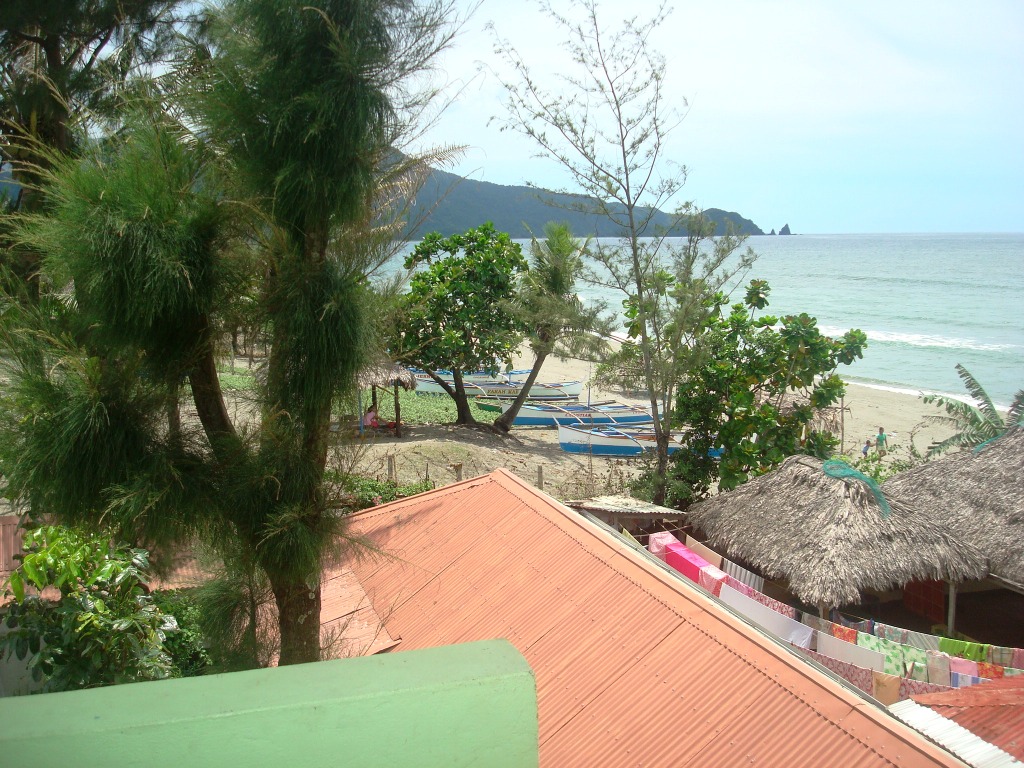
By the time we came to the fork in the road with a big sign that says "Claveria" exactly in the middle of the two diverging roads it was almost 11:30 am. The sign shows left to Claveria and that’s the way we went. Five more minutes and we pulled into our digs for the next six days, The Claveria Bayview Inn. It would be our "base of operations” for all of the eight dives we got in during our stay there.


Don and his gal decided to take the second floor room almost directly over the office while the wife and I opted for the newly built third floor room across the driveway with a window view of the beach. Give me a choice and I’ll always go for the view, even if it means a little work getting up to it; and with scuba equipment on tap there is always going to be some work involved.


Once all our bags and stuff was situated in our rooms, my preference was to get right back out on the road to find our first dive spot. But, Don outvoted me on that one, saying he needed some rest first. I knew he was bone tired from driving 10 straight hours through the night and day, so I didn’t argue; I only insisted that we rest no more than an hour or two or I'd never be able to do it. I know that more often than not, an hour nap can turn into a six hour bout of slumbering unconsciousness.


Heading up to our room to wait out the “rest period,” I turned on the aircon, pulled out the lower hide-a-bed and purposefully took an uncomfortable seat on it. I was hungry as well as sleepy but I can’t dive on a full stomach so I asked the wife to cut up some fruit which I finished in about five minutes. With the History Channel blaring at me, I propped my back up with a single pillow and only then allowed my eyes to close.


If I had curled up for a deep sleep I knew my mind would fog and I’d be done for the day. Staying vertical wards off deep Slow Wave Sleep, thus allowing me to snap my eyes open and immediately press feeling almost refreshed. An hour and a half later I opened my eyes for about the fifth time. Struggling to my feet, I stretched and decided it was time to head over to see how my dive partner was doing.


I had to laugh. He was sprawled across the bed on his back, his head resting on his girl’s lap who was sound asleep. What made me chuckle were his eyes. They half opened as I knocked on his door jam and for the next half minute, try as he might, he could not quite get them fully opened.


Sounding as chipper as possible I inquired as to how soon I could expect us to take off to find our first dive spot.

He yawned before answering, “Give me about a half hour to shake off the cobwebs and we’ll head out down the road. I don’t know how you can be so wide awake after not getting any sleep last night.” Another yawn.

I chirped, “Ha! I’m faking it man. I’m dead tired too. . . . No, really, I just know from experience not to fully lie down or I’ll never get back up, at least not while the sun is still shining anyway.” I paused, “Okay then dude, we’ll see you down at the car in about a half hour.”


Forty-five minutes later, the four us loaded back into his Honda SUV, we continued for about twenty minutes east through town until we came to an unmarked turnoff down a dirt track toward the sea. He said they had found it during one of his many past motorcycle trips north, and the spot ahead that he was thinking about, he thought might make for a good dive entry point.


Approaching the unseen South China Sea coast we rounded a wooded bend and soon had to stop where the tracked trail was blocked by several dumped loads of gravel. “Hmmm, that wasn’t there before,” he declared.

We got out and walked around the huge piles of gravelly dirt. A fast moving brown hued stream gurgled and swirled to our right. Sounding a bit uncertain he announced, “Hmmm. None of this looks the same as last time we were here.”


The trail gave way to a jumble of boulders and rocks. “All of this was under about five feet of sand,” he continued. “I thought we’d be able to reach the water through here, but it doesn’t look doable now with all the sand gone.”

In my best know-it-all scientist voice I lectured as if speaking to a classroom of students, “You know what man? There must have been a hell of a storm since the last time you guys were at this spot. You can tell that all this area has been swept clean by fast moving water. That’s how it is around the ocean; nothing EVER stays the same,”


I looked out across the wide deep looking torrent more than a dozen feet across at that point and spotted a long sandy stretch of beach in the distance. “How about over there?” I asked pointing toward the beach.

“Let’s go check it out,” he answered.

We backtracked to the car where the stream was more easily fordable. Jumping across the water using some rocks, we picked our way through thick grass, partially hidden stones and mats of folliage thick with beautiful yellow and white wildflowers, until we reached a sandy knoll where goats had obviously chewed the foliage down to where it was more like a neatly clipped lawn.


From the top of that rise we could clearly see the beach. There was a single bangka boat and a trike parked next to it, so we knew there must be some kind of access. Standing on tippy toes I shaded my eyes and pointed excitedly, “Hey, see there? It’s a lane where vehicles have traveled. I’ll bet we can back up and get on it and get close to that beach.”

My partner in crime nodded agreement and headed back to the car. I told him I’d continue to walk toward the spot so he’d have me as a visual reference. He didn’t need me for that though, since by the time I made it there on foot he and the girls were just pulling up. I signaled him to pull around and back it up so that our gear would be easily available. As usual he was way ahead of me.


Soon, we made our way on foot down to the swells sequentially rolling noisily up a steep bank of soil colored sand constituting the beach. The surrounding view could have been the scene on a “wish you were here” tropical beach postcard. It was serene and it was lovely, but as I closely examined the sandy brown beach I began to develop some misgivings.

“Dude, look at this sand.” Kicking at it, I continued, “There are no coral bits, no broken shells, no seaweed, there’s nothing here; nothing that was once alive anyway. Have you ever seen anything like this? And see the color of it? It’s the color of soil from all the tons of sediment that has come down from the hills from all the rivers dumping into the sea around here. Man, I do NOT have a good feeling about this.”


“Well, we won’t know what’s out there until we GET out there,” he rightly stated.

“Okay, let’s get our gear on and check it out!” We fist bumped before turning and making the trudge back up the gentle slope. Gentle yes, but we still had to work hard due to our feet sinking deep into soft sucking stuff that looked more like powdery soil than beach sand.


It was a new experience for me, putting my dive gear together out there in the great outdoors. As we took our pieces of equipment out of our dive bags the sky turned sullen. Angry drops of rain began to spit down on us intermittently. I searched for a spot on a little grassy hump where I could place my tank and BCD so that I could sit under it while strapping it on once I had it ready. Then, with a hand up from somebody I'd be able to struggle, creak and groan myself back up onto my feet.


I moaned when I noticed that I had chosen a spot covered with brown little goat droppings, most of them still quite fresh. ‘Oh well, it will all wash off my wetsuit once I’m in the water I suppose.’ Just the same, I brushed away as many of the little goat “raisins” as I could before planting my big fat butt on the grassy spot in front of my gear.


Once again, my dive buddy was way ahead of me; with his immense strength he simply swooped his heavy dive gear up from the ground, shrugging into the shoulder straps as if it was no more than a heavy winter coat. I’d be lame for a month if I tried something like that.


Before getting to that point though I insisted that we discuss our dive plan before weighing ourselves down with some 70 pounds of dive gear. One of my main concerns was not knowing the waters we were about to enter. What would we do if a fast current took us? We made a plan for every possible contingency, including what we’d do if we got separated or lost visible contact with each other. We knew that what we were about to do included a modicum of danger, but hell, THAT is much of the excitement.


With both of us geared up, we checked each other’s equipment one more time and took turns turning on each other’s air—first I turned my back to him and then him to me. Then we stood for one more second staring out at the gorgeous view before us.

“Okay, let’s go see what’s out there!” he exclaimed. I nodded, and down the sandy hill I traipsed. From behind me I heard him say, “Ahhh. I’ll be right with you Phil; I’m going to get one more drink of water before I go.”


I chuckled answering, “Okay brother man. See you in the water.”

As I always do I carefully watched where I placed each foot before planting the next, all the way into the drink.

That dive in the next post….

Friday, June 10, 2011

A trip north, the Bojeador Lighthouse along the way


It was a relatively short foray up to the top of the island and back, less than a week in all, but we did a lot, saw plenty and learned even more.

We’ve been back now for four days but with so much to do upon our return—like renewing my driver’s license, putting the kids in school, and getting my dive photos and videos prepped for possible use by a Northern Luzon TV station—I’m only now getting around to writing and posting about the trip here.

The primary goal of this particular expedition was to dive in an area that has probably never been dove before, at least not by scuba divers. As it turns out, surprisingly, lots of people have been down to the deep places we dove, only by a slightly different method than by scuba. More on that later.


The quiet little town of Claveria was our final destination. To get there we drove almost the entire way up a road that Don simply calls The National Highway, which is called MacArthur Highway where it passes by us just 500 meters from where I now sit.

I'm not sure what that long stretch is actually called, but heading north from where we live on Central Luzon means Don's "National Highway" is THE only way to go north without deviating way to the east or west of here, no nearby expressways or back roads to provide a more or less alternate pathway in that direction.


Everyone who lives on or near this primary artery uses it, sometimes even for transportation. They walk on it to visit the next nearest sundry shop called a sari-sari store, and of course, while doing so they socialize along it. Dogs sleep on its tree shaded surface when it’s hot, and in the early morning chill they’ll bask on it in the warmth of the sun. On its shoulders and inner lanes farmers dry their rice and corn crops on it; but mostly, people travel to destinations far and near on it, in trikes, jeeps, cars, jeepneys and buses.


Based on all the above mostly daytime action, we decided to start out at 1:30 am to avoid most of the worst of the “speed bumps” and obstacles in our quest for unhindered travel. From 11 pm until just after sunup the road’s primary users are mid-sized semi-trucks, patiently tooling along at an economical 45 mph, sometimes even slower; which makes that timeframe a perfect time to travel almost unimpeded.


And that’s what we did. With me taking on the roll of “Chatty Cathy” I did my best to keep him alert as we sped north, easily passing every lumbering truck in our way. In the post midnight dark we zipped through Capas Tarlac and a few hours later through the blessedly empty streets of La Union.


When dawn broke we were almost to the ancient city of Vigan, where the plan was to have some breakfast at the McDonalds smack dab in the center of town. Down its still deserted streets at 6 am we found everyone’s favorite restaurant closed. Vigan’s McD’s doesn’t do early breakfast it seems. Oops.

So, we opted to keep driving. We knew that by the time we reached the city of Laoag a few more hours to the north that both of its Mickey D’s would be open and raring to serve us some egg McMuffins and hash browns.


The girls were wide awake when we turned right off the highway to the first McDonald’s in Laoag (pronounced Lawag), the second one being a bit more complicated to get to. It was still early enough that we were just about the only customers wanting to eat.

I hadn’t slept at all the night before but the now streaming sunlight tripped my brain’s wide awake trigger so that I was good to go. Don said that he had lay down for about five hours before getting up at just after midnight, so he was on all cylinders as well. Not bad for a couple of 50 something year olds.


North of Laoag the highway started to follow more closely the coastline, almost always giving us a pleasant view of The South China Sea off to our left. Seeing its rippling waters spreading blue out to the western horizon reminded us of scuba diving, our favorite pastime that we soon hoped to be doing that very same afternoon.


But first, Don said that I would most certainly enjoy a stop at the 120 year old Cape Bojeador Lighthouse, located near the town of Burgos. It was built by the Spanish in the 1890s and marks the most northwesterly spot of Luzon. Don was right. I loved it. And to prove it I took almost sixty photos of it. If you have a few minutes check out the set of them here using Flickr slideshow.

The ancient and the historical fascinate me, something this picturesque structure has both of. This lighthouse, according to this Wikipedia article on it, is a national cultural heritage structure. Unfortunately, despite this lofty designation, it appears to be dissolving into its basic elements fast—the wood is
rotting and the mortar disintegrating. Not much seems to have been done to preserve it. In light of that, if you get out that way then make a point to stop in and check it out, for its fading slowly, if not quickly, into ruination. Even so, the photos I’ve taken of the current evidence of its leisurely undoing are quite captivating.


More on the trip tomorrow or soon thereafter…