Showing posts with label Cebu trip Jan 09. Show all posts

Monday, February 09, 2009

Heavenly Flight


The morning of our departure day started out okay, but I should have known better; things had been going way too smoothly. That's not usually the way things go for me.

Right around 9am we all moseyed down to the hotel restaurant for our last complimentary breakfast. Halfway through it my thighs started to ache. Then the soreness migrated on to the rest of me, so that by the time I was done eating I knew I had just been “struck down” by some kind of virus. I wasn’t exactly “down for the count,” but I felt like total crap. Life sucked, at last.

When I get sick, I get quiet. I withdraw and don’t want anyone to talk to me. Just leave me alone and let me be miserable. My sick motto, “I appreciate your concern, but butt out.” I know that sucks about me, but that’s my style.

The hotel allowed us a 2pm checkout. Problem is, our flight wasn’t until close to 6. Not wanting to be miserable in public for the hour we had to wait until the shuttle left for the airport, I stayed in bed watching TV until 1:59. During that miserable hour I sat on the uncomfortable benches in the lobby directly across from the burbling waterfall feature and just stared at it. I put my music on hoping everyone would just leave me alone, but what actually kept everyone concerned about me at arm’s length was my crotchety attitude. Basically, I was being an ass. I didn’t care; every second that passed saw me feeling worse.

Divine wouldn’t even sit next to me on the short ride to the airport. She was mad at me and I was mad at her for being mad at me. Oh what fun!

She stayed miffed for quite some time. After check in I tried to find a seat as far away from noise and people, something virtually impossible to do in most departure lounges in this country. To make matters worse the Sinulog festival with its traditional dance and repetitive music (maddeningly repetitive!) was now in full swing. I had been listening to that grating melody for a week, in the malls, in the hotel lobby and restaurant, on the streets, seemingly everywhere, and I could not take even one more note of it. And now, lucky me, they were playing it right there in the airport on all the TVs and at full volume. I had had enough. I wanted to escape it, to go home.

Finally, some luck, and believe it or not, it was good! Cebu Pacific has a lot of late flights, they average about 65% late takeoffs by the stats, but they can also leave early. Sure enough, they informed us that our flight would be heading back to Clark almost a full hour early. Yes! I was feeling better already.

More luck—we were seated on the left side of the aircraft. Heading north that meant the sunset would strategically be on our side of the plane. None of that would have made a difference except for the early departure; otherwise, it would have been dark for almost the entire flight. In preparation for a flight almost full of sunset I limbered up my Cybershot camera.

Our plane with its four turboprop engines was practically factory fresh. Due to that newness the passenger windows were almost crystal clear and totally unscratched. If there was going to be good photo-ops out those pristine windows then the photos should turn out great. More luck!

I was not disappointed. The awesome vision of clouds, sea, mountains and sun as they interacted was like an amazing special effects show put on by God for almost the entire 70 minutes of that “heavenly” flight. Seeing that constantly changing spectacle from my perfect window just about made me forget that I was sick.

Afraid I might miss something, I don’t think I looked away for even a second.

The beauty of the short shuttle flight, also known as a “puddle jumper,” is the relatively low altitude flown by those aircraft. On our flight we probably never got higher than a mile or so; any higher than that and it’s hard to see anything. From three miles and up everything below is flat and featureless, even most of the clouds. Our flight north back to Angeles City however, was anything but featureless. It was breathtaking.

I’ll never forget it. Early in the flight the sun was not directly visible from behind a dark wall of clouds. Instead, it seemed to come directly from the sea’s surface as a perfectly brilliant reflection. The sky was upside down, with sun below and sky above.

Every few minutes something new would show up out there. I clicked the shutter continuously, trying different settings and hoping that I would capture even half of the beauty I was seeing. I think I got a lot of good shots. Check them all out here. I recommend seeing them full-sized as a slideshow.

Thursday, February 05, 2009

Cebu City's Fort San Pedro


Cebu City’s Fort San Pedro is a mixed bag for me. I love some aspects of this very old citadel, but as a purist I was also disappointed, actually very much so.

On a much smaller scale, the entrance to this ancient Spanish stronghold reminds me a lot of the gate into Fort Santiago, which is another much larger Spanish fort located inside the walled Intramuros area of old Manila. Legaspi was responsible for the building of both forts. Under his administration in the late 1500s both were first built with log palisades and then rebuilt with more permanent thicker walls of coral stone.

I’m certain that when I visited Fort San Pedro back in 1985 there was still a view of the sea from high up on its ramparts. During my recent tour of it however, as I rambled along the top of its walls, I was confused, wondering if this was the same fort. I asked one of the engaging guards, who also acted as museum guide, if there wasn’t another fort in the city, one that overlooked the sea. He didn’t know of any. Was I imagining things? Had the 24 years since my last visit really wrought such visual change?

Unless my memory is completely skewed, the last quarter century has not been kind to the view now afforded to those looking out from the fort’s refurbished parapets. In a word, it’s crummy. In another, it’s a shame.

I suppose it could be said that a similar “tragedy of progress” has happened to Fort Santiago in Manila, but not completely, since although Manila Bay is no longer observable from any portion of it, and probably hasn’t been for a century, at least it still overlooks the Pasig River, as it always will.

On the other hand, Fort San Pedro now overlooks nothing but unremarkable buildings (at best) on what was once its seaward side, while on the entrance side all one sees is a ramshackle park with lots of ongoing construction.

Even worse, just outside of an entire wall of the fort, the city has allowed what looks to be squatters to move into a double stacked row of unsightly metal shipping containers, the sort loaded onto container ships and pulled by trains and semi-trucks all around the world. This unattractive display is fully visible from what I believe to be the southwestern wall of the fort. At the foot of this same wall also happens to be where a statue of Miguel Lopez Legaspi stands; at least I think it’s him. I don’t know for sure since I didn’t feel like venturing down into that area; it just didn’t look all that tourist friendly.

It’s strange and unlikely, the sight of this bronze rendition of the Spanish Conquistador who was also the first governor general of the Philippines, towering way up there on his platform, now apparently the lord of the squatterdom to his front.

So, I got the bad part out of the way, that being that the City of Cebu has squandered a wonderful opportunity for what could have been a real draw for the city. Instead, with its very unattractive, if not ugly surroundings, Fort San Pedro is only slightly remarkable as an attraction to outsiders.

The plight of Fort San Pedro’s “uglified” surroundings brings to mind (to my mind anyway) that most Philippine towns and cities of any size do not do their “waterfronts” very well; and that is a huge shame, and a very real economic lost opportunity for sure. I say that because most foreign tourists (like me) love the sight of water, and seek it out when they go sightseeing or look for restaurants and shops. Other than Manila, along its Roxas Boulevard, I haven’t been to any other large city here that has developed its waterfront for anything other than industry. I’ve been frustrated in this quest for an aesthetic waterfront at every coastal city or large town I’ve been to so far.


Even Manila needs to get with it—last time I walked along the bay side of Roxas I had to hold my nose to keep out the stench from sewage floating in the water below the seawall. I have no idea how anyone can possibly eat in the seaside cafes along its sidewalk. I had meant to try one, but opted instead to walk across the boulevard to an inside restaurant away from that nasty smell.

Inside Fort San Pedro is another matter, a delightful one in fact. In the shaded tunnel-like entrance is a very well done set of display photos and placards explaining and showing the history of the place. I looked longingly at the pictures from long ago showing the fort with water lapping almost right up to the base of its walls. If only it still looked like that!

At one time, several decades ago during one of its earlier lives, the fort was turned into a small zoo; during another period it was used as the site of a city garden club. The Spanish, the Americans and Japanese all apparently used it militarily, and even Filipinos used is as such for a short time just after the Americans had evicted the Spaniards. It’s also been put to use housing government administration offices as well as a school building for a time.


Reading the history of the 400 year old fort reminds me of The Alamo in San Antonio, another old Spanish edifice that was used in all sorts of ways before settling into its final role as a national shrine.

I applaud the current managers of Fort San Pedro’s grounds in the excellent job they’ve done maintaining its garden-like features. I love plants of all kinds, great and small, colorful or not; and that’s exactly what you get as you walk through its lovely inner courtyard and along its wide stone ramparts. I took a lot of pictures of a lot of plants and flowers, as you’ll see in my flickr set of the fort.


I was also pleased to see that apparently many of the original Spanish cannon are still on display on the walls, although now only the huge barrels are left, minus any wheels or carriages, and forlornly propped up on their original firing embrasures.

Driving away from the fort, we asked the driver about the odd looking deep pit-like construction going on not too far from its inland side. I was surprised when I believe he told us that it was a subway in the making. Unless we misunderstood him, I don’t know of any other subway in this country. The public tram in Manila is all above ground. I’ll have to do some more sleuthing on that one.

Monday, February 02, 2009

Magellan's Cross, and the City Square it sits in


The day before we were to head back to Angeles City we did a tour of Cebu City proper. We made a deal with a taxi driver for three hours for 650 pesos. Now that's not a bad deal, only about 14 bucks. We probably could have gone lower still, but he seemed like a good chap, so what the heck.

We told him we wanted to see "the sights," but he didn’t seem to get what we meant by the phrase. So, I got specific and asked him if he knew about Magellan’s Cross and the old fort. Aha! He got that. He seemed to know the location of both of those sites, so, off we went across to Cebu City from Mactan.

Magellan’s Cross is the first place
we stopped. With the big time annual Sinulog Festival just kicking off, which I understand lasts for more than a week, evidently there were lots of folks in town to help celebrate it. Along with all these people, we checked out the cross pavilion located right in front of a church devoted to The Santa Nino, or the Christ Child; or at least that what it says on the sign in front of the church.

The story behind this religious festival, "The Sinulog," goes like this:


More than 40 years after Magellan’s death, Legaspi and his men returned to these islands to make good on the original claim for them for Spain made by the ill-fated Magellan. Using overwhelming firepower and lots of Spanish steel to destroy all resistance, Legaspi didn’t repeat the mistakes of Magellan. While looting one of the villages in what is now Cebu City, one of the Spanish soldiers found a wooden statue of the Christ Child that a priest under Magellan, some 40 years earlier, had presented to Hara Amihan, the wife of Rajah Humabon. The statue was a gift to celebrate the occasion of the Cebu queen's conversion to Christianity. The finding of the statue was declared miraculous by a priest under Legaspi and he declared the site a holy one. So, upon it, or near it, the basilica of San Augustin was built.

So that explains the Sinulog festival and the origin of the Santo Nino Basilic
a, but the tale of Magellan’s Cross is a bit different. The pavilion for the cross is in the square outside the entrance to a basilica and across the square from the Cebu City Hall. There is also a university in the vicinity, also named after The Santo Nino, the evidence of it being groups of nursing, and other medical type students in their training whites, all roaming about all over the place.

The sign inside the kiosk-like pavilion says that the cross in there encases the remains of the original one planted by Magellan in 1521. Now excuse my skepticism, but if you really think that any of the original cross still exists, and it’s there, inside that cross on display, then I have a bridge in Brooklyn to sell you. Still, I found it to be historically significant, because even though the Spanish priests that started the tradition, did so in the early 1700s, about 200 years after the time of Magellan, it's still important because of how long it's been there, and thus probably marks the spot not too far from where Magellan actually did plant his cross. As they say in the big city, “it’s
all good.”

The colorful mural on the ceiling above the cross depicts Magellan planting one for Spain, and in doing so, the bringing to this part of the world, among other things, Christianity. It also marks the arrival of a whole new set of traditions and culture, and perhaps most importantly, it marks some 350 years of Spanish dominion over the Philippines. I mak
e no judgments here on whether or not that was a good thing; as an interested observer of history, it just is.

After the moment or two it took to take several photographs at the cross pavilion and to read the captions, we decided to take a lap around the outside of the large square. I took photos of the view as we sauntered around to the left, past the college, city hall, past a fellow in charge of burning candles to The Santo Nino, and finally to the larger-than-life statuary of Jose Rizal way up on his concrete pedestal, forever conducting business at his over-sized desk. If you don’t know who Rizal is, then you kno
w nothing of this country. I call him “Jose the Brilliant,” and he is THE MAN.

We took our time and did the whole thing in a liesurely 25 or so minutes. We texted our taxi man, met him back at his sedan, and headed out to the nearby Fort San Pedro. There is a lot to like about that fort, and a lot to comment on. More on the fort probably in the next post.

In the meantime, when you have time,
check out here the full flickr set of photos I took of Magellan’s Cross and the immediate environs.

Saturday, January 31, 2009

Mactan Guitar Factory, Allegre's

It was raining steadily by the time we left The Magellan LapuLapu Monument. Pete and I are sticklers when it comes to time and within a split second of each other we both came up with the fact that we had just over an hour left on the three hours on our taxi. I had remembered going to see a guitar factory during my last trip to Mactan back in 1985 and mentioned to our little group that it might be nice to check one out before heading back to the hotel. No one objected, so off we went.

The driver took us to a place called Allegre’s Guitar. It was nothing like the crude dusty so-called factory I remembered seeing before. That one had been nothing but a barn-like wooden building with a tin roof. Inside, about a dozen men squatted on the floor in a huge pile of saw dust and wood chips. It must have taken them weeks to build up so much. It was messy, but it was impressive to see.

By comparison to that place from long ago, Allegre’s is nothing if not professional. There is nice place to park on the outside of the factory wall and a greeter meets and escorts guests into the factory. A lot of work and thought has gone into the displays.

I’ve included a few shots in this post from my flickr site of our tour of Allegre’s; from them you get a good idea of what they attempt to accomplish with their museum-like exhibits. All the different components are shown before they go into final assembly. If you are a carpenter or woodworker of any kind, such as a furniture maker, you will probably take a lot of interest in all the different types of wood they have. They have everything from oak and maple from Canada to various tropical hardwoods from right here in the Philippines.

Just as I had seen 24 years ago at that less sophisticated factory, Allegre’s also puts their woodcarvers, assemblers and painters on display as they demonstrate their craft. Also, just as I recall from that earlier trip, hardly any sound is heard other than the quiet rasp of file or chisel on wood, or the almost silent shushing of sandpaper. I didn’t see a single power tool of any kind, not a jigsaw or drill press one, thus the peaceful silence, not something you’d normally expect from a factory. I doubt that they could get any more low tech, but I think that’s actually pretty cool.

The one thing that Allegre’s has that I don’t remember from my earlier visit is a glitzy show room. And the neat thing about the show room aside from all the very beautiful guitars, ukuleles, mandolins, and other stringed instruments on display are the fellows that show them off and skillfully play them for you. We spent more time looking at these exquisite instruments and listening to the showmen play them one after another than we did in the actual factory.

Watching them play so effortlessly turns out to be a very effective sales ploy. I don’t play anything, but while watching our guide, and now salesman, play a ukulele as if it was almost playing itself I developed a hankering to have one. I was surprised at the rich sound he made come from it, not all plunky like I thought.

Intently, I watched him play one made from a richly dark mahogany. Amazed I asked, “All that great sound from a ukulele; I can’t believe it. How much would something like that cost?”

Without stopping his graceful strumming of a Filipino folk song used to dance the tinikling, a traditional Filipino dance, he answered, “Only 10,000 pesos, and that includes a really nice carrying case.”

“Oh man! I don’t have that kind of cash on me. If you took credit cards I’d probably have to get one though.”

“Oh, we take credit cards; no problem!”

Divine laughed, “Ha! He got you! Now you gonna buy one?”

I grinned, “Well, I guess I have no choice now, do I?” And buy one I did. It’s a beauty!

Wednesday, January 28, 2009

Far be it from me to expect perfection, still...

And speaking of hyper-critical, let’s talk about the hotel we stayed in on Mactan, a pretty nice place called The Crown Regency; well, it was mostly nice.

First, some good things: The suites are spacious; they include two bedrooms, one with its own full bath; a full kitchen (not a kitchenette) with all the basic appliances that you’d expect; a good-sized living room/dining room; another separate full-sized full bathroom; and finally, a total of three verandas—all for 6000 pesos a night, or just over $125.

And here are some more good things: A beautiful big ol’ well-maintained pool (with nice landscaping), free internet access in all bedrooms, a fairly well-equipped fitness room free for guests, and on the roof (I think about the 10th or 11th floor) a fancy-schmancy spa with “reasonable” prices (reasonable being relative). Oh, and let’s not forget that breakfast is gratis as well, with eggs made to order by a pretty good chef staff.

The price per day isn’t too bad I suppose, if you consider what you get. Still…

You’d think that the person in charge of putting someone in charge of selecting the furniture for a hotel that might rate a star or two would put more thought into it, because I spent much of my time in the room scratching my head and chuckling at the obvious deficiencies (chuckling, because if you didn't laugh, you'd scream).

For instance, I’m a TV hound—the first thing I do is look for the remote upon entering any hotel room. Check out the picture of the TV cabinet in the living room. This idiotic cabinet has two doors that do not fold all the way back. Therefore, the only way to see what’s on is to sit directly in front of it. I’m sorry, but that’s just plain moronic. It’s like watching TV down a tunnel. I never once spent time in that room, seeing that silly TV with its wooden blinders overloaded my BS detector; it was more than I could bare.

Then there are the beds! They look great made up and all, regal even, but they are WAY too tall, unless you happen to be over the height of 6 feet. Well, my girl and I are veritable midgets, so we just about had to take a running leap to get up and into the darn thing. Then, to make matters worse, the springs are extra firm, so that they put a crown on the bed. In other words, you are way up off the floor as it is, and now you feel like you are going to spill out over the side. It’s like sleeping downhill on the edge of a cliff. You get too close to the edge and it’s a long way down. I’m telling you, I developed a phobia from it.

Now, as I said, the beds are tall, so naturally you’d suppose that they’d buy nightstands that are equally tall, right? Wrong! Sitting up in bed watching my beloved TV with a coke in hand, I had to lean way over and down to put my drink on the stand. Of course, if I strayed too close to the edge, off I’d fall.

On that note, both the nightstands and dressers had the same ridiculous design on their table tops. I’ve never seen anything like it—they were beveled right along their edges. Because of these dopey slanted edges, more than an inch wide, if I didn’t pay attention and put something on them too close to the slant, off it would slide. I dropped cans of coke onto the floor and other assorted objects, such as coins, my cell, my sunglasses, you name it. Just to make sure, I pushed everything to the center of all the table tops. It drove me nuts. The fact that the nightstands are also like this made them even more difficult to use while sitting in bed since they were so far down from the lofty top of the bed. Getting the point?

In choosing between rooms I noticed that the bedroom with the private bath was set up all wrong in relation to the TV. (Heaven forbid!)The bed was sideways to the TV. What? So only one person is supposed to watch TV from the double bed at a time? No way. I’d rather have the other bedroom, without the bath, but with the TV where it should be, right in front of the bed; thank you very much.

The lack of ergonomics theme continued down in the hotel restaurant dining room. Aside from the ever-present flies, I realized the problem when I first sat on one of the over padded bench seats and my chin barely reached 6 inches above the table top. Jokingly, I asked the waiter for a booster chair, but he didn’t get the joke.

As far as the flies, the dining room is about as far away from the entrance as it can get, so where are all the flies coming from? I used one hand to wave them off while eating with the other; and that’s something you get used to over here, but it shouldn’t happen in a nice hotel restaurant, should it?

I can tell you this: The windows and sliding veranda doors of the suite bedrooms are definitely NOT sound-proofed. We were on the fourth floor over-looking the main boulevard and MAN it was noisy. Some really big trucks continuously rumbled past, and since horn-honking in the Philippines is part of driving here, there was lots of that as well—every bit of that persistent sound seemed to be taking place right outside the thin panes of glass. My veranda door wouldn’t latch properly, so that it was always about 1/8th inch cracked open, which reduced its sound muffling abilities to next to nothing. Bottom line: if you stay at The Crown Regency, ask for a room facing away from the front of the building.

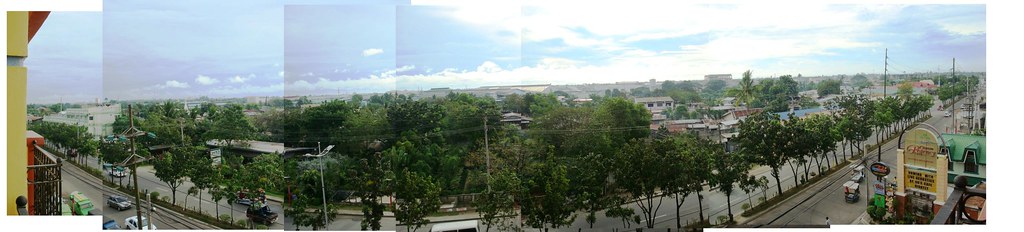
I put this panarama together using multiple shots from my bedroom veranda. In making the horizon level notice that the busy and noisy street below, which is straight as an arrow, became boomarang shaped when I layered the pictures together into one (Click on the pic for a full-sized flickr view of the panarama).

Ever see elevators with hair-trigger doors? Well, they got ‘em at The Mactan Crown R. There is almost no pause after they open. Slam! There they go, and up or down the elevator swoops. I developed a complex to the effect that whenever the doors opened I’d hastily reach in and hold the middle slats to keep them from slamming shut. And don’t try to be nice and step back to wait for it to empty of riders before getting close. I did this once and wasn’t able to get a hand against the door in time—SLAM! Swoop—I missed my chance to get in.

So would I stay there again? Yeah, probably; sometimes it doesn’t pay to expect perfection. Just the same, if the owner and managers happen read this, why not take some of these observations under advisement?

Monday, January 26, 2009

Magellan Beach, ...I Mean, LapuLapu Beach.

A week ago today (Sunday) we returned from an outreach to Cebu. Our entire office (the three of us) went to offer our services and advice with veteran’s affairs to the local veteran and dependent population under the auspices of our qualifications and experience as volunteers in a local VSO (veterans service organization). While there, we took the opportunity to check out a few of the sites in Cebu City and on Mactan Island.

One of the first things I noticed was all the little white sedan taxis. They are everywhere. I loved two things about these ubiquitous little “go vehicles:” the cost to get anywhere in them is cheap, and their drivers don’t seem intent on ripping you off. Even when we made a deal off the meter to have one stay with us for three or so hours at a whack, the most we had to pay for such a thing was between 15 and 20 dollars; and, being from Angeles City, (a place where taxis are pretty much only available within the confines of The Clark Economic Zone) I was pleasantly surprised to learn that it’s actually cheaper to get somewhere in the Cebu City area by a clean air-conditioned Cebu taxi using the meter than it is to get virtually anywhere here within “The City of Angels” in an uncomfortab
ly cramped trike.

About the only downside to the Cebu taxis is also the thing kind of interesting about them. Most of them have been modified with an LPG package to run on that much cheaper kind of fuel. So, if you need to put luggage in the trunk you just might be out of luck. We didn’t discover this until the morning we needed to get to the consulate only to learn that our taxi’s trunk space was mostly filled with an LPG tank. Not wanting to wait around until a regular gas taxi happened by, my counterpart opted to hold a heavy boxed printer on his lap for the half hour it took to get there. We should have just taken two taxis, but he didn’t realize how painful that box was going to become sitting across his knees by the time we got there. Shame on me, I remember thinking, ‘Well, better him than me!’ The poor guy; good thing he’s made of sterner stuff than I am these days.

It’s been since 1985 since I’ve been to Cebu. During my short return visit there last week, I wanted to see the four things of interest that have stuck in my mind since all that time ago: 1) Magellan’s death site, which is a beachside memorial on the island of Mactan, and 2) also on Mactan, one of the guitar factories that that island is known for worldwide, and 3) Fort San Pedro over in Cebu City proper, and finally 4) also in Cebu City, the reliquary monument supposedly containing a piece of the original Magellan's Cross. This post will only be mostly about the national memorial to the chieftain LapuLapu, and the Spanish explorer, Ferdinand Magellan, killed by the former in April of 1521, with more to follo
w on the rest of our Cebu trip in future posts.

Unluckily, on the day we happened to go to “Lapu Lapu Beach,” or “Magellan Beach,” if you prefer, a typhoon was passing by close enough to reach out and touch us with a few of its outer windy rain bands. But that’s okay; we were still able to take it in before the really hard rain kept us trapped under the makeshift tarps at the site’s row of T-shirt and seashell shops.

Who knows if the site of the memorial is the exact spot where Magellan’s quest to circumnavigate the globe ended abruptly with his death here in the Philippines at the approximate half-way point (one of his lieutenants took over and actually made it the rest of the way around back to Spain). Chances are it’s not the exact same spot, nevertheless we do know that it took place on a beach on that part of Mactan; so it’s close enough.

I do know that it must be the traditionally accepted site since the oldest m
onument onsite is a stone block obelisk put up by the Spanish. I say evidently since the placard date is during the time of Spanish rule and the language on it is Spanish. One side states, “A Hernando De Magallanes,” with “Glorias Espanolas,” and “1866 Reinando Ysabel II” on the other sides. So, that particular monument is for the memory of Magellan to the Glory of Spain dedicated in 1866 during the reign of Queen Isabel the Second.

Notice that there is no mention of LapuLapu, the datu (chieftain) whose men famously killed Magellan. Based on what I know of colonial Spain I’m sure that the great notoriety and status now given to this pugnacious tribal chief was not in place until after the Spanish eviction in 1898.

On the other hand however, over in the more modern pavilion devoted to LapuLapu, with its mural of “The Battle of Mactan,”there is plenty of acclaim to this kampilan wielding killer of Magellan. I got a kick out of the inscription, the part that goes, “…Thus, LapuLapu became the first Filipino to have repelled European aggression.” Not trying to be too flippant, it should also say “and the last Filipino to do so,” since once the Spaniards got their footho
ld under Legaspi they were here to stay until the Americans finally did the actual repelling some 377 years later.

Interestingly, the story is told by the Italian Pigafetta, a follower of Magellan, and a survivor of the battle, that the only reason Magellan got into it against LapuLapu in the first place was at the behest of the rajah of Cebu, Humabon, who asked his new friend and supposedly militarily powerful ally, Magellan, to go over and settle the score once and for all with his old rival LapuLapu. Magellan made three classic errors: 1) getting involved in a fight that was not his, 2) underestimating his opponent, and 3) lack of good pre-battle intelligence.

There is a greater than life statue of LapuLapu facing the beach. When I showed him to the kids they all laughed at the close up shot of his backside, which seems to show him wearing an equally oversized diaper. I explained that it was actually a loincloth, but they insisted it was a diaper. Kids!

I gave LapuLapu some thought as I inspected his massive statuary physique and it occurred to me that if not for the fact that he killed a famous Portuguese explorer, chances are, no one would have ever heard of the guy. In effect, he is who he killed; something like the notoriety achieved by Mark David Chapman, the guy who killed John Lenin.

As for the memorial site itself, unless my mind plays tricks on me, it doesn’t look the same as I remember it from when I last saw it 24 years ago. Back then, I don’t believe the pavilion was up yet; all I remember is the big statue of LapuLapu and the Magellan obelisk.

I definitely like the improved garden aspect of it. There was little of that before and now it’s quite extensive. I saw three or four gardeners busily pruning, cultivating and snipping. Looking around the place though; if I’d been in charge, I would have had that crew pick up all the rubbish mucking up the place before allowing them to snip away at the grass and shrubs. Priorities dang it! For some reason the sight of trash
on the ground doesn’t seem intrusive to the folks in these parts. It drives me nuts; I can’t stand the sight of litter in an otherwise beautiful place. (sigh)

Another change is that an open view of the sea is no longer possible. This is because of the presence of a line of mangrove trees parallel to the beach that prevents all sight of the Camotes Sea. I’m pretty sure I could see the open water before. Chances are, they planted the mangroves to preserve the beach from storm erosion. The problem with that is that the beach no longer resembles the battle site, and being a purist when it comes to history, of course I’m going to complain about stuff like that.

Have you noticed I tend to be critical? Can’t help it; it’s my nature.


Here are all my photos from the memorial site on my flickr site.