Tuesday, July 05, 2011

The Tall Wall & a Mighty Moray


After Don had made peace with the tourism officials we continued to prepare for our first dive of the day.

It was our third day of diving, including the day we had arrived when we had explored the barren waters just around the point from the eastern end of the Claveria beach.

Our plan that day was to dive one more time in the canyon region, (the labyrinthine area I’ve been raving about in my last few posts) which is made up of a confluence of ravines and fissures, interspersed with gigantic boulders and slabs. We just could NOT get enough of that spectacularly whimsical spot.

By then we knew that the Claveria canyons have way too much to see in just three dives, but three is all we gave ourselves since we still had the entire western side of the lagoon yet to explore; not to mention some intriguing possibilities that we’d learned about from some of the locals. They told us of some promising sites just down the coast to the west. They described very deep waters right along the coastal wall with lots of fish, while others mentioned underwater caves and tunnels. It all sounded too good to be true.

Just hearing about those kinds of adventurous possibilities made us crazy to check them out. But even if all those extraordinary prospects didn’t pan out, the expedition so far was more than meeting our expectations. Yes, the long drive to Claveria had been WELL worth the effort.

The first dive went fairly smoothly except that a head cold I’d been staving off with decongestants was nevertheless getting the upper hand. The meds kept away the drips and stuffiness; just the same, my inner ears resisted equalization. No matter how hard I held my nose and blew, it wasn’t pushing much air where it needed to go behind the eardrums.

Therefore, I had to make depth at a very slow pace; otherwise the pressure behind my eardrums was excruciating. And once I WAS equalized at depth I was forced to ascend slowly as well, to give the pressure some time to leak back out the other way. I needed Sudafed, but that particular brand of superior decongestant is very difficult to find in this country for some reason.

We came up after about an hour, once again chattering happily about the majestic beauty of those incredible canyons. By this time the Claveria tourism official was our buddy. He and several others were very curious about what we were seeing out there. However, it’s difficult to describe something like that. We did our best by using lofty words like wonderful, gorgeous, and stunning; but it just doesn’t do it. Even my pictures and videos don’t do enough to capture the scope of the splendor just outside the lagoon entrance.

On our second dive, for the first time ever we angled toward the left side of the lagoon inlet instead of to the right. An underwater channel extends deeply almost into the middle of the lagoon. We found it from the surface using our masks and snorkels, then we followed it on out to the sea.

Even before leaving the confines of the lagoon, the deepness of the channel provided items of interest at which to gander. Geologically speaking, the sight of the channel way below is itself interesting. It’s easy to see that it’s either an ancient river gorge; or it is a place where flowing lava had deeply cut a channel out to sea. Either way, it was formed a LONG time ago.

Concerning the channel still, the other interesting sight is the continuous flash of fish along it; it’s a veritable fish highway in fact, relatively large ones too. As it gets deeper, towards the lagoon perimeter, the fish in it become more profuse, diverse and larger; although it’s difficult to tell exactly how large since by that time the bottom of it is more than 30 feet from the surface.

Fishermen obviously are aware of this congregation of fish; several times I witnessed boats, three in a line, dragging their nets deeply through the channel right into the lagoon. We took mental notes of this knowing that we could easily be hurt or killed if we got caught up in those dragging nets. It’s one of the dangers we knowingly put up with, diving in places where no one else ever does it.

When we reach the base of the little islet forming the western side of the lagoon inlet we know we are into something special. Inspecting it from the water we are able to see what is both above and below the surface. It reminds me of what they say about ice bergs, that what you see is ONLY the tip of it. It is massive, the amount of rock BELOW the diminutive island protruding above the water. I couldn’t even see all of it because the bulk of it is hidden from view where it drops off a shear edge to the north.

Don makes for the sunlit edge and immediately drops below it out of sight into the eerily dark blue waters far far below. I don’t realize how far until I also reach the precipice. I’ll NEVER get used to that feeling, swimming out over an area where suddenly the bottom is SO far below.

For a second I forget that I am not about to crash to my demise, that I can hover right there, like an ethereal spirit or a wispy hummingbird. My heart always races with the thrill of it, as if I’m cheating death. I follow Don over the edge with camera in video to make the short clip that can be seen in the YouTube embed below.

My inability to quickly equalize causes me to hang high above Don for quite some time. Necessarily in slow motion, I gently drop to ever deeper depths. I let my ears get used to the increased pressure, head cold and all. I drift down the side of the steep wall closer and closer to Don while watching him explore under every rock and in every cranny 50 feet below the waves.

Strangely, by the time I make it down to him we have lost much of the earlier brightness from above, and it happens seemingly in seconds. At first I think the gloominess is from being so deep at the bottom of what amounts to an underwater valley, the sheer sides of it towering high above us perhaps blocking out the sun. But no, craning my neck to look at the surface I can see that it is at least three or four shades darker up there and becoming more so.

I don’t know what the deal is but there is hardly a bit of coral or sponge growing in and along the sides of that gorge. There IS a nice bit fish life, but once again, it is few and far between. We can find it but we must look hard to spot it.

Don and I separate to do our own individual investigations of the area. The next time I glance toward him though, he flashes me with his spotlight. You can see it in the video below. That’s our signal for “come over here!” which I immediately do.

Approaching up through a gap in the rocks I see that he’s checking something out way up inside the recesses of a tiny cavern. Not knowing what he’s got for me I carefully push the camera into the hole’s entrance.

He’s got something lit up way in the back. At first, to me, it looks like a moving lump; but then I see a head with a mouth and beady eyes, then a very thick neck with a very LARGE bit of the rest of it visible that it has not been able to push back out of sight.

It’s a huge moray eel, the biggest I’ve ever seen. Don says when he first came up on the eel its head was protruding from its burrow and that’s how he spotted it, but when he moved in for a closer look, it retreated as deep as it could go. The middle of its long massive body is almost as thick around as my thigh.

With a happy nod and some okay signs flashed at each other, we continue our journey of discovery and separate once again. The darkness was becoming more noticeable. Suddenly, a bright flash pops off like one of the old-time flashbulbs. I look over at Don about 30 feet away thinking he is spotlighting me again. He is looking at me too but with no spotlight. We carry on with our examinations but stop again when the bright light flashes us once more.

‘What the heck was that!’ We look at each other thinking the same thing.

‘Did you do that?’

‘No. I thought YOU did!’

It happens again, for a split second starkly lighting up everything in the gloom around us. Now we know what it is—a thunderstorm is passing overhead with lightning strikes every few seconds. It’s comforting knowing that all that menacing rain and thunder way high above in that OTHER world has nothing to do with us.

Eventually though, when our air pressure approaches and then surpasses the red markings, we have no choice but to return to the land of the air breathers. Leisurely rising up the wall toward whence we came, we get back up to a depth of 20 feet. From there we look up and see raindrops heavily splattering the surface above; we can even make out the distant hiss they make. From down there it sounds like static from a far away radio.

Finding the lagoon inlet channel again, this time we follow it quite a ways back in, almost to the center of the lagoon. Somewhere in the middle of it with only about eight feet of water above us, we listen for the sound of boat engines.

Determining there are no boats about to bear down on us, we surface into a markedly differently world from the one we had departed only a little less than an hour before. The sun is gone, replaced by low dark clouds heavily dumping sheets of rain on everything around, including us. Luckily the bolts of lightning are striking miles away. The storm doesn’t dampen our spirits any; once again, we are ecstatic over what we have seen.

Before making our final swim and wade in to the rain drenched beach, I make a final remark while standing in the shallow water over to my dive partner:

“Dude! That was amazing! We have GOT to go back there again!”

And we would. The only problem is that our next dive was going to have to wait since we had just used up the last of our filled tanks. The next day we would have to find a place to get them refilled, hopefully back up the coast to a dive resort called the Terra Rika in the town of Pagudpud.


More on that little endeavor in the next couple of posts. . .

Sunday, July 03, 2011

From a foreign tourist to the people of Claveria...


From the hatchery we continued up the beach road to Claveria’s lagoon. After the amazing underwater views we witnessed the day before, we were stoked to continue our exploration under the waves.

Every time we went out through the lagoon channel we always saw things new and interesting; and just knowing that no one else scuba dives the area made it all the more exciting. I'll bet that we are probably the first white men to ever lay eyes on the undersea stuff, and I say that for the privilege that it is.

The attendant told us that we couldn’t have pavilion 9, the one we rented the day before, because a seminar on tourism was being held in pavilion 10. So, we wouldn’t be able to use the karaoke they said. We argued for pavilion 9, telling them we were HAPPY to let them TAKE the blasted karaoke machine from 9 to one of the far pavilions that “needed” one. (To paraphrase Rodney Dangerfield: Take my karaoke, PLEASE!)

All the pavilions are set up with those horrible things, each one set at high volume so that EVERYONE within a quarter mile can “enjoy.” We were thankful for the presence of the seminar because it shut down all the karaoke machines within two pavilions of it. Ahhhh. Blessed relief as far as we were concerned. With that in mind, we practically insisted that they put us in pavilion 9, right next to the seminar, the closer to it the better. Our final pleading point of argument: we promised that we’d be quiet as church mice.

Its stuff like full volume karaoke in the most unlikely places (like the natural setting of the Claveria lagoon park), not to mention inappropriate (profane) hip-hop “music” playing over loudspeakers (emphasis on LOUD) in malls and theaters all over the country, that has put me in the habit of carrying around two sets of earplugs. For not only is the karaoke singing here universally BAD, but the music at the malls and department stores is more often than not raunchy and overtly sexual. The nasty mall music makes no sense to me because these people are not like that. I mean they do not denigrate themselves by making and embracing personal obscenities like so many Americans do these days.

Don pulls the car up close to our pavilion and we immediately unload our gear and begin to put it together for our first dive. I look up startled when the girls call our attention to some folks who want to speak to us. Four very solemn people stand just outside our hut almost glowering at us. I recognize just one of them—a woman—the boss of the lagoon park attendants. I wondered why suddenly she doesn’t look so happy with us. After all, she’d been very pleasant the day before and even just a few minutes before when we had signed in. What had happened to make her look so serious all of a sudden?

One young fellow did all of the talking. He introduced himself as being from the Claveria tourist office, he was attending the seminar of course. He wanted to know why we were scuba diving there, and that we should have received permission from his office first. He went on to say that this area, gesturing generally out at the waters of the lagoon, was a sanctuary.

My impulse was to question his claims that we were supposed to check in with any office before going into the water anywhere.

I practically screamed in my head: ‘Since when is a stop in any tourism office required anywhere?’ ‘And THIS is a sanctuary? Dude, there are about 40 fishing boats right HERE on the beach! And we’ve been watching locals go out into the lagoon and “harvest” little tropical fish half the length of my hand for the cooking pot. Sanctuary! What is your definition of sanctuary? Isn’t a sanctuary a place where wildlife is supposed to be allowed to live in a safe haven, free of harassment and harm? And I don’t understand why you would harass us, foreign tourists, who just want to come to your town to enjoy the sights and spend money in your hotels, restaurants, shops, markets, and right here in this beautiful park?”

Fortunately I said NONE of that. Instead, I bit my tongue and let Don do all the talking. I say that because for me to speak in confrontative situations like that is like giving me a loaded gun and expecting me not to shoot myself in the foot with it, multiple times; and if I’m lucky it’s NOT the foot planted firmly in my mouth.

In a conciliatory tone Don simply answered, “Oh, okay, well, we didn’t know. Sorry about that.”

But the tourist office guy wasn’t done yet. “. . . And we have no facilities for scuba diving here.”

Don was all over that: “Yes, but that’s no problem for us. We have everything we need to dive. We brought all of our own equipment. But hey, just to allay any concerns you might have about us, let me tell you what we are doing. My dive partner and I are both advanced certified divers. We drive all over the country sampling the diving and the surroundings. Then Phil here, he writes about our experiences in an online travelogue. And just to let you know, his site has a pretty good following, like 70 to 100 hits a day; so we could actually help you BRING tourists in here. We would be HAPPY to work with you to do exactly that.”

Don’s spiel completely defused the earlier tension. The local tourism administrator had duly asserted his authority; Don had showed the proper deference, and then had provided exactly the right tone so that we could be seen as partners in their obvious mission of trying to lure tourists to their fine city and environs.

In fact, by the end of the two day Department of Tourism seminar, Don had made friends with the big tourism boss for that province, a very nice lady from the capital of Tuguegarao. Indeed, she seemed very happy to have us there, as they all were once they got to know us. Or I should say, once they got an earful of “nice-nice” from Don the politician, maker of all things right. Thank God. Of course, I give myself a lot of credit as well, for keeping my idiot mouth shut.

Coincidentally, while I was doing some online research for this post I came across this article in the Ilocos Times: http://www.ilocostimes.com/may09-jun05-05/news_11.htm

So, HERE are some excerpts that I find particularly cogent to this post. My comments, observations and suggestions, mostly directed respectfully to the mayor of Claveria and his constituents, are in parentheses in blue:

"Ilocos Norte, Cagayan join forces to boost North Luzon tourism"
by Dominic B. dela Cruz

Claveria, Cagayan—Armed with the same vision, the neighboring provinces of Ilocos Norte and Cagayan are set to put up consolidated efforts to promote Northern Luzon’s eco-tourism destinations as safe vacation places for foreign and domestic tourists. (This is an outstanding idea for the town of Claveria and its beautiful vicinity! And now that I have been there, may I add a few comments and suggestions below?)

Ilocos Norte officials pledge to advance the development of tourism in the Cagayan Valley, particularly this town, which is very close to Pagudpud, Ilocos Norte, as an ideal extension of excursion activities when tourists are visiting Ilocos Norte.

Claveria, known as the town of palm and coastal paradise in Region II, has been made famous by its boating tours dubbed “Lakay-lakay”, “Baket-baket” and “Ubing-ubing”. These tours take visitors to the natural and breathtaking scenic spots of the Claveria.

Claveria’s famous scenic spots are the Claveria Beach, a lagoon and the Mabnang Falls. (We were fortunate enough to see all three of these places, and yes, they are indeed scenic. I have a couple of suggestions on how you can make each of them a more desirable place, particularly for foreign tourists like me:

Claveria Beach: This miles long curving stretch of shoreline is great. There are already a series of covered concrete picnic style shelters, some usable, some not; but what’s missing are porta potty facilities. Many foreigners prefer not to relieve themselves in the open.

Mabnang Falls: It is indeed a gorgeous place. The falls provide a wonderful backdrop of sound and scene. My ONLY problem with the place was with one of the picnic kiosks populated by a small group of young people. They were playing a boom box on full “boom.” And to make it worse, they played the worst kind of hip-hop loaded with the foulest vulgarities. Not even the reverberating sound of the falls was enough to drown out the acoustic pollution being spewed upon us by those kids. And even if it had been Sinatra they were playing, why should everyone else be made to listen to THEIR music? Why not add (and enforce) a rule that all personal tunes be kept just loud enough to be heard only within THAT hut?

The lagoon:

It combines a park for recreation with a place for fishermen and boatmen to beach their boats. The lagoon is not a place that foreigners would tend to use for snorkeling as the water by the beach is too shallow, murky and rocky for most casual swimmers to put up with. To get to any decent snorkeling areas one needs to either swim or be boated out to the seaward edge of the lagoon, which is quite some distance from the beach, too far for most casual swimmers.

The karaoke machines, as they tend to be throughout the Philippines, are all set on the highest volume. Why not turn them down so that they are only heard within the confines of each pavilion? Filipinos don’t seem to mind listening to multiple karaoke “singers” at once, all singing different songs, but many foreign tourists will not be as enamored.

I save the best for last —the scuba diving (potentially speaking). From our experience, the diving possibilities out of the lagoon are mindboggling. This includes the far side of the lagoon area, just outside of the lagoon inlet, up and down the coasts from the lagoon, and perhaps all the way out to the far reef.

The underwater terrain features are incredible, worth coming to see from just about anywhere IN THE WORLD; BUT, what’s missing is any abundance of sealife. Oh, it IS there, but it’s sparse, obviously greatly stressed by the constant harvesting and harassment by fishermen using nets from their boats, and divers breathing through hoses from air pumps using spear guns. Mayor Bolante, if you can truly make these areas around the lagoon actual PROTECTED sealife sanctuaries, and ENFORCE that protection, as they do in world-renowned scuba diving sites around Palawan, Mindoro and Batangas, I can guarantee you that Claveria would ALSO become a PREMIERE “must dive” site in the Philippines.

I doubt you know what you have there sir. Even as is, the underwater geologic terrain features alone provides an absolutely stunning dive experience. My partner and I were privileged to make 7 dives out of Claveria’s lagoon and we would LOVE to make 70 more!

To foster Claveria scuba diving I would encourage either the city or one of the nearby resort hotels to start a dive shack staffed by a trained dive master. It would need a compressor for tank filling and of course all the required dive equipment to rent to dive tourists. Also, a small dive boat, along with a trained dive boat man, (any large outrigger bangka would do) fitted out with proper seating and a diver retrieval ladder. Start out small and inexpensively; I suggest buying used (refurbished) equipment from places like Puerto Gallera, where there are plenty of dive resorts always looking to unload replaced gear.

And Sir, please let the sealife recover from the current methods of indiscriminate and apparently unmanaged “harvesting.” It would be better if ALL fishing of ALL kinds was banned in that relatively small mile square area, but in the long, and perhaps short run, it WOULD be worth it.

Mayor, believe me, do the above, and divers WILL come. Guaranteed! In truth, divers from not only around the Philippines, but the world OVER, love to go to new places for new scuba experiences; it’s what we do.)


The abundance of seafood in the area is also a major attraction for tourists as they can enjoy lobsters, “kusimay”, various species of tuna among others while vacationing. (I’m sorry. Please forgive me, but after what I’ve witnessed by way of the overfishing in this country, I personally do not eat any seafood. The only fish I eat is tilapia because it comes from fish farms.)

With the Laoag International Airport (LIA) as the gateway to the north, Gonzales said Claverianos should also take advantage of this opportunity and join hands with Ilocos Norte tourism officials to promote both provinces as an ideal vacation spots for tourists. (LIA would be the natural air entry way for divers to use to get to Claveria. Currently, as far as I know, the only diving available on the north coast is out of the Terra Rika Resort in Pagudpud; but from our discussions with the dive master there, the diving they offer does not compare at all to what’s available in the Claveria Lagoon vicinity.)

Meanwhile, Claveria Mayor Pablo N. Bolante Jr. said he is amenable to this proposition as it would help his program of government wherein he has instituted policy reforms to enhance the growth of Claveriano’s main livelihoods which include tourism, fishing, diversified farming, furniture manufacturing and metal works. (Mayor Bolante, again, by all means, start or encourage a local scuba diving enterprise at the Lagoon. Dive tourists, by the very nature of their sport, DO spend money. They love to dive in the day and party in the evening. We LOVE to have fun, all kinds, and lots of it.)

Bolante, who had been named an outstanding mayor of the Philippines, also mentioned that he has included in his administration’s agenda the improvement of this town’s foreshore areas, coastal resources and an environmental management project that would rehabilitate and conserve coastal and forest resources, the proper zoning and implementation of the land use plan and the enactment of the revenue code to generate more income for the local government unit that would later be translated as services to the community.


(Okay, people of Claveria, I’ve said my piece. I hope you’re not offended by some of the things I’ve related. In my blog in general I seek only to describe events as I remember them, and how I feel about "things" from my perspective as a foreigner living in the Philippines. And, when and if I get it “wrong,” I always encourage corrective and instructive comments. Also, I made the various recommendations above only because I am excited by the wonderful things I discovered in your fair town. I'm not trying to be "directive" at all. And finally, Claveria is great now and I'm sure it's on the way to being even greater!)

And please, check out these photos loaded into my Claveria Dive Trip Flickr set if you would like to see a few of the wonderful things we saw in the waters of your beautiful lagoon. My gift to you!

Friday, July 01, 2011

A tour of a hatchery; lobsters, crabs and cukes


Our third day of diving in Claveria broke sunny, blue and calm. Diving in bright tranquil weather is aces over any other circumstance, especially when it comes to underwater photography; and ultimately, for me, taking pictures down there is what it’s all about.

Based on some earlier remarks I’d made in passing, Don knew I wanted to stop at the hatchery. We passed it every day on the way up the beach road to the lagoon.
The hatchery is a little more than halfway up the coast from the Bayview Inn if driving west on the gravel track to the Claveria lagoon.

He pulled into the hatchery driveway almost as an afterthought, just a few seconds before announcing that he intended to. I was pleased; looking forward to the chance to speak to a marine expert about what exactly was going on in the waters thereabouts. Maybe someone in the hatchery could tell us why the sealife was so meager in the lagoon area and completely missing just a couple miles from it up the beach.

Climbing out of the car, I tell everyone to sit tight until I can find out if we’ll be welcome or not. Three or four folks are standing out in front of their office building, probably curious to see who we are. I stop at the gate and request permission to enter. One of them nods and gestures to come on in. Waving my hand as I approach I call out a hello.


Shaking hands with the first fellow I come upon, I remove my ball cap with my left as an unconscious sign of respect, and continue to shake hands all around while I speak.

“Hi there guys. Hi. How are ya? Hey, we’re visiting the area for a few days from down south and just wondering if you might have the time to show us around your hatchery.” I ask literally with hat in hand.

The oldest looking of the group immediately answers agreeably, “Sure. Why not?” He turns to one of the other younger looking guys, I assume with instructions for his man to give us the nickel tour. I shake hands again with the youthful guide and find out his name is Jay. By this time Don has already joined us and is already meeting and greeting everyone as well.


With Jay leading, the three of us walk across a long wide stretch of close clipped grass inside the fenced hatchery enclosure to some open sided pavilions containing water-filled bathtub style concrete tanks.

Not wasting time I pepper Jay with one question after another, starting out asking if the entire shoreline is just as bereft of sealife as the “the dead zone” area appears to be. We explain then that we are recreational divers up from Pampanga to see what we can see along this section of the northern coast.

Surprisingly, he didn’t sugarcoat at all, telling us that overfishing hadn’t left much out there. I forget what he called the style of net fishing that he cited as being particularly destructive, but I’m sure he was referring to the massively long ones we constantly saw manhandled from the beach by up to 20 people.


To me, they look like trawler style filament nets adapted for use from the shore. They use several bangka boats to stretch them way out, mostly horizontal from shore, and then use a gang of strong backs to pull them in to the beach. The nets are hundreds of feet long and weighted on the bottom side.

Surely then, as these things drag and bump along the seafloor they rip and chew up the bottom, stirring sediment and catching anything and everything in its hyper-effective monofilament webbing.

Those nets explain why nothing is left. They even tear up any seaweed and all other life forms that live by clinging to the bottom. All that remains now are endless expanses of sterile sand.

The hatchery’s mission has little to do with restoring the natural undersea habitat. Both Jay and the hatchery’s sign out front announce that they raise high value species for release back into the sea for commercial purposes.

Check out the three videos. From what we saw, the place concentrates on cultivating crabs, lobsters, and sea cucumbers. Then again, we might not have seen everything.

The sea cucumbers I found hilarious. Jay pulled several of the phallic looking creatures from the water and each immediately began to squirt water from one end. I have no idea if it was the head or back end, but seeing them do that struck me hard in the funny bone and I could not stop giggling.

The hatchery’s crabs are equally funny and fascinating. As you can see in the video, this species is perfect for the sandy conditions prevalent to that region. . Jay demonstrates how they find their place in their world. Dropping them back into the water, in less than two seconds they back their way back into the soft sand, completely disappearing without a trace. I had Jay demonstrate the trick twice so Don could check it out too—very compelling stuff for someone who finds the natural world as intriguing as I do. I cringe watching the video now, listening to myself cackle-laughing at how the little crabs do their disappearing act.


We asked Jay if the entire coastline’s underwater environment was as dead as what we saw down at the eastern end of Claveria. He nodded, explaining that what we saw is typical of what we’d find no matter where we dive. But then, pointing east down the coast toward the lagoon, he said that there is a reef area over there still active with fish life.

Hearing Jay’s comment, Don and I nodded excitedly, with Don piping up, “That’s exactly the area where we dove yesterday. So you’re saying there is an actual reef out there? Because all we explored was the area just outside the lagoon along the shoreline.”


Jay explained that further out from shore, straight out from the lagoon is an actual reef that hasn’t yet been destroyed.

Don told our guide about the giant lobster hidden way back under the furthest reaches on the underside of a boulder, asking if there are any laws prohibiting the
use of spear guns to catch something like that. Jay informed us that there are no laws preventing anyone from taking anything. (I heard the implied, ‘and THAT is the problem.’

We left the hatchery thankful for the tour, as well as for the useful information. Unfortunately, just down the road we were about to have an encounter with another
government official that did not go nearly as swimmingly, at least it didn’t start out very pleasantly.

Wednesday, June 29, 2011

'Yes, I SEE you Mr Rockfish!'


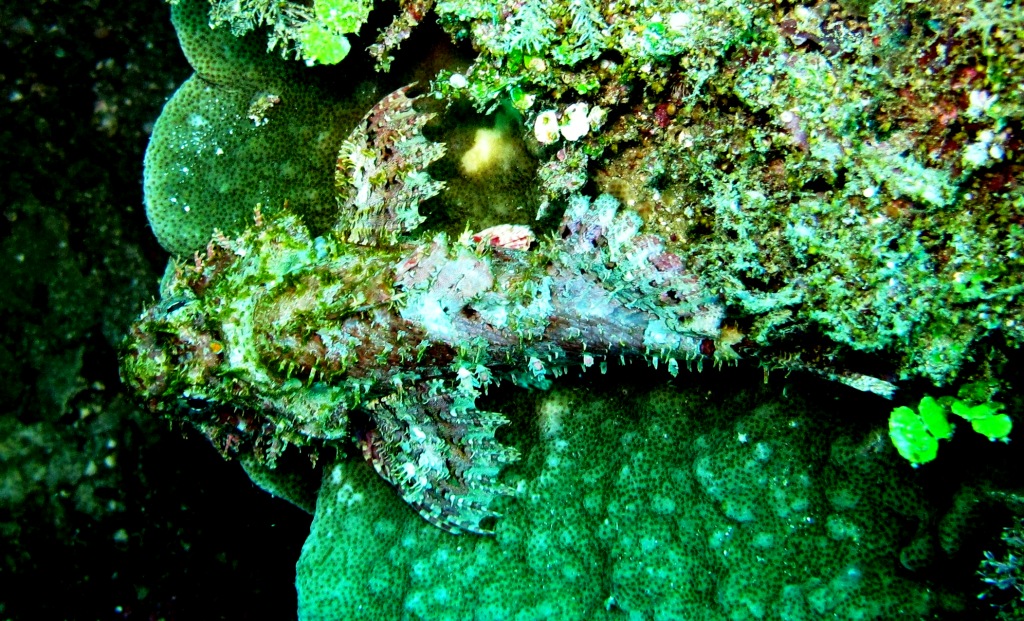
Towards the end of the second dive at the end of our first day in the Claveria Canyons and I literally do a double take when I catch a fleeting glimpse of my first rockfish; in this case a tasseled scorpionfish. I doubletaked because I wasn't sure if it was actually there or not. I had to get almost right on top of it before I could make sure.

'Yes, I SEE you Mr Rockfish!'

These critters are so ugly that they’re beautiful, at least to me they are.

How could you NOT love a fish that nature has gone to such great lengths to camouflage so perfectly? I mean they aren’t rockfish because they LIVE in rocks, although they DO hang out in them; no, it’s because they LOOK like a rock.


They also have a second claim to fame—they are SUPER toxic. In fact, this family of fish is THE most venomous fish in the world, bar none. Fish of the genus Synanceia (rockfish) do NOT inject venom into their victims by way of fangs—they don’t even have fangs.

They do their self-protective harm through the introduction of neurotoxins into a skin puncture. This normally occurs when an unsuspecting creature, such as an unwary barefoot swimmer, steps on a nearly invisible rockfish’s dorsal fin.

So, for most potentially harmful creatures in the sea, it’s NOT the ones that you see but the ones you DON’T see that get you.


THE number one lesson then that I’ve learned about doing scuba—pay attention. Undersea living booby-traps are everywhere, and it’s why I always wear gloves in tropical waters. And even so, I try NOT to touch anything if I can help it. Of course, it doesn’t matter HOW careful you are; eventually, something IS going to get you, without a doubt.

- - - - - - - - - - - - - - - - - - - - - - - - - - - - - - - - - - - - - - - - -
We broke the surface coming back into the lagoon through the shallow waters between the spit of land jutting from the eastern mainland and the first island forming the perimeter of that side of the lagoon.


Our excitement from what we had seen that day was so intense that we began to chatter about it right there in the water. We had no doubt that we would head right back to the same vicinity first dive the next day.

I had noticed people splashing and jumping into the water around us as we pulled our way through the rocks of the submerged saddle. A combination of shyness and wariness always keeps me from being open and friendly with strangers, that being the case again, I paid scant attention to the swimmers and whoever it was watching us from up on the large eastern island.

“Hello, what is your name?” asked a young female voice, followed by giggling, which instantly caught our attention.


Three young ladies in water-soaked shorts and t-shirts, all still dripping wet from their water play, were perched above us on the smooth cracked sides of what was once a lava flow from some ancient volcanic eruption.

“Hi!” another called out, obviously thrilled to see us. “Is it fun doing that?” she asked.

Don and I forgot about our dive for a while and just enjoyed conversing with these three flirtatious “mermaids.”

I can’t even remember how many times that’s happened to me over here, where girls and women, dazzlingly beautiful, yet completely unpretentious, act interested—in ME for crying out loud.


Of course both of us are completely spoken for, seriously committed in fact, but that’s not the point. The cool thing is that we KNEW that if we WANTED to that we COULD get to know these charming young fillies. We could have chatted with them until the two of us became waterlogged and sank to the bottom if we wanted to.

And yes, we are both WAY too old for them; at least we WOULD be if we were back home, where the first thing any young thing thinks when they see any male over the age of 35 is “EWWWWW!” And I’m sure you could add a retching sound to that for guys over 50, like us. (chuckle.)


Never mind the social and economic reasons why this kind of thing exists in this place. We hear it all the time, “They only pretend to be interested because they think you can take care of them and their family.”

And I always laugh, “Okay, and your point is…?”

We said our “so longs” to the chatty chipper damsels, leaving them back to their diving and splashing, and made our way back to land.

Weary from the two incredibly exciting dives I dragged my body horizontally through the shallows as far as I could before having to revert to a standing walking land creature once again.

Angry dark storms clouds spitting the occasional rain drop fooled me into thinking dusk was close upon us, but it was barely past 4 pm. The early shade was fine by me, it made me feel cool and relaxed.


We gushed and exclaimed over the wonderful sights we had just witnessed while shedding our gear piece by piece. Carefully dropping my tank and BCD to the concrete floor I plopped hard onto the wooden seat slats, still breathing hard from the effort of walking up from the water with all that crushing weight. It was okay though; the fresh memories of that wondrous underwater world just right out there made every ache and pain completely worth it.

The girls scurried over us, breaking down our gear and rinsing each separate piece while we mostly rested. My wife had me stand while she unzipped my wetsuit down the back and began spraying me down inside the suit and out with fresh water from the pavilion’s hose. Yes, we let them baby us, take care of us, something they really seem to take great pleasure in. Who am I to stand in her way?


Our post diving routine was already set. On the way back to the hotel we stopped at the local market so the girls could buy cold drinks as well as meat and vegetables to cook for the evening meal. We never accompanied them. The mere sight of a foreign tourist is enough to jack the prices up double.

Back at the hotel I washed the salt off me in the shower while the girls cooked together over a charcoal stove in the hotel's outside communal kitchen. Unfortunately, the hotel doesn't offer meals or even much in the way of drinks, so we were on our own in that respect.

We could have driven down the road a piece to one of the handful of eating places in Claveria, but the girls don't mind cooking that way. And better yet, the food they cooked was just fine by me.

Yup, Don and I are spoiled as heck. We ARE lucky dogs!

Tuesday, June 28, 2011

Chasing a krait, then ogling an eel


This is probably a Laticauda colubrina or Laticauda laticaudata, all the online photos I found of those two species look similar to the one I videoed (see below) in the canyons outside of the Claveria lagoon.

It seems that every single dive trip I’ve ever been on I see at least one krait, or banded sea snake; and this trip was no different. We made a total of 8 dives this trip and saw this single snake.

I never get tired of seeing them. Just knowing that their venom is ten times more poisonous than that of a King cobra, always makes it thrilling to observe them.

The first time I saw a krait is back when I was still just a snorkeler. When it happened I made an immediate retreat, meaning I swam backwards, always keeping my eyes locked on the thing. All I knew then is that every sea snake is potently venomous and that was enough. I was scared to death.
Of course, I found out later that sea snakes are rarely aggressive toward humans as can be seen in my video. All this poor fellow wants to do is get the heck away from me.

I have seen them act very curious and begin to swim toward me, which always caused me to swim backwards and away. But once learning how difficult it would be to be actually bitten by one I’ve become a lot more blasé when I spot one.

And since I started seeing my role underwater as a photo / video-diver, I am now the pursuer, looking to “shoot” everything I see, with my camera as my “weapon.”Did you notice?

Doing research on kraits reveals that they are mostly nocturnal and THAT explains why I usually only see one or two of them during each trip. Out of my 60 dives I’ve only made one at night.

In my You Tube submission above it makes sense to include the short segment of the juvenile moray eel after the minute plus scene of the Laticauda, since morays are one of the kraits favorite meal items. Although I assume that kraits go for eels small enough for them to swallow, and based on the small size of most of the snakes I’ve seen, they likely only go for baby eels.

Wikipedia states that the Laticauda can get up to 11 feet long. I would LOVE to film one close to that length. I’m sure I'd be scared to death and yet thrilled to the bone, all at the same time.

We saw only the single moray in the canyon, which is out of the lagoon channel to the right or east. It wouldn’t be long though before we would find a spot so populated by the things that we ended up naming the spot after them. More on that in an upcoming post.